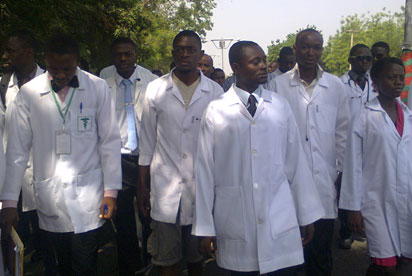
doctors
By Oghene Omonisa & Aderonke Adeyeri
As Chinenye Kalu approached the notice board last November, she felt beads of cold sweat on her forehead. She was scared and tensed up, with hands trembling. She was one of the medical graduates who sat for the University of Benin Teaching Hospital (UBTH) internship examination six months before, and knowing that very limited space was available for the tens of applicants who sat for the examination, she realised it would be a major challenge. (Chinenye Kalu is not her real name as she does not want her name mentioned.).
 “My name was not on the list”, she recalls with sad nostalgia as if it was only yesterday. She says she read the list over and over, and though she is a dentist, she read even the names under medicine and surgery and optometry to be very sure her name had not been included in the wrong category.
When it finally dawned on her that her name was certainly not among applicants accepted, with controlled emotions, she had to call her father back in Lagos. The man was as heartbroken as the daughter. So was her monther and younger siblings.
As Chinenye left the building and approached the hospital gate, her sadness was similar to that of other applicants whose names did not come out too. Her case is one of many in a rising trend of medical graduates not having placement for internship or housemanship.
Becoming a doctor
From time immemorial, “the medical doctor has been one of the most respected members of society”, says Prof. Oluwadiya Kehinde Sunday, whose blog, Oluwadiya KS Online enjoys wide following among fellow medical experts and students. He adds that for this reason, “medicine has been one of the most sought after courses in UTME examination.”
However, a large number of these candidates never secure admission to pursue their dream, due to the competitiveness of the course. And even a similar number does not get to continue after admission as they are not able to face the rigours the course requires. Studying medicine, says Prof. Oluwadiya, “takes a certain amount of intelligence …. However, organization and good study habits can make the difference between an average student who succeeds in the medical school and a brilliant student who fails to make it.”
And the course definitely takes the longest years. “Becoming a doctor takes time”, Prof. Oluwadiya continues. “After secondary education, you will spend six years in medical school, one year as an intern and another year as a NYSC member. That’s eight years from starting university to practising medicine.”
Clog in the wheel
This circle must be completed to qualify as a practising doctor. Alongside his degree certificate, the medical graduate is issued a provisional license by the Medical and Dental Council of Nigeria (MDCN), which entitles him or her to a one-year internship. The internship is mandatory for the one-year NYCE Certificate or NYSC Exemption Certificate before a permanent license is issued to qualify as a medical practitioner. (MDCN is a Federal Government parastatal which regulates the practice of medicine, dentistry and alternative medicine.)
However, with the difficulties in securing placement, internship is fast emerging a clog in the wheel of becoming a practising doctor. Though the temporary license has provision for delay in securing internship placement, it was learned that there have been cases where some medical graduates could not secure placement in the two years stipulated on the license.
In such instance, the license expires, and the medical graduate will have to pay and sit for another examination, this time to be organised by the MDCN, whose grading methods are said to be more rigid than those for the final degree examination organised by the universities. It was learned that most medical graduates who got to that stage frequently failed the examination, leading to resits till they finally passed it to qualify for another provisional license. This explains why every medical graduate is intent on getting internship space before the provisional license expires.
But why are these medical graduates made not only to resit for an examination they passed two years before, but also pay for it? When Saturday Vanguard sought the response of MDCN, we were requested to formally write the Council for its response. However, a source at the Council who wants to be anonymous says: “They are required to sit for the MDCN refresher examination as two years after graduation is too long before a medical graduate goes for housemanship.” On the payment for the resit examination, he rhetorically asks if the medical graduates did not pay for their final examination before graduation, and wonders why MDCN refresher examination should be free.
When reminded that not having internship placement is not entirely the fault of those who could not secure a place as it is limited, the source blames it on the medical graduates, adding that internship placement is simply based on merit: performance in the examination and the available space. This position was interestingly shared by sources in some of the teaching hospitals and other health institutions legally recognised to accept interns: Federal Medical Centres, military hospitals and state general hospitals.
However, most medical graduates who have had placement challenges blame it on the so-called Nigerian factor and not merit, insisting that medical interns get placement due to their connection or financial wherewithal as scores are not released with the names of interns accepted.
Challenges
There are 25 fully accredited and six partially accredited medical schools in Nigeria, which churn out medical graduates annually. However, it was learned that not even the teaching hospitals of these medical schools as well as the Federal Medical Centres, military hospitals and state general hospitals can accommodate these graduates as interns every year.
As a solution, the interns are taken in batches and even on awaiting lists. Investigations revealed that by taking them in batches, more interns are taken in a year, because within a year when a batch is having theirs, a previous batch could round off, leaving a vacuum. It is this vacuum that a new batch replaces, to utilise every available period, just like NYSC is presently operated.
For the awaiting list, intending interns who did not make any of the batches, are kept waiting for any available space for them to occupy. Ironically, while these practices were confirmed by past and present interns, most teaching hospitals, including those of first generation medical schools, denied or outrightly refused to respond to inquiries on these practices.
Tales of woes
There are almost as many sad stories to tell as there are medical interns or intending interns. “Presently, I’m not being paid salary like other interns”, says Oben Taylor, an intern at the Lagos State University Teaching Hospital (LASUTH), who is a medical graduate of the Ambrose Alli University Medical School. “This is because there was no space for me here after applying, but because I could not remain at home, I had to accept internship without pay as I would rather have a permanent license without being paid salary, than risk losing this opportunity to qualify as doctor.” So, how does he cope? He says his parents are based in Lagos, and he leaves home for the hospital every day and returns late.
“I personally will not say I had much problems securing an internship placement”, says Dr. Boniface Ezeanyagu, a qualified medical doctor of the University of Port Harcourt Medical School. Now practising in a private hospital in Lagos, the 2010 medical graduate says he did his internship at his medical school teaching hospital. “My problem was accommodation. There was no enough accommodation. We had to be staying four to a cubicle. It was like a cell. Sanitary, laundry and cooking were terrible. It was hell and I tell you, it affected both our learning process and our total output as interns.”
“Many Nigerian medical graduates had terrible experiences they will never forget”, says Dr. Jude Uchedenna, who studied at the Delta State University Medical School and also practises in a private hospital in Lagos. “After spending six years at the university, I spent two more years struggling to get an hospital for my housemanship.”
“This is my sixth hospital and last bus stop”, says Wale Jacobs, an intern at a general hospital in Lagos who also reveals that after completing his medical degree at the University of Jos Medical School in 2014, he chose to have his internship at the Lagos University Teaching Hospital, and returned to Lagos, his base. Surprisingly for him, he was not accepted.
From LUTH he went to LASUTH, then the Federal Medical Centre, Ebute Meta, Federal Medical Centre, Abeokuta, and the military hospital at Ikoyi. “Honestly, I was scared my temporary license was going to expire on me”, he says, relief written all over his face. “It was utmost relief for me when I was accepted here,” he said.
Panacea
It will not be difficult to conclude that there is a major problem in the medical profession when medical graduates cannot find placement to practise what they had been taught as well as qualify as practising doctors. “The Nigerian Medical Board should fight against this maltreatment on the part of medical graduates”, advises Dr. Uchedenna. He said: “This situation can discourage some students from taking medical courses, and it will have negative effects on the number of doctors the country produces annually. More hospitals and health facilities should be established to accommodate the growing number of medical graduates.”
The establishment of more medical training facilities appears to be the best solution from the lips of medical experts. “I think the problem actually is lack of corresponding number of hospitals to accommodate the growing number of medical graduates”, says Dr. Sunday Bulorunduro, Medical Director, Talent Specialist Hospital, Ikeja, Lagos. The 1980 graduate of the University of Nigeria Medical School, recalls his days with nostalgia saying, “In those days, a medical graduate had a variety of choice hospitals for housemanship.”
Dr. Bulorunduro’s views tally with those of the Lagos State Commissioner for Health, Dr. Jide Idris, who, while speaking on the issue with the News Agency of Nigeria (NAN) recently, attributed the problem to the non-availability of spaces compared to the number of graduates being churned out every year from medical schools: “There are more medical graduates than the available spaces and resources.
We are churning out more doctors, pharmacists and other medical personnel every year because everyone wants to study medicine and the universities are admitting students excessively. The case is peculiar to Lagos because it is saturated.”
The non-availability of spaces for internship poses a serious problem not only to the medical graduates but also to effective healthcare delivery as this challenge has the potential of reducing the number of medical students and eventually medical graduates in a country fast growing in population and lacking in the provision of amenities and social infrastructure, including health.
Disclaimer
Comments expressed here do not reflect the opinions of Vanguard newspapers or any employee thereof.