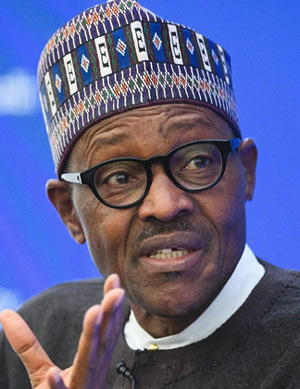
President Buhari
By Ebun Olu-Adegboruwa
ON May 29, 2016, President Muhammadu Buhari marked his one year anniversary, as civilian President of the Federal Republic of Nigeria. It was an anniversary of unfulfilled expectations, especially in relation to the manifold promises made by the President, during his campaigns for the votes of Nigerians, in 2015.
The anniversary speech was the same rendition of promises and states of intention, without any concrete action plan. As some have called it, it was a pure disappointment. While I may not entirely agree with such school of thought, it has however become important to situate the performance of the President in the past one year, within the context of the rule of law.
A better way to answer the question of whether this administration is following the rule of law is to begin by examining what law itself is. Law is a collection of rules, guidelines and directives adopted to regulate human conduct. We adopted law in order to abolish anarchy, confusion and chaos, as properly captured by Thomas Hobbes. With law therefore it becomes easy to predict human conduct and not to be governed whimsically, arbitrarily, capriciously or according to the dictates of whosoever is in authority for the time being.
The rule of law then is a situation whereby the totality of law is embraced as the common choice, a system by which law is upheld and respected. The rule of law is the method of law, its documentation, implementation and preservation.
Democracy on its own is a system of choice through which a people elect their representatives, freely determine their system of governance, how to sustain such government when it delivers on contract and to replace same when it fails. Thus, Thomas Jefferson concluded that democracy is a government of the people for the people and by the people, the main characteristic being to uphold the will of the people.
Having examined all the above, one can then proceed to x-ray the impact of the rule of law on democracy. No doubt, democracy thrives on the rule of law. The method by which people choose their leaders are already coded in a statute, in most cases named ‘The Electoral Law’. Then there is a body of laws establishing and defining various organs of government, their functions and their relationship one to the other, in most cases called The Constitution. Following this closely are other mini regulations adopted to govern generally human conduct in specific areas, in most cases called Statutes.
Standing on its own, the rule of law connotes three situations; (1) equality before the law, (2) a sound and transparent method of interpreting and enforcing law and (3) respect for law and the due process. The rule of law presupposes that the law is no respecter of any person and so everyone is equal before the law. In this regard, it is expected that the same standard will be prescribed for A and B in all cases with the same set of facts.
Equality before the law means that law does not respect status, race, position, wealth, sex, etc but rather it prescribes the same conditions for all manner of persons irrespective of their personality or rank. Even when citizens are equal before the law, the rule of law prescribes an additional scenario in which cases of breach of law are dealt with transparently, speedily and efficiently. Thus, there must be an independent judicial system by which law is interpreted and enforced. In this regard, law becomes useless if its breach cannot be sanctioned. Put differently, what is law if it cannot be enforced?
Additional scenario
Assuming now that all citizens are equal before the law, the judiciary is independent and active, the rule of law requires that the process created for determining the issue of equality before the law and for interpreting and enforcing law are strictly followed. For instance, no one can be allowed to claim that since the Constitution guarantees freedom of movement then criminals should not be arrested or that suspected criminals should be arrested and executed on the spot without trial.
The rule of law therefore requires due process and that all things pertaining to law must be pursued systematically and methodically. Thus, even when one perceives a right, it must be pursued rightfully, following and adopting the prescribed processes and procedures for the ventilation of grievances. Once the rule of law is disregarded or discarded, then democracy is in danger because the latter survives on the former. In this regard, respect for the rule of law is crucial to the sustenance of democracy.
It is proper now to examine the ways in which this administration has fared. The general feeling in Nigeria presently is that might is right and that you are guilty as alleged until you are able to prove your innocence. In other words, the Constitution has been turned upside down, because of an alleged war against corruption.
Without any doubt whatsoever, the president deserves commendation for his boldness in confronting the forces that have held us down as a nation, and no word can be spared to laud his efforts in this regard. The point being made however is that as it is under the law that a citizen can ever be accused, arrested, detained or arraigned for an alleged offence, the same law should be followed if it gives room for the release of such an accused person.
In the past one year, what we have witnessed under the Buhari administration cannot be short of abuse of the rule of law. Examples abound in the summary execution of the Shiites in Kaduna, illegal demolition of their houses, crackdown on peaceful protesters in the virtually all states of the South East, leading to the death of so many citizens, wilful disobedience to orders of the court, especially in the forceful implementation of the electricity tariff increase, various court orders for the release of suspects in custody, abridgement of citizens’ rights, deliberate suppression of all voices of dissent and opposition, intimidation of judges and lawyers and so on.
Good enough, my friend Emeka Umeagbalasi, of the International Society for Civil Liberties and the Rule of Law, has compiled 127 breaches of the Buhari administration. Disobedience to orders of court is condemned mainly because of its unsavoury implications for the polity. The rule of law thrives mainly on precedents such that once it is possible to cite instances where even the government itself is guilty of disobedience to order of court, then it becomes a licence for citizens to brazenly tow the line of disrespect, which indeed is dangerous.
In most cases, it is the executive arm of government that is found wanting in the area of obedience to orders of court. Because of its involvement in the formulation and implementation of policies, it is the executive arm that is directly dealing with the general populace of the people such that it is mostly the actions of the executive that comes up for interpretation in the court of law.
between the old and the new order. It is therefore rare to hear of a regime sacking all judges, magistrates, khadis, alkalis and other judicial officers. So if the judiciary is so important to the sustenance of democracy and indeed the stability of the nation, we all have a stake to ensure that such a vital institution is not compromised or rubbished by transient functionaries of government such as the executive and the legislature.
Disclaimer
Comments expressed here do not reflect the opinions of Vanguard newspapers or any employee thereof.