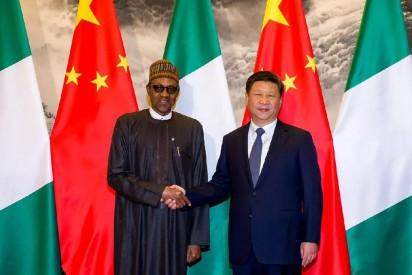
Nigerian President Muhammadu Buhari (L) and Chinese President Xi Jinping shake hands during a signing ceremony at the Great Hall of the People in Beijing on April 12, 2016. Muhammadu Buhari is on a visit to China from April 11 to 15. / AFP PHOTO / POOL / KENZABURO FUKUHARA
By Babajide Komolafe
The Naira/Yuan currency swap agreement between the federal government and Chinese government will increase dependency of Nigeria on China, said Financial Derivatives Company Limited (FDC).
 In an analysis of the deal titled: ‘Naira /Yuan Currency Swap: The Mother of all Deals – Nothing to Cheer’, the Company stated that, “While the objective of the swap deal is to correct the trade imbalance, the reality is that the deal will increase the dependency complex and parasitic relationship between Nigeria and China.
Despite its drawbacks and more important, it will provide a negotiating platform for Nigeria to extract better trade and investment concessions from other Western countries.”
The Company also noted that currency swap will not have any effect on the exchange rate of the naira, and it would not help curb inflation.
“Will this transaction make the Naira stronger in the Forex markets? No. The impact on the currency pressure is neutral. This is because the swap deal does not increase the inflow of forex into the country.
“Will this deal help curb inflation? No. This is because the root cause of the spike in consumer prices is the scarcity of forex exchange and other cost push factors. The currency swap deal has not addressed this issue. Therefore, the problem of soaring inflation remains.”
Explaining how the swap will work, FDC said, “The Central Bank of Nigeria (CBN) will convert a certain portion of its external reserves say $3bn to Naira (N200 x $3bn = N600bn) and deposit with the Peoples Bank of China. The Chinese government will give Nigeria the Yuan equivalent of $3bn.
Nigerian trader wants to import spare parts from China will approach Nigerian bank, and pay N40m for $200,000 (at N200/$). The Nigerian bank will open letter of Credit (L/C) confirmed by Industrial and Commercial Bank of China (ICBC). The Nigerian bank credits ICBC with N40m, goods are shipped and documents negotiated. ICBC is long Naira and short Yuan.
If ICBC needs to import goods from Nigeria i.e. oil at $43pb, it will pay NNPC with naira at $43pb x N200. Consequently, Nigerian oil exports to the rest of the world will reduce by the volume sold to China. Nigerian Yuan earnings increase and dollar revenue reduces by the same amount. Impact neutral on external balance. Nigeria will end up importing more from China and selling more to China. EUREKA! EUREKA!
It is the economic equivalent of Archimedes’ principle: The Yuan volume is the object that is immersed in the Nigerian dollar pool. The amount of Yuan will be equal to the dollars displaced. In the end oil revenue will not change and import volume will not. Destination of exports and origination of imports is all that will change.”
The Company noted that while the currency swap will, “boost bilateral trade volumes between Nigeria and China, it will also increase dependence on China for imports of raw materials and equipment.
It observed that the currency swap, “guarantees China a significant portion of our Nigeria’s trade but our trade with the rest of the world will reduce due to lower foreign reserves. The agreement will allow Nigerian traders to transact business with the yuan instead of dollar.
You will see more Chinese cars, TV sets, smartphones and “tourists”. Crude oil sales between Nigeria and China would be settled in Yuan/Naira and access to Yuan would also be easier. The swap will eliminate challenges arising from transactions with the US dollar and promote business flexibility between Nigerian and China. “
Disclaimer
Comments expressed here do not reflect the opinions of Vanguard newspapers or any employee thereof.