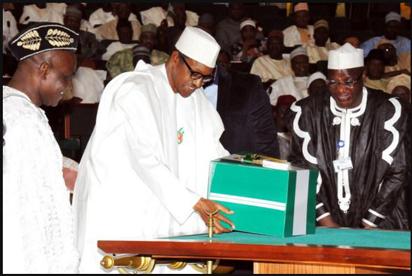
File: Buhari during the 2016 budget presentation to the National Assembly.
By Levinus Nwabughiogu
Though it has been approved by the National Assembly, three months after it was presented, the 2016 Budget estimates can only come into effect only when assented to by President Muhammadu Buhari. But looking at the unfolding events, this appears to be a mirage. Yet, Nigerians are facing what could be called a grave economic situation. Why the delay in the presidential assent to the Appropriation Bill? What has gone wrong? This piece tries to find answers.
They drew the first blood by not releasing the details of the approved 2016 Budget estimates. And trust him, he would give it back to them just as he had vowed. Indeed, to think that President Muhammadu Buhari is former President Olusegun Obasanjo or the late Umaru Yar’Adua or even his immediate predecessor, Goodluck Jonathan, is the high point of self-deceit and political hallucination.

President Buhari
Buhari is not given to flippancy or theatrical rhetorics. He is a man of action. He is man of reason and nobler ideals. He is thorough. He is Mr. Integrity. He holds onto his beliefs and convictions so tenaciously that one needs to advance superior arguments to make him shift grounds. Perhaps, when he converted from the military junta to become a staunch democrat, only a few Nigerians understood him. When he assumed office as President, only a few persons understood that a new Sheriff was in town and so must evolve news ways of doing things. Yet, 10 months into his administration, many still think governance is business as usual. This is preposterous and infantile.
But, to a large extent, these beliefs and convictions are climes sensitive. They don’t always work in an atmosphere of tainted dreams or skewed political interest that exclusively recognizes self and divorces collectivity. And that has made Buhari a strange species of mankind in this part of the world.
Buhari, indeed, stirred the hornet’s nest when he voiced out, on Wednesday, in faraway Washington, D.C., United States (US), during a meeting with the US Secretary of State, Mr. John Kerry, on the sidelines of the just concluded 4th Nuclear Security Energy, that, come rain or shine, he would not assent to the 2016 national budget of Nigeria unless it was critically reviewed. The budget of N6.08 trillion, laid before the National Assembly on December 22, 2015, had been passed by the legislature on March 24, 2016 after it had been pruned to N6.6 trillion and transmitted to the President without the details of the minuses or additions made to it.
On the periphery, Buhari’s statement may have been seen as callous; wickedness personified; a joke taken too far; outrightly military. With the current harsh economic realities, the financial meltdown and their concomitants, one would have expected that the President would be in a hurry to sign the budget into law, having been passed by the National Assembly. One would also have expected that the President would appreciate and expressly crown the enormous work done by the National Assembly on the budget estimates. Moreso, having come under venomous vilifications and vituperations from critics that no visible achievement has been recorded by his administration after ten months in office, many would have thought that the signing of the budget would be given the urgency it merits. But that was not the way of the spartan Buhari.
Meanwhile, the man has his reasons. And the reasons may look germane. For the first time in the history of budgeting in Nigeria, the people were treated to a drama of budget disappearance, a development that attracted public odium, national and international embarrassment. Recall also that, for the first time, Nigerians were introduced to “budget padding”, a word that suggested alteration of the figures of the 2016 Budget estimates.
Recall Buhari’s words to the Nigeria community during his visit to Saudi Arabia in February: “I have been a military governor, petroleum minister, military Head of State and headed the Petroleum Trust Fund. Never have I heard the words `budget padding’. Our Minister of Budget and National Planning did a great job with his team. The Minister became almost half his size during the time, working night and day to get the budget ready, only for some people to pad it. What he gave us was not what was finally being debated. It is very embarrassing and disappointing. We will not allow those who did it to go unpunished”.
Yes, the two chambers of the National Assembly must be applauded for going through the Appropriation Bill within three months of the receipt of the estimates. They must also be commended for the eventual passage of the Bill. But, to many analysts, they have created room for suspicion. For a budget that prompted a history of intrigues, disappearance and alterations, sending only the highlights of the approved copy without the details to the President to sign into law was, to some people, a big risk Buhari could not afford to take. With all these at play, it would be foolhardy not to hold everyone, everything with suspicion. Once beaten, twice shy, so goes a saying. This must be the feeling of Buhari and the reason for the statement that the budget must be subjected to review, ministry by ministry, page after page. To him, the reviewing of the budget, vis-a-vis the original copy, was the proper thing to do in the ‘change’ era. And that gave way to the words of the President on Wednesday in the US.
Said he: “Some bureaucrats removed what we put in the proposals and replaced them with what they wanted. I have to look at the Bill that has been passed by the National Assembly, ministry by ministry, to be sure that what has been brought back for me to sign is in line with our original submission”.
Other Presidents signed budget without asking for the details-National Assembly
To make matters worse, the National Assembly, in responding to Buhari’s demand for the details of the approved copy, gave what many people considered an infantile answer to a serious issue. One could applaud their readiness to make available the details of the budget within a fortnight but definitely not the remark that other Presidents signed their budgets using only the highlights without the details. Besides, leaving the details behind or alluding to the old practice of submitting the details, weeks or months after the implementation of the budget had taken off, creates an impression that the job may have been haphazardly done.
Said Hon. Abdulmuni Jubril, the Chairman of the House of Representatives Committee on Appropriation on the issue: “At the moment, we’re working on the details of the budget. We’ll take a week or two to work on the details. We’re doing the final harmonization. We’re looking at the various reports of the committees.
“We had instances where Obasanjo signed the budget without the details. Yar’Adua came and he preferred to see the details. So, if President Muhammadu Buhari prefers to see the details before assenting to the bill, I don’t think we should make a big deal out of it. It’s absolutely normal”.
“This is the most difficult budget we have ever dealt with. The MTEF and the budget came late. With all the challenges we had, I doubt if the executive would be throwing stones at the National Assembly.
“Even while we were dealing with all such realities, multiple budget details came up and we were able to manage the situation in a very friendly manner with the executive”.
Some analysts think that it was a wrong notion to liken the days of Obasanjo, Yar’Adua and Jonathan to present day Nigeria where change and transparency are the order of the day. Should Buhari act like others, then the gospel of ‘change’ would have been half preached.
Where two elephants fight, the grass suffers
What troubles many of the analysts in the present quagmire between the Presidency and, by extension, the executive arm of government, and the National Assembly, is that the common man, who stood in the sun about this time last year, to vote for Buhari and the lawmakers, is the most affected. Whereas the budget suffers fresh delay, the President would still be globetrotting in the guise of attending to state matters. Also, the lawmakers would continue to sit in their cozy offices and driving their earth-sized jeeps. But the common man would be left in the corner, begging for food. Infrastructures would remain in their dilapidated state. The much touted million jobs would not be created. The N500 billion earmarked to prosecute six social programmes would be delayed and the promised change would be in abeyance. Already, the first quarter of the year is gone with nothing done. Now, the question goes back to the gladiators: Without the budget signed into law, how would the common man get a facelift?
Gale of reactions
Sunday Vanguard reached out to Nigerians some of whom participated in the budget debate as the House of Representatives members to sample their views on the matter. Below are their submissions:
It is normal to demand the submission of approved budget details before signing-Hon Phillips Shuiba, member representing Etsako East/West/Central of Edo State, House of Representatives
“The President has the right to demand for the details of the budget. He will be the second President seeking details before signing. It is not abnormal. President Yar’Adua also did likewise. But it has been the tradition to send summary first before the details. And truly, it’s the summary that is always before members during the passage of the budget at plenary. The details are captured in the summary in various ministries, and MDAs, during passage. The details are always resolved at the committee stage. The final copy of the budget is sent to members most time after signing. So I don’t know why we are making this an issue. This is a budget that the leadership and members of the House should be commended for, following the issues that came with the budget. The issues of budget padding, the inconsistencies that occurred, the time frame were all the challenges the lawmakers had, yet the budget was given the attention it required for it to be ready by now. I am of the opinion the the National Assembly deserved a pat on the back. I don’t see this as an issue. It will eventually be resolved”.
I endorse President’s decision to wait— Chief Chekwas Okorie, a former presidential candidate and National Chairman, United Progressives Party, UPP
“I fully endorse the President’s decision to wait until he has the details of the budget proposals before appending his signature to the Appropriation Bill. The controversy arising from his presentation of the proposals to the National Assembly as a result of the discovery of the padded figures and other inconsistencies which he presented out of trust that his aides, mainly the ministers and the permanent secretaries, had done a thorough job in the compilation of the budget only to be exposed to a monumental national embarrassment ought to caution him to err on the part of diligence instead of expediency. I urge Nigerians to give Buhari the benefit of the doubt to scrutinize the details of the budget before signing. If this takes addition of two weeks, it is better than committing another blunder. What I will urge the President to do is to ensure an expeditious implementation of the budget proposals once the Bill is signed. Nigerians expect 100 percent implementation in order to address the economic problems that we face.”
The details will take weeks to come- Hon. Ossai Nicholas Ossai, member representing Ndokwa East/Ndokwa Federal Constituency, House of Representatives
“I don’t know what has transpired between the leadership of the National Assembly and the President. So commenting on it wouldn’t benefit anybody. But my position is that the National Assembly owns the budget. The budget is not a budget of the executive. It is the budget of the National Assembly where every constituency in Nigeria is represented. And, probably, with a reasonable discussion, the President wanted to sign sector by sector. The normal thing is to transmit the details, everything. But I don’t know what may have happened. There is no problem with giving him the details. The National Assembly would give him the details. It is just that the details take time. It is not something of one week because, as you put the details, you will be able to analyze them sectorally, agree with the sectoral amount. It takes up to three weeks or more than that. Even if the committee is working 24 hours everyday, it takes more than two weeks. So, I think people should understand that the details take up to three weeks. It is not a week issue. And this is something that takes more than one month to couple by the executive and, if there are amendments in many areas, the executive does not expect the National Assembly to sort it out within one week.”
President has constitutional right to withhold assent- Chief Mike Ozokheme, SAN
“PMB can insist on seeing the budget details before signing the Bill. A budget captures all income and expenditure, including the details, not just summary. But PMB cannot unilaterally review the budget. That is the NASS prerogative. PMB can make his observations and views known to the NASS for them to address and reincorporate into the budget and re-forward to him for assent. The President can constitutionally withhold his assent. If he does, NASS can, in turn, after 30 days, ignore him and pass the budget into law. These are the inbuilt in checks and balances envisaged by the French philosopher, Baron de Montesquieu, when, in 1748, he propounded the doctrine of separation of powers.”
Last line
One thing this unhealthy development has achieved is that the cheers that greeted the passage of the 2016 Budget estimates by the National Assembly last week have disappeared overnight. The excitement is gone and the peoples’ faces have gone gloomy again. Everyone had thought that the long wait was over. But politicians are back at loggerheads. But it is still not too late for them to restore the hope of the common man. They can shift grounds for his sake. Yes, if the National Assembly, especially the House of Representatives, could cut short their holiday and hold session on a Sunday during the mass protest against subsidy removal in 2012, the relevant committees involved in working out the Budget details or, better still, the whole parliament could also work expediently to resolve whatever issues there are. By this token also, Buhari could also think of a middle ground to perch for the good of the common man. The long wait for this budget of change is killing.
Disclaimer
Comments expressed here do not reflect the opinions of Vanguard newspapers or any employee thereof.