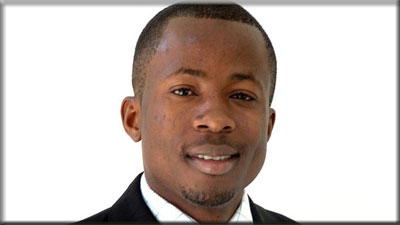
Dr Braimoh Bello is a senior medical scientist/research technical leader at the Johannesburg-based Centre for Statistical Analysis and Research (CESAR). He is also an honorary lecturer at the University of the Witwatersrand and President of Beyond Tomorrow. Braimoh who was in Nigeria recently, spoke to Financial Vanguard on various issues and the need to pay more attention to research and innovation. Excerpts:Background:
With a background in microbiology, Dr Braimoh Bello has been practising Epidemiology and Public Health in the past 10 years. “I started off with health and medical research but I have been able to apply my skills in other aspects of research, including education and psychology,” he said.

Braimoh Bello
Research can benefit society:
Health is wealth says an old adage. Bello believes that a disease-ravaged population cannot grow the economy. He said: “I am involved in a project in Zambia being executed by the Population Council of America (PCA) with funds from the UK Department for Foreign and International Development (DFID) to find out if a particular human development program can help teenage girls in terms of their reproductive and sexual health. PCA provides this intervention with different components. One component is a social skills training.
They got mentors for about 10,000 girls over a period of two to four years. The mentors train the girls every Saturday on reproductive/sexual health life skills so the girls get to know what menstruation, sex, pregnancy, and sexually transmitted infections are in areas in Zambia where teenage pregnancy rates are very high and there is also high HIV infection rate as well as Herpes Simplex Virus. So the PCA, through this program, is trying to reduce all of these things. Such a program is very expensive so many donors like the World Bank, UN, etc., do not just sponsor the program, they build a research component to it to see if the program works, what we call Impact Evaluation or Value for Money. They measure and estimate the size of that impact on society.
Research component:
“They got a team of experts from different parts of the world as external evaluators. So Mott MacDonald, an international consultancy firm in London, was contracted. The firm put together four people – two researchers from London, myself and another person from Zambia. We go to Zambia and carry out scientific processes and document with the PCA the impact of the program. If the program is impactful, we then begin to discuss sustainability plan with the PCA, to say this kind of program can solve your HIV problem or your teenage pregnancy problem. It is now time for the government to take over. So the research is done in discussion with government. It is the duty of researchers to carry government along so that government can translate research findings into policy.”
Varsity/private sector gap: Lecturers should collaborate with the private sector to bring money to their universities and close the gap so that the private organisations can also learn from them.
It is hard to be a fee-paying PhD student in South Africa. Your supervisor will almost always have sponsorships for you to pay the fees and even pay you monthly stipend because they write proposals to private organisations to get funding. Example, researchers could check if a particular microorganism can provide a particular antibiotic or check the antimicrobial properties of bitter leaf in partnership with a private pharmaceutical company who will take up the results of the research.
As you translate research to practice, you are closing the gap as whatever you find goes straight to the industry.
The government should be sponsoring research. We blacks can be very emotional and illogical sometimes. When they tell you there is a white man who has Ebola and he is being given Ebola drug, you say it is racism. The Ebola medication was tested overseas, the antiserum was extracted overseas, the money was American money. These organisations are willing to pay to train their people. They invest millions and billions of dollars into research but Nigeria has not been able to tell us what is happening with sickle cell anaemia. A long time ago, we heard about different medicinal plants that have anti-sickling properties.
If all you dedicate your life to is materials that have anti-sickling properties, it is okay. It is not difficult to tell the sickling rate or the sickling frequency of the cells and then from in vitro, we can go in vivo. We can start talking about safety trials, efficacy trials and then we take it from there and see if we can have a drug that can be licensed. So government should be sponsoring research, whether it is health, environment, water, construction or whatever, we need people to understand the value of research and it will create a lot of jobs. If I tell you how much jobs we can create in Nigeria by bridging the gap between academic research and practice, you will not believe.
Research funding:
There are different aspects of research – food, water, health, social issues, environmental issues etc., and government has to come in. South Africa is a research- intensive country. I was contracted by their Department of Environmental Affairs to provide training on statistics to the staff. I asked them what they do, one of them said as environmentalists, they are responsible for removing alien plants. It was a new body of knowledge for me. They said the amount of water available to the country depends on the amount of water in the aquifers which can be depleted by alien plants that do not contribute anything to the vegetative quality of the country.
They map out areas with alien plants and measure the volume and quality of water in that area before and after. So they are able to say this is the amount of water we need for the whole country, this is the amount of water we have, this is the amount of water we can add if we remove our alien plants. These people are not in private organisations, they are in a government ministry! Government ministries in Nigeria should be doing this type of research, using science to better their work. They paid a lot for us to provide the three-day training. We have had discussions with a government ministry in Nigeria to provide exactly the same training and they said they could not afford it.
Invest in capacity-building:
To build capacity, you have to invest. We need people who have insight, who can think and make technical decisions on behalf of their departments, ministry and country. We need financial resources, we need to be willing to spend if we want to capacitate the employed and those we are still going to employ because training is an ongoing process and any government department that wants to be relevant in the 21st Century has to make training a top priority.
Ministries should be opened up to private organisations, consultants and universities. Corruption is a big problem. If I say it will cost $10,000 to train your staff and you inflate the budget by 30 per cent, then the number of people you can train in a year is significantly reduced. So management of the small resources we have is one of the biggest issues in the country.
It doesn’t matter how much you have in revenue, if corruption is the order of the day, you will not achieve anything. Even if you budget to have a training course monthly, but at the end of the day, you may only have one in a year and all that money goes into somebody’s pocket.
Disclaimer
Comments expressed here do not reflect the opinions of Vanguard newspapers or any employee thereof.