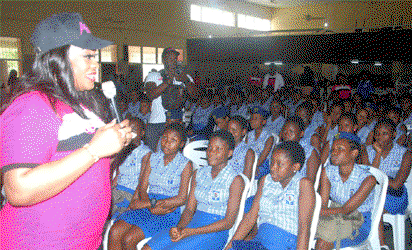
Sanitation Officer, Benue State Rural Water Supply and Sanitation Agency (RUWASSA), Ms. Rita Soso, has urged all stakeholders to build clean and separate toilet facilities for female students in schools.

Soso told the News Agency of Nigeria (NAN) in Abuja on Tuesday that this would promote good menstrual hygiene and enable more women and girls achieve their potential in the country.
According to her, poor hygiene during menstruation has been associated with serious ill-health, including reproductive tract and urinary tract infections.
She quotes a United Nations Children’s Fund (UNICEF) report, which says one in 10 school-age African girls didn’t attend school during menstruation.
Soso said such girls dropped out at puberty due to lack of cleanliness and separate toilet facilities for female students at schools.
“In many schools in the country, there are no toilets, water for washing, soap, sanitary disposal facility.
“Similarly, there is no private place or a separate toilet where girls can change their underwear or sanitary napkins and manage their hygiene while they are in school.
“It is important for all tiers of government to make deliberate efforts at providing water, toilets and necessary facilities to enable girls achieve their full potential in the country. “
She said if Nigeria would achieve the newly set Sustainable Development Goals, necessary polices must be put on ground to enable women and girls live their lives to the fullest.
The sanitation officer said fulfilling these gaps in all schools would enhance girl students’ school attendance and their academic performance too.
She said it was a matter of regret to note that awareness on adolescent reproductive health needs is low among children.
Soso advised managers of all schools to include the study of adolescent reproductive health in their curricula.
“The fact that about half of students did not have the right knowledge about menstruation suggest that adolescent reproductive health needs is neglected in rural areas of Nigeria.
“This is a grey area for intervention in light of increasing girls’ school enrolment and in order to realise girls’ empowerment and gender equality.
“There is the need for emphasis on the need for girls to prepare for menarche and sanitary disposal facilities at school and at a community level, “ she said.
Soso urged parents and guardians to encourage their female children to practice basic hygiene practices, like hand washing at critical times.
She explained that this would reduce incidences of preventable deaths and diseases among them.
She said Nigerian women and girls were at risk of reproductive tract infections during natural events in their life such as menstruation among others, due to poor hygiene management.
She said a rural woman’s capacity to manage her periods is affected by a number of other factors, including limited access and affordability of hygienic sanitary materials.
“In Nigeria, especially in rural areas, the existing culture of ‘silence’ and shame on issues relating to sexuality and menstruation is gradually reducing but the issue of menstrual hygiene remains a big concern.
“Some women and young girls in rural and urban areas in Nigeria still the use of old torn cloth and wrapper either used or unused, may be clean or dirty as menstrual absorbent as there is no cost involved.“
Menstruation is a natural, biological and beneficial process in the life of adolescent girls and women of reproductive age.
Globally, approximately 52 per cent of the female population (26 per cent of the total population) is of reproductive age.
Most of these women and girls will menstruate each month for between two and seven days, and approximately 450 – 500 times in a life time. (NAN)
Disclaimer
Comments expressed here do not reflect the opinions of Vanguard newspapers or any employee thereof.