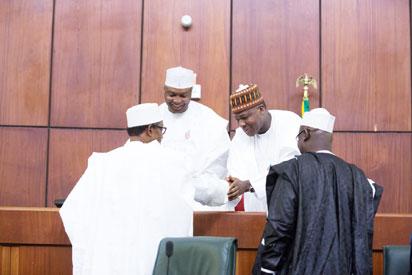
Senate President, Bukola Saraki; Speaker, House of Representative, Dogara exchanging pleasantries with President Buhari during the presentation of N6.08trn 2016 budget to NASS, on December 22, 2015.
By Godwin Oghenede
MUCH has been written and said about the 2016 Budget. New vocabulary has been imported into the budget terminology. Words like Missing Budget, Budget Padding, Fake Budget, Distorted Budget and many more as widely reported across the media platforms. This has led to the President’s refusal to assent the budget while the economy remained in the dodurum and at the verge of collapse. There seem to be no sense of urgency in the face of dwindling resources and the need for economy stimulus needed to avoid a deep recession that will be difficult to come out of.
The ongoing tussle between the Presidency which represents the Executive arm of government and the NASS in my mind is the lack of understanding on the part of NASS and those saddled with the responsibility for the budget preparation to understand or be adequately briefed and trained on the cardinal change agenda of the current administration as far as budgeting is concerned.

File: Senate President, Bukola Saraki; Speaker, House of Representative, Dogara exchanging pleasantries with President Buhari during the presentation of N6.08trn 2016 budget to NASS, on December 22, 2015.
A change that calls for the adoption of Zero Based Budgeting(ZBB) method in the preparation of all Ministries, Agencies, Departments of Governments (MDAs) and Head of all Public Educational Institutions Budgets effective from the 2016 BUDGET.
This new approach as promoted by the office of Vice President Yemi Osinbajo (SAN) and the National Planning Commission was brought in to address some of the short comings associated with the old incremental budgeting approach which is characterised by poor implementation, budget padding and wasteful spending. An approach that has held us back over the years and which can no longer be sustained in the face of declining Revenue from Crude Oil.
This being the case, some of the current controversies, around the 2016 budget could have been avoided through effective training and capacity building for those agencies of government responsible for budget preparation, approval, interpretation and implementation.
Zero Based Budget (ZBB) defined
Traditional incremental budgeting method assumes last year figures as a starting base for this year’s budget with allowance for inflation and percentage increases. Zero Based Budgeting on the other hand assumes a starting point of Zero with no reference to last year’s figures. Government sets its objectives while all budget headings are drawn in line with those objectives. All expenditure old and new are critically reviewed and prioritised. Cost Benefit Analysis is carried out on each heading. Alternatives are considered. Minimum expenditure levels below which the project or services are no longer feasible are set. All expenditure heading are fully justified by stating vision, mission and mandate, strategic objectives of project, Challenges, Strength, Opportunities, Key performance indicators and deliverables. It is a bottom-up approach where departmental heads are involved in its preparation prior to consolidation at budget committee level of each ministry.
ZBB Historical perspective
Zero Based Budgeting as a budgeting technique is not new. It has been around since 1924 when E.Hilton Young advocated for its use by the then British Budget Authority. The US Department of Agriculture again adopted a form of ground up system of budgeting as the first formal use of Zero Based Budgeting by the US government in 1962. It was not until 1970 when Zero Based Budgeting finally came to the lime light and made popular through an article written in the Harvard Business Review by Peter Pyhll now referred to as the father of Zero Based Budgeting. This article attracted the attention of Jimmy Carter as the then governor of the State of Georgia who invited Peter Pyhll to help adopt Zero Based Budgeting for the 1992/93 budget in State of Georgia and became fully adopted by US government when Jimmy Carter became US President in 1979.
*Mr. Oghenede, an accountant, wrote from Lagos.
Disclaimer
Comments expressed here do not reflect the opinions of Vanguard newspapers or any employee thereof.