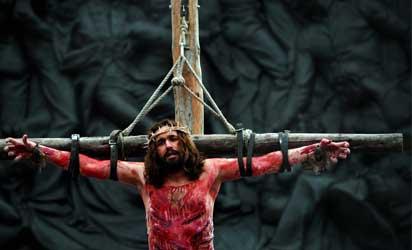
An actor playing Jesus hangs on a cross during a performance of the Passion of Jesus by the Wintershall Players in Trafalgar Square, central London on March 29, 2013. AFP PHOTO
By Douglas Anele
If, in a big auditorium full of people one were to ask all the Christians present who believe that the biblical story concerning the resurrection of Jesus Christ is an established historical fact to raise up their hands, I am sure all of them would do so irrespective of the denomination they belong to.
Such unanimity of response is premised on the conviction that the individual named Jesus of Nazareth was an actual human incarnation of God who was crucified on the cross to save humanity from the dire consequences of sin, which is one of the fundamental doctrines of Christianity and the reason for Easter celebrations. But for a sceptic and nonreligious humanist like myself, Easter, Id el malud, Christmas, iri ji (or new yam festival) and other widely accepted faith-based practices offer a good opportunity for examining critically the core doctrines of religion. Without any scintilla of doubt, Nigerians love religion too much, especially Christianity and Islam.
As a result, they tend to assume that outward show of religious piety is a good thing. Presently, our people have not yet grasped the potential dangers inherent in being led by two devout religionists, President Muhammadu Buhari and his deputy, Prof. Yemi Osinbajo. I will explore the problems associated with having people with strong religious beliefs at the topmost echelons of political power in a future essay. Suffice it to say, however, that religions in Nigeria today, engender stunted intellectual and spiritual growth, self-abnegation, hatred, hypocrisy, poverty and a host of psychological disturbance among believers. Thus, it is important, using the platform of a popular religious celebration, to subject the fundamental doctrines of religion to the bright light of ratiocinative scrutiny from time to time. Moreover, Section 39 of the 1999 Constitution explicitly provides for “freedom of expression, including freedom to hold opinions and to receive and impart ideas and information without interference.” Therefore, our laws permit criticism of religion; in fact, the section cited above entails freedom of unbelief and suspension of belief also.
Now, the constitutionally guaranteed secularity of the Nigerian state has been whittled down by the presence of churches and mosques in Aso Rock and state government houses across the country, not to talk of the highly questionable inclusion of the country in an Islamic organisation or coalition by retired general Ibrahim Babangida and President Buhari. In this regard, there is an urgent need to robustly challenge the increasing domination of the mind-set of Nigerians by religious superstition at a period in world history when serious countries are relegating religion and harnessing the technological spin-offs of scientific knowledge for sustainable national development and wealth creation.
The absurdities of religious superstition is spreading among people faster than the dreaded Ebola virus, such that, in the next few years, if those who prefer rationality to blind faith as the best strategy for living do not start speaking out now against religion, Nigeria will be overrun by a population of feeble-minded theological robots destitute of the basic critical thinking skills and scientific worldview required for sane and responsible life in the community. The irrational quest for miracles, for quick supernatural interventions, is rampant now partly because extremely wicked, audacious, and diabolical “men and women of God” use hypnosis, auto-suggestion, intimidation and subtle blackmail not only to steal from their congregation but also to instil fear, intolerance and obsessive-compulsive preoccupation with heaven or paradise (imaginary in my view) in those that happen to take their bombastic nonsense seriously. I am not aware of any systematic research programme detailing the effects of excessive reoccupation with religion on the individual and on the society as a whole. Probably, many scholars with the required expertise and competence to conduct such research are themselves devout Christians and Muslims who see nothing wrong with Nigeria’s troubling reputation as one of the most religious countries in the world alongside Saudi Arabia, Iran and, possibly, the Vatican. Consequently, now is the time to fill that lacuna so that people can have a better understanding of the toxic nature of religion and, hopefully, learn to move on with their lives free from religious superstition.
That said, the upcoming Easter celebration, which commemorates the trial, crucifixion and resurrection of Jesus of Nazareth(all of which I believe are mere allegations), ranks as one of the grossest artefacts in the museum of theological nonsense. As we go along in our analysis, justification for that bold assessment would become increasing clear. Note, however, that the significance of Easter for Christians derives from the fact that without belief in what they say is the exemplary redeeming character of Christ’s mission on earth, particularly alleged death, resurrection, and ascension into heaven, the entire edifice of Christianity would crumble to dust. Put differently, if it can be demonstrated that the events commemorated as Easter did not actually happen, Christianity would lose its raison d’être and the uniqueness which believers attach to Christ’s life in world history.
According to the biblical point of view, God, right from the very beginning, singled out a Jew, the man Jesus, to carry the burden of redeeming humankind from sin and eternal damnation in hellfire through death by crucifixion. Hence, in Christian depiction of world history, Jesus of Nazareth occupies an unprecedented position in humanity’s quest for reconciliation with God. The view that, out of all the peoples in the world a Jew was selected by the almighty to die an “accursed” ignoble death and resurrect on the third day to save humankind as a whole is, in my opinion, the pinnacle of self-delusional arrogance. For it is impossible, except on the basis of blind faith, to assert that a supposedly omniscient, omnipresent, and omnipotent deity would be so narrow-minded as to have a “chosen people” and allow his son to die in disgrace and resurrect afterwards just to atone for our sin. Why should an all-powerful all-knowing benevolent being engage in the ghoulish rigmarole of allowing Adam and Eve to commit the so-called original sin and wait for thousands of years to send Jesus to die when he could simply have forgiven Adam finally and left the matter at that? What type of God would take a simple matter of disobedience so seriously to the extreme as to decree a punishment far beyond the gravity of the offence committed by the first couple it created without knowledge of good and evil, as recorded in Gen 3:14-19?
More pertinently, is the narrative about the death and resurrection of Jesus a historical event or a variant of the myth prevalent in Mediterranean cultures centuries ago that for the redemption of humans a God or a son of God must die and rise up from death? To answer these questions, we shall examine the views of scholars on the biblical narratives pertaining to the arrest, trial, death and resurrection of Jesus, knowing full well, as Bertrand Russell correctly observed in his Why I am not a Christian, that the historical question pertaining to Jesus is yet to be resolved. But even at that, we still have to surmount a difficult challenge, namely, the problem of harmonising conflicting stories of the trial, crucifixion, and resurrection of Jesus in the so-called synoptic Gospels. Several commentators have analysed many of these discrepancies. For instance, J.D. Shams, a Muslim cleric, wrote a book with the tantalising title Where Did Jesus Die? In it, he highlighted contradictory stories in the Gospels of events shortly before, during, and after the purported death and resurrection of Jesus, which puts a big question mark on the credibility and veracity of the Gospels.
Disclaimer
Comments expressed here do not reflect the opinions of Vanguard newspapers or any employee thereof.