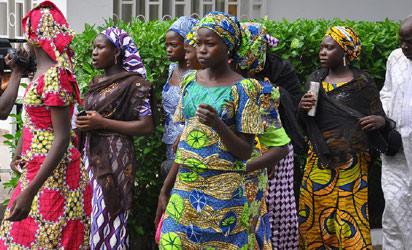
CHIBOK GIRLS—Schoolgirls who have escaped from Boko Haram kidnappers in the village of Chibok, arrive at the Government House to speak with Governor Kashim Shettima in Maiduguri, yesterday. Shettima met with 28 schoolgirls that escaped from the abductors, their parents and parents of more than 200 missing girls to seek ways of assisting them. Photo: AFP.
The International Women’s Day first emerged from the activities of Labour movements at the turn of the twentieth century in North America and across Europe. Since those early years, the Day has assumed a new global dimension.
The United Nations began celebrating the International Women’s Day (IWD) on March 8, during the International Women’s Year 1975. Two years later in December 1977, the General Assembly adopted a resolution proclaiming a United Nations Day for Women’s Rights and International Peace to be observed on any day of the year by member states in accordance with their historical and national traditions.
The Day is a time to reflect on progress made, to call for change and to celebrate acts of courage and determination by ordinary women who have played extraordinary roles in the history of their countries and communities.
The theme for this year’s celebration is “Planet 50-50 by 2030: Step It Up For Gender Equality”. The idea of this theme is to accelerate the 2030 Agenda, building momentum for the effective implementation of the new Sustainable Development Goals, especially empowering women, achieving gender equality and ensuring inclusive educational opportunities for women/girls.
It is, however, disheartening that here in Nigeria, apart from a few rustlings in the media and civil society circles, not much was heard from the Federal Government or many of the state governments about activities lined up to showcase our commitment towards achieving these laudable universal goals. One would have expected the President Muhammadu Buhari government, through the Ministry of Women Affairs, to outline its vision and programmes towards achieving the Agenda 2030.
It is very imperative for concrete steps to be initiated to ensure our girls and women have equal access to quality education across the geopolitical complex of Nigeria without any section being left behind. This is what a national action plan articulated by the Federal Government can help to achieve.
This year’s International Women’s Day comes at a time that the girl child is faced with increasing social burdens occasioned by an upsurge in violent crimes. These criminals have tended to target girls – especially school girls – more. From the 279 Chibok school girls who were carted away by Boko Haram insurgents nearly two years, to the rash of abduction of girls from their parental homes and forcible conversion of girls to Islam, to the kidnap of school girls for ransom, the Nigerian girl child has become even more unsafe today than twenty years ago!
Unless something urgent and drastic is done, Nigeria will be struggling with these primitive challenges confronting our female population while the rest of the world, in the next fourteen years, will be breasting the tape with their womenfolk fully integrated in the 2030 Sustainable Development Agenda.
Disclaimer
Comments expressed here do not reflect the opinions of Vanguard newspapers or any employee thereof.