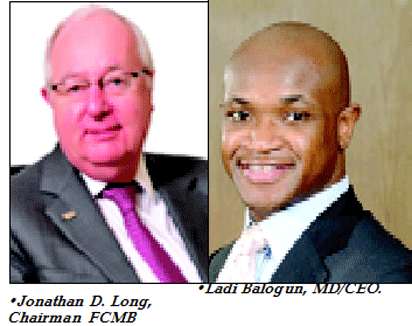
•Jonathan D. Long, Chairman FCMB & •Ladi Balogun, MD/CEO
FCMB Group Plc is one of the oldest private sector indigenous operators in Nigeria’s financial system in 1977 as City Securities Ltd (CSL). It then operated as a Stockbroker, Issuing House and Registrar. CSL gave birth to First City Merchant Bank Ltd in 1982. It converted to commerical banking trading as First City Monument Bank Ltd in 2001 and became a public company listed on the Nigerian Stock Exchange in 2004. Following Central Bank of Nigeria’s directives embedded in Regulation 3 of 2010, the bank in 2011 converted to a group structure.
 Under this new arrangement, FCMB Plc became a private límited company and a subsidiary of the group, and same for CSL Trustees Ltd, FCMB Capital Markets Ltd, and CSL Stockbroker Ltd. FCMB Ltd (The Bank) is the group’s flagship with about 2.7 million customers, 3100 full time staff and 248 branches spread across the country. The bank is also a parent to FCMB (UK) Ltd and Credit Direct Ltd (a micro finance lender).
By the close of business in 2014, the Group operated with total assets valued N1.2 trillion haven grown by 16% in the preceding year. The Group had 523,442 shareholders out of which 345 were foreign investors
Capital Adequacy
As at close of 2014, shareholders fund of FCMB Group had accumulated some N160 billion up from N143.7 billion in 2013. The increase resulted largely from accretion to reserves. The Group decided to retain significant part of earnings in the business to pursue future growth opportunities. The bank’s Risk Management committee is mandated to ensure that capital levels remain adequate and consistent with prescribed ratio by regulators.
The bank’s computation actual risk weighted asset ratio yielded a Basel II ratio of 19% against 18% in the previous year. This leaves the bank with sufficient margin of safety as it expands business and risk assets size.
Customer Service, Deposits and Liquidity
In 2014, the bank won 481,643 new accounts made up mostly of retail customers. Total deposit liabilities amounted to N734 billion. Net deposits grew by just 2.7% from the preceding year’s level reflecting the challenges faced by the bank in building up deposits during the year. In managing these accounts to minimise liquidity risk, the bank relies on maturity and re-pricing gap analysis to ensure that obligations are met on continuing basis. However, during the year, proportion of assets classified as cash and near-cash securities declined to about 40% from 48%.
Obviously, the level of liquidity appeared sufficient to satisfy demands of the bank’s counter parties, and meet regulatory requirements. The level and extent of decline could not have in the opinion of our analyst, been the major factor in the near stagnation of deposits as they favourably compares with capacities shown by other banks in the market.
Earnings and Profitability
In 2014FCMB Group leveraged on its diversified business structure to report a gross earning of N148.7 billion against N131 billion in 2013. Interest component was N117.98n billion of 79% of total. Interest expense virtually closed flat at N45 billion leading to increased at interest margin of N72.6 billion.
Net charges arising from impairment of assets rose from N7.98 billion to N10.64 billion. Although operating expenses (including personnel costs) increased by about N6.2 billion, increase in the top line was overwhelming lead to higher profit after tax of N22.10 billion against N16.0 billion in the previous years. With this satisfactory business outcome even in the face of challenging financial market conditions, the directors were pleased to pay a cash dividend of 25k per share for which shareholders were very delighted. Many others were not able to pay cash dividends during the period.
Asset Quality
During the year, FCMB took more risk by winding down certain cash and cash-related positions to expand the level of risk assets. This appear to be a response to higher reserve requirements that locked in some liquidity during the period. Accordingly the bank had go grow lending from N462 billion to N633 billion in order not to unduely suffer reversal in earnings and profitability.
At the end of the year, about 3.6% of the total loan was classified as non-performing according to criteria prescribed by regulation. This reflected a marginal improvement from 3.9% achieved in 2013. Though marginal, this improvement is remarkable in the sense that the bank expanded credit by a net figure of about N171 billion.
Accordingly credit was expanded rapidly even as the rate of impairment went down. The Group has skilled credit analysts who are fully guided by internal rating framework and lending politics. They employ a 9 grade loss severity model to reflect expected makers in approval and pricing decisions. We believe that in the application of this framework in 2014, FCMB was relatively efficient in loan origination and other processes leading to repayment or recovery of facilities.
Disclaimer
Comments expressed here do not reflect the opinions of Vanguard newspapers or any employee thereof.