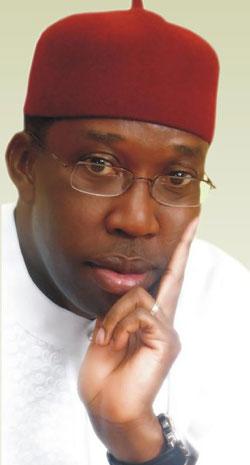
Gov. Ifeanyi Arthur Okowa
.Delta PDP stakeholders’ meeting fallout:
.We inherited N10bn debt, why we refused to award new contracts
By Emma Amaize
ASABA—LAST Thursday at a stakeholders meeting of the People Democratic Party, PDP, in Asaba, the state capital, the governor, Senator Ifeanyi Okowa, publicly lambasted top officials of the Delta State Oil Producing Areas Development Commission, DESOPADEC, for allegedly gallivanting while the conference was on.
Okowa, who took the stakeholders’ meeting as a very important session for every political office holder, particularly highly placed officials in the state, was surprised when he rose to speak, looked around and saw neither the DESOPADEC board chair, Mr. Godwin Ebosa nor the managing director, Chief William Makinde.
A source said, “The governor wanted to say certain things, which touches on DESOPADEC and he was not happy that the very senior officials were outside.”
The governor, obviously dissatisfied, described their absence as a high level of indiscipline and ordered a query. Before Okowa concluded his speech, some persons had gone outside to alert Ebosa, Makinde and other DESOPADEC officials, who stepped out of the hall to hold a meeting not knowing that the governor would speak next.
This reporter, who was outside at the time saw Ebosa, Makinde and others brainstorming together before the governor’s outburst, which saw the whole hall shaking. They quickly aborted their discussion and dashed in. However, the big man had already made his pronouncement.
However, Executive Director, Projects, DESOPADEC, Mr. Philip Gbasin, who was in the hall when the governor was looking for his chair and managing director spoke to Niger Delta Voice on what happened, the refashioned DESOPADEC and how the commission intends to meet the expectations of oil-bearing communities in the state.Excerpts:
Deltans expect so much from DESOPADEC, how prepared is the commission to meet the expectations?
Of course, we are aware of the expectations of Deltans from DESOPADEC. To Deltans, DESOPADEC is like a second state government, we all know that the state government is the number one intervention agency; the real development agency of any state is the government.
Government has expertise in every aspect of development, economic, political, educational, health, youth and sports, every aspect of development and responsibility. DESOPADEC being a product of the state government for the purpose of intervention in the area of development has become a second state government.
It is not only the people that are expecting much from DESOPADEC, the government itself is expecting so much from DESOPDEC and other stakeholders, including the press. How we plan to meet them is to manage the resources available giving priority to the needs of the people.
I like to tell this story, in my former company, Chevron Nigeria Limited; we proposed some community development projects and the community in the Eastern part of Nigeria told us they needed a post office.
We were wondering what they needed a post office for in a rural area. We did not see the human or mail traffic that will attract a post office to the place. However, they insisted that they need a post office and it is either you do it or you do not do anything or you do not even operate.
So somehow, we went ahead to execute the post office and we started to do investigation on why a post office and they said that a neighboring community that had people in government was able to bring a post office.
Now, they are oil producing community, they want to show them that they have oil, not people in government, so the post office they want should be two times bigger than that of the neighboring community. Therefore, we built a post office for them two times bigger than that of their neighboring community, until today, they never used that post office because it serves no purpose.
Therefore, we will manage the realistic expectations. Sometimes some of these expectations from us are not to meet the need of the community. Therefore, our resolve is to priortise the needs of the communities, the governor had told us to adopt the bottom-up approach, go to the communities and hold town hall meetings with them.
We have many projects proposed by contractors sitting down somewhere and saying these are what we want to do in the communities, but you to the communities, you discover that what they need is not what somebody has come to request from DESOPADEC.
What really happened, the governor was furious, last week, with DESOPADEC management for gallivanting while a meeting was on in Asaba. He saw it as indiscipline on the part of management and directed that the absentee top officials be queried, where were you all?
What happened was that while the governor was making his speech, few of us were actually in the hall, but some were holding a tête-à-tête outside the hall, okay, and that meeting had to do some expectations from the government, some reports we need to submit to government. So, some were outside holding that meeting on how to meet that expectation.
So as soon as the governor announced that he did not see DESOPADEC people, within five minutes, every other person came in, but unfortunately, their return was not announced as their absence was.
Probably, we would have gotten back to the announcer, so it was not a slight on the governor. I think that the one or two persons might have also informed the governor that the DESOPADEC board members were actually around because they entered even before he finished his speech.
What are the uncompleted projects that DESOPDEC inherited and plans by the commission to initiate new ones to meet the expectations of the people in the oil-bearing communities and state government in general?
The files we inherited is quite frightening in terms of how much we are still owing contractors, which is within the range of about N10 billion. One of the greatest challenges I found is that contractors will do a project, for one certificate, it will take up to three or four installments to pay because they are so many projects that have been awarded , but nobody was expecting the financial situation that we are now in Nigeria.
We are still a mono economy and 90 per cent dependent on oil as our revenue base and that revenue base has dropped across the globe, Nigeria is not an exception. However, we already have commitments with these contractors and some have completed their projects, but the revenue drop has really affected paying them and so, it is one of our challenges, managing the payment of contractors.
For that reason, this year, 2015 for example, we are not awarding any new project and will not award any new project. So that we can clear the backlog of… this year alone may be enough to clear the debt, but at least, it will reduce the best profile standing against us from contractors.
In the years to come, we also want to put that into consideration smaller size portfolio for new projects and pay attention to human capital development so that we do not sound like brick and mortar all through.
If we develop human capital around us, they in turn will become employers of labor, they will become entrepreneurs and begin to generate contract and in that way, we have a multiplier effect of our operations. That is for now our focus.
There is duplication of projects by government interventionist agencies, how does you commission intend to avoid this?
Part of what we want to do is that as we visit the communities, we will not only look at our own projects, we will look at for example what other agency has projects and probably take a census of what government is doing and then see how we can build synergy with other interventionist agencies.
We also plan to interact in budget planning so that if they are projects that we know that is already in NDDC project or another ministry, it will not be wise for us to put it in our budget. We will also look at the possibility of collaborating in certain areas.
For instance, we could have regional projects, that is if it is going to serve maybe three to four communities within that region and we probably do not have enough money to do it, we can partner with other agency to execute it, they can do phase one, we do phase two.
These are ways we want to avoid duplicity of projects, we will ensure that we intensify our project monitoring activity so that we do not have the kind of problem we had in the past to ensure that we do not waste our money. Sometimes, you find that three health centres in one community and it is only one that they use.
Disclaimer
Comments expressed here do not reflect the opinions of Vanguard newspapers or any employee thereof.