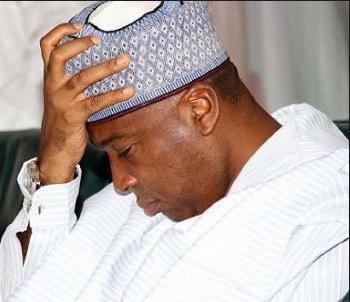
Saraki
By Douglas Anele
Some of the acts of misconduct and corruption levelled against Saraki took place in 2003 when he was governor of Kwara state. Therefore, if it is proper to deal with a case of alleged corruption that occurred over twelve years ago, why should “time constraints” deter a leader keen on change and eradication of authority stealing from investigating corruption perpetrated between 1985 and 2009?

Saraki
Why is President Buhari acting as if it is an abomination to investigate retired military heads of state and their close associates? Of course, it is virtually impossible for Buhari’s government (or any administration for that matter) to deal with all corruption cases simultaneously – the war against graft must begin from somewhere.
Nevertheless, it is counterproductive for the President and his cabal, using official instruments of law enforcement, to single out only opponents of government or “enemies” of, and rebels within, the ruling APC for probe and subsequent prosecution: such selectiveness would, as time goes on, erode public trust and confidence in the sincerity of government to tackle corruption headlong.
Allegations of false asset declaration against Saraki are very weighty indeed. Many Nigerians, including this writer, earnestly wish that the Senate President or any other high-ranking official of government must be severely punished according to law for serious misconduct, especially corruption. Yet, some lawyers maintain that due process was not followed in the Saraki case: that before Saraki was brought to the tribunal, he ought to have been given the opportunity to explain anomalies discovered in his assets declaration forms, and that approval of the Attorney-General of the federation was needed as well.
Now, a large number of high profile corruption cases have been bungled by the EFCC, the police and other agencies of government due to inattention to legal technicalities, poor investigative skills, and slipshod prosecution. Without a doubt, corruption in the judiciary, together with obsolete and faulty laws, has also hampered efforts to deal with corruption in high places.
Meanwhile, President Buhari and several hypocritical APC kingpins with stinking reputation for corruption are propping up a caricature of what genuine war against corruption ought to be. As Chinweizu perceptively remarked, they are deploying all sorts of Machiavellian tactics, including sacrificing some of their very own, to create the illusion of fighting corruption when, in reality, their overarching concern is to use the 1999 constitution as a tool for preserving the geopolitical and economic status quo which favours selected members of the Northern establishment and the Caliphate generally.
Therefore, those expecting a radical difference now in the war against corruption are likely to be disappointed because the current APC government is genetically incapable of dealing with the root of corruption in Nigeria, namely, the unitarist 1999 constitution and the geopolitical economy flowing from it.
APC leaders have not been honest and straightforward with Nigerians. A case in point is the public announcement by Garba Shehu, one of the media aides of President Buhari, of the so-called assets declared by the President and Vice-President, Yemi Osinbajo. It is remarkable that some public commentators hailed the announcement as if what Buhari and Osinbajo did was unprecedented in Nigerian political history. But the late President, Umar Musa Yar’Adua, not only publicly declared his assets shortly after assuming office, his declaration was more detailed and concise; moreover he declared his liabilities as well.
From the information released to the media by Garba Shehu, neither Buhari nor Osinbajo (who is a Professor of law anyway) fulfilled the constitutional requirement in the Fifth Schedule, which stipulates that the declaration must include all their properties, assets, and liabilities and those of their unmarried children under the age of eighteen. Assuming that both men do not have unmarried children below eighteen years, why were the liabilities omitted?
Why the ringing silence concerning the exact worth of shares and properties owned by Buhari and his deputy? In my view, President Buhari, in his attempt to portray himself as a moral messiah, created unnecessary problem for himself by making promises he knew would be hard for him to fulfil. A leader genuinely interested in real change cannot pick and choose the extent to which he can act in accordance with the law or mislead people by pretending to set a new standard when actually he has not even met the one already set by any of his predecessors.
Accordingly, if the information from Shehu accurately represents what both men declared to the Code of Conduct Bureau, it means that expectations of greater transparency and accountability by Nigerians from the APC government is an illusion that has no basis in reality.
On a general note, without thorough forensic investigations to ascertain the veracity of what was declared by any public official in the period stipulated by the constitution and genuine efforts to punish offenders notwithstanding their position or social status, the entire assets declaration exercise is a meaningless waste of time and scarce resources.
Now, after months of keeping a broad section of Nigerians in suspense, President Buhari has finally sent the first batch of twenty-one ministerial nominees to the National Assembly for screening. According to media reports, the President had met the leadership of the National Assembly, although Deputy Senate President, Ike Ekweremadu, was absent at the meeting. The unfolding scenario brings into prominent relief the President’s lack of political sagacity and naivety when he declared that he was uninterested in the leadership of the National assembly, that he is prepared to work with anyone at that level.
That is another unnecessary mistake by the President. His I-will-not-interfere-stance is analogous to that of the chief medical director of a general hospital who claims he does not care about the quality of nurses posted to his hospital because he is willing to work with any nurse! Buhari seems not to fully appreciate the fact that, given the significant oversight functions of the federal legislature on the executive branch of government, he must be keenly interested in the selection of principal officers of the senate and house of representatives and, as much as possible, use whatever resources he could muster to influence legislators’ choice on the matter.
Buhari wasted the opportunity to do so in a futile effort to convince gullible Nigerians that he is “Mr. Clean” who respects the [principle of separation of powers. Every political theorist knows that the principle of separation of power is a theoretical construct which does not exist in reality. That is why even in the United States, no President can ever dream of alienating himself completely from the leadership calculus in the legislature, because it is important to have a legislature whose leadership largely shares the same vision as the President.
As we already noted, Bukola Saraki, the Senate President, is being prosecuted for serious misconduct at the Code of Conduct Tribunal. Some Nigerians, including Saraki himself, believe strongly that his travails are politically motivated, that some cabal in APC wants to punish him for defying the party by conniving with PDP senators to become President of the senate. Perhaps, Saraki might use the ministerial screening exercise by the senate to cut his own pound of flesh from Buhari and the APC by surreptitiously mobilising his colleagues to scuttle approval of the list sent by the President.
He could even play to the gallery, as his party often does, by creating the impression of seriousness and thoroughness in the screening exercise through instigating his colleagues to adopt stringent criteria which only few ministerial nominees can meet.
The eventual outcome what is happening now depends largely on the dialectical interplay between contending affiliation, whereas the skewed system that breeds corruption is left relatively intact and untouched, it means that the more things change in Nigeria under APC, the more they remain the same. To be concluded. power blocks in the senate, that is, in the power relations between Saraki’s loyalists and APC members that believe in the supremacy of the party.
If the President genuinely insists that he would not interfere in Saraki’s case and Saraki refuses to co-operate with him on the ground that his travails are engineered by the leadership of APC, the machinery of governance would be jeopardised until the matter is resolved one way or another.
In my opinion, if prosecution of Saraki is a sincere effort to deal with top-level corruption anchored on diligent forensic investigation, the matter must be pursued to its logical conclusion so that our people would not lose faith in the war against corruption. But assuming that the whole thing is an elaborate charade to hoodwink Nigerians into believing that the war against corruption is no respecter of status, religion, ethnicity and party
Disclaimer
Comments expressed here do not reflect the opinions of Vanguard newspapers or any employee thereof.