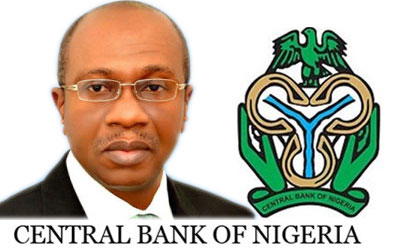
CBN Governor, Mr Godwin Emefiele
* As FG plans to set up infrastructure funds
By Omoh Gabriel in Lima
LIMA—The Nigeria delegation to this year’s IMF/World Bank meetings, led by the CBN Governor, Mr. Godwin Emefiele, on Sunday in Lima, Peru, disclosed that additional products were submitted to the CBN to be excluded from access to foreign exchange by some manufacturers, arguing that such items were being produced in the country.

CBN Governor, Mr Godwin Emefiele
In a joint press briefing, the Permanent Secretary, Federal Ministry of Finance, Mrs A. M. Daniel-Nwaobia, said the federal government was considering setting up an Infrastructure Fund and had approached the World Bank for assistance.
She said this was one of the issues discussed with the Bank at the annual meetings.
Emefiele responds to IMF criticisms
Mr Emefiele, who led this year’s delegation in apparent response to IMF criticism of the CBN policy of removing 41 items from access to foreign exchange on the grounds that it was detrimental to economic activities, said the CBN did not at any time ban the importation of any item.
He said: “What we did was to exclude from access to foreign exchange items we think can be produced and indeed in the past have been produced in the country in large quantity, and we think that these items, because of the challenges we have as a result of the drop in commodity prices and the revenue that comes from it, that there is a need for us to begin to produce these items in the country.
“That position still stands. I must have been quoted out of context if any body said I am reconsidering the issue. What I said is that the exclusion stands, indeed I have also mentioned in different fora, that we have even received a list of more items that should be excluded which some manufacturing companies think can be produced within the country, but we said no that we need to properly digest these 41 items that have been included in the list.
“The basic issue is this, that there is economic slow down, there is the fact that revenue has dropped as a result of the drop in commodity prices and if that has happened, we need to prioritise, just as Mr. President said we need to reprioritise and make sure that foreign exchange is made available to only those who are importing essential materials. Essential materials, raw materials and products that can not be produced within the country.
“That is the only way we can conserve our foreign exchange, that is the only way we can reduce the demand for foreign exchange for the importation of these items that we are saying can be produced in the country. We will continue to plead and crave every body’s support, we are convinced that these items can be produced locally, I have read and heard at different fora that the Central Bank is preventing people from having foreign exchange, and let me seize this opportunity to also say that the CBN only intervenes in the foreign exchange market and has tried as much as possible to encourage the broadening of the foreign exchange base so that those that earn foreign exchange from export proceeds can make their funds available in the market for every body to share.
“From time to time, we will continue to do our best to provide foreign exchange to the market to meet the foreign exchange needs of Nigerians. What is important is that Nigerians should understand that the challenge we are facing now is the same challenge facing all commodity exporting countries world wide.
“Practically, in all the countries in world, there are only a few of them you can say are insulated for now, even at that, they themselves know, for instance, that they should be very careful of the action they take now because it could have a contagious effect that could also affect them.
“We need everybody’s cooperation to ensure we meet those targets and refocus and think of the best way to diversify our economy away from excessive reliance on oil.”
On Nigeria’s economy sliding into recession
Mr Emefiele said the Nigerian economy was not sliding into recession. He said: “We have added two quarters of slow growth and like I told you, even the World Bank has revised the global growth out look from about 3.8 per cent to 3.1 per cent at this meeting.
“Africa has been revised from above 5 per cent to 3.75 per cent at this meeting, It is even projected at 4.5 per cent in 2016.”
Everybody is affected, what we are saying is that because we have seen two successive quarters of slow growth, that we all need to embrace the policies that we are putting in place both by the monetary and fiscal authorities so that we can see a reversal.
“So we can see increased growth not slowing growth, so no one has talked about the fact that Nigeria is going to go into recession. We are only saying we need to work hard to begin to reverse the trend so that we can move toward positive growth rather than slowing growth.”
On subsidy removal
Mrs Daniel-Nwaobia said: “Subsidy has been in the front burner, we are still debating it whether subsidy should be removed or not, just like the governor said every country is dealing with the issue specific to it, you have to take into consideration various issues before you remove subsidy, it is a political issue, you know we have a new government that is studying the issue, I think with time we will know the position of government on that.
“A lot of reforms are in the pipe line, you have seen the issue of the Treasury Single Account, TSA, which is being fully implemented now and we believe that with time we will see improvement in our revenue. Leakages that have been in place will be eliminated. Another major issue I know that was discussed at this meeting like I said is the issue of investing in infrastructure which government is already looking into, discussing it, government is thinking of setting up an infrastructure fund to develop infrastructure that will add value to the economy and create jobs.
“We have already seen what is happening in the power sector like the governor said and we know what power can do if we are able to get the power sector right, the effect it will have on our economy so we are looking at the issue of power, looking at agriculture and its value chain, we are looking at the mining sector, we discussed these with some of the institutions we have engagement with here and when we get home we are going to further reengage with them to see how they can help us especially in the area of capacity building for us to be able to come up with fiscal policies that will help us in the development of our economy.
Inflation and exchange rate effect on electricity tariff.
The CBN Governor also said “Well when you talk about inflation and exchange rate being a factor that is worked into the model for pricing tariff, you are very correct, that is why we are doing our best to ensure that we keep inflation under check, that is why we have been very stubborn in further adjusting the exchange rate. You would have seen that in the last eight months we have achieved some level of stability in exchange rate and that will continue. Yes I have also read in the papers that we are not going to continue with the current electricity tariff.
“For you to have good electricity, you need to be able to pay a little more and the truth is that if we compare the cost of electricity, the cost of generating our own electricity using our generators with the cost per kilowatt hour for using electricity through the DISCO grid you will find out that what we spend on generators is significantly higher than the kilowatt hour. Let me give you the numbers, for your generator, It cost as much as N80 to generate a kilowatt hour and today from your DISCO, Nigerians are paying about N20 per kilowatt hour in some cases. What we are saying is even if you have to pay a little more, so that you can throw away your generator, pay a little more so that you can have electricity, I think it is worth it and some of the policy which the Nigeria electricity regulation commission is putting in place, to support what is called cost reflective tariff, I can assure every body that what ever that cost reflective tariff eventually turns out to be it will still be substantially lower than the eighty naira per kilowatt we spend today on our generators. “
Disclaimer
Comments expressed here do not reflect the opinions of Vanguard newspapers or any employee thereof.