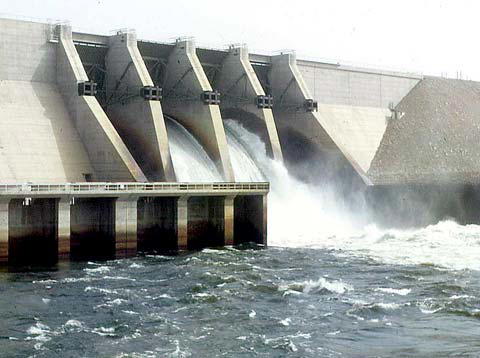
Kainji Dam
By Jacob Ajayi
It will be considered unpatriotic on my part if I do not comment on the availability of a realistic Federal Government policy to bring sufficient and uninterrupted electric power supply to Nigeria. My employers, Africa Mutual Funds Corporation, had been studying and making presentations to the Federal Ministry of Power since 2010 on the feasibility of realising 17,100 megawatts, MW, power to Nigeria in 2014, and thereby increase this to about 50,000MW.
One of our principals who studied our proposal to generate 17,100MW told us that we should be looking further to 50,000 MW of which we thought it was achievable after we might have reached our portfolio of 17,100MW.
We have also made it known to the authorities in 2012 that affordable electric power could be harnessed from existing hydropower facilities in Nigeria without waiting seven years to develop Mambilla hydropower project. We also showed that gas-based electricity generation is not affordable to Nigerians coupled with the proclivity of such a gas-based model to vandalism, which will not only drive up the cost of power generation but also affect the availability of electricity on the national grid.
We have showed, and we still have the template that would produce over 70% of our national power requirement from hydropower sources with the balance coming from the operating gas power plants that are located close to the source of gas in the Nigeria’s delta region. Our plan also call for the reactivation of the Oji River coal fields to generate power with coal, which was our main source of electric power in Nigeria before the construction of Kainji Dam.

Kainji Dam
Electricity costing more than 5cents (N11.00)/Kwh is seen as unaffordable in Nigeria given our per capita income. We have also alerted the authorities that only hydropower or coal-based power generation can be produced at less than 5cents/Kwh. There and then can we say that our source of electric power is definitely not gas!
Source of power
I know our company (Africa Mutual Funds) spent more than $500,000 on the feasibility, technical audit and technical repair plan to bring adequate power to Nigeria. The $500,000 spent on our own of which $50,000 was paid to secure concession of the existing three hydropower plants in Nigeria!
We know that our plan, copies of which are at the Federal Ministry of Power is as feasible today as when we conducted those studies and technical audits in 2010-2011. I hope our President has the political will to pursue this acceptable proposal (see note below) for which the authors are very much around, and are ready to work for Nigeria to benefit from economic development. This will bring billions of US$(dollars) into the Nigerian economy, reduce cost of production, open up the country for investments and reduce graduate unemployment.
I am writing this and very sure of what I am saying because our President once said that “these generations of Nigerians have no other country to call their own.” I agree with General Buhari then, and I agree with him now, and I know that these generations of Nigerians are ready to roll up their sleeves and go to work to make Nigeria great!
NB: The proposals to revamp hydropower facilities in Kainji, Jebba and Shiroro and upgrade them to produce about 17,100MW by 2014, was adjudged bankable by many experts both in Nigeria’s Ministry of Power and by three other power generating companies in the United States and Canada. The Nigerian Union of Electricity Employees and the Senior Staff Association of Electricity Workers saw the proposals as sure remedy to the electric power malaise in Nigeria.
I am writing this and very sure of what I am saying because our President once said that “these generations of Nigerians have no other country to call their own.” I agree with General Buhari then, and I agree with him now, and I know that these generations of Nigerians are ready to roll up their sleeves and go to work to make Nigeria great!
NB: The proposals to revamp hydropower facilities in Kainji, Jebba and Shiroro and upgrade them to produce about 17,100MW by 2014, was adjudged bankable by many experts both in Nigeria’s Ministry of Power and by three other power generating companies in the United States and Canada. The Nigerian Union of Electricity Employees and the Senior Staff Association of Electricity Workers saw the proposals as sure remedy to the electric power malaise in Nigeria.
Disclaimer
Comments expressed here do not reflect the opinions of Vanguard newspapers or any employee thereof.