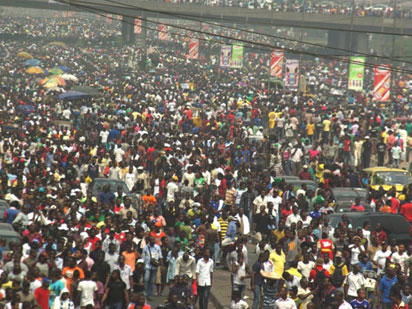
Statistics by experts show that by2040, Nigeria’s population growth would have quadruplewithout commensurate amenities and employment to sustain it
By ‘Uju Onwuzulike
“A problem is a chance for you to do your best”…Duke Ellington
When there are opportunities and different choices to choose from, people and organisations tend to choose the best. What happens when there is no opportunity or probably options available to people or organisations to choose? I mean when you are left with no option. I have been privileged to ask more than 200 people during my training programs this pertinent question: what do you do if you don’t have an opportunity or choice that will help you to achieve what you want? The answer(s) I got from these people and from some organisations I have posed the same question to made me to realise why most people and organisations are not achieving their desired results.
Desired results
You really want to know what they answered. Coincidentally, they all answered almost in the same line: they will hope for the best. So, hoping for the best has suddenly become what most organisations are adopting especially in difficult times.

We need to ask in our different organisations, is hoping for the best a reliable strategy for organisation’s growth especially when the odds seem not to be very much in their favour. organisations may be quick to ask: is it wrong to hope for the best when their businesses are not thriving, the economy is not looking up, fewer opportunities on their way, and generally when things are not working in their favour? From their point of view, they want to be optimistic. My answer to them always is: in difficult times, hoping for the best is not enough. Why? Millions and millions of organisations are hoping for the best in tough times, but the “best” is always masked and might not go to anyone expect those intentionally doing their best. Like Dr Martin Seligman will say, “If the cost of failure is high, optimism is the wrong strategy”.
The irony is that even organisations that have not evolved any game plan, core strategies or have not taken definitive steps towards achieving their desired results will still hope for this “same” best. The truth is: the best does not come to organisations who are mere positive or who are wishing for the best. The best will come to organisations that can match their desires with equal amount of time bound actions.
It will come to those who despite all odds will go the extra mile when others are quitting. The best will come to those organisations who value every customer they have and will do all in their hands to constantly amaze them. The best will come to those organisations who do not allow the change on the outside to exceed the change on the inside. There is no better time to pay attention to this Jack Welch quote more than now: “If the rate of change on the outside exceeds the rate of change on the inside, the end is near”. So, when organisations merely sit down without being strategic and hope for the best, they are simply making their end nearer.
Organisations are failing more than ever before because, they always assume some magical effect will turn around their situations. Such organisations believe that by hoping for the best, the “best” will graciously and calmly come to them – that is mere optimism and it does happen less of the time. In order to achieve higher and sustainable results for the remaining part of the year, organisations and individuals would need to move from mere optimism to Optimal Thinking.
Mere optimism
The difference is that mere optimism will say, ‘our organisation wants the best for Q4’, while Optimal Thinking will ask, ‘what can we do to achieve the best for our organisation in this Q4, what are our options’? What can we do differently in this circumstance? Etc. In challenging times like we are, organisations should avoid wishful thinking and evolve implementable game plan for achieving success.
Final note:
You might be wondering what then can an organisation or someone do if there is no choice. Remember, I said earlier, if there is a choice, choose the best. Now there is no choice. What will individuals and organisations do when they have no choice? Very simple, they should be the best. Same goes to everyone reading this insight, instead of hoping for the best, be the best, make the best to come.
For your views or perspectives:
Email: [email protected]
Mobile: 09091142093
www.hainescentre.com
Disclaimer
Comments expressed here do not reflect the opinions of Vanguard newspapers or any employee thereof.