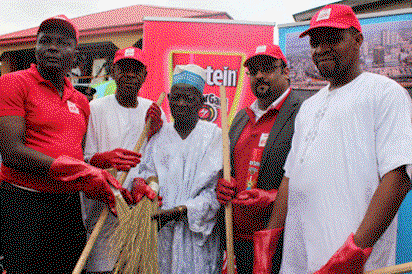
MALARIA ELIMINATION: Officials of the Lagos State Government, Reckitt Benckiser and members of Kosofe Community during an awareness programme.
By Chioma Obinna
When 9 –month-old, GboyegaAdesina, woke up in the middle of the night with high fever and a feeling of nausea, his mother just assumed it was “normal” fever, gave him paracetamol syrup and went back to bed. Gboyega lives with his parents in one of the slums in Kosofe, a water-logged area of Lagos associated with consistent flooding. Life in the one – room apartment is best imagined.

MALARIA ELIMINATION: Officials of the Lagos State Government, Reckitt Benckiser and members of Kosofe Community during an awareness programme.
A study done in the area showed that malaria-carrying mosquitoes breed more there. Gboyega and his siblings are unprotected from mosquito bites. They have no mosquito nets and do not go to hospital. Few days later, Gboyega was no more. He was killed by “ordinary malaria.” He is now part of the statistics lit to the disease in the country everyday.
The high death rates resulting from malaria is because Nigerians do not consider it a serious disease. When Health & Living spoke to pharmacy operators in Lagos, they blamed it on poverty and ignorance and lack of evidence based research to show that most interventions are really effective.
For Abiola, the economic situation of the country and high cost of treatment in the hospital has made many people to stay away from going to the hospital. He said some who come to buy drugs in the pharmacies prefer cheap drugs which may not have effect on their fever.
On how to reduce mortality due to the disease, create awareness, evaluate interventions as well as educate Nigerians in the communities, the Nigerian Institute of Medical Research and Reckitt Benckiser and the Lagos State Ministry of Health, is focusing interventions in areas and on groups most hit by the disease. Recently, Reckitt Benckiser embarked on a community research in Kosofe area of Lagos State to assess the impact of integrated approach for malaria control in Lagos state.
The assessment will provide information on the impact of using integrated approach -LLINs, insecticide ‘Mortein aerosol’ and larval source management, LSM, for malaria control in Lagos. Head, Malaria Research Project, Nigeria Institute of Medical Research, Dr. Sam Awolola, said the research, tagged: “The Mortein Own A Community Campaign of RB in Kosofe Local Government was not only to educate the people but to have an evidenced- based research that would show that intervention can go beyond just implementing them.
“There should be clear evidence that the intervention is working. Evidence -based implementation cannot be proven without research. RB is supporting the research to provide evidence that intervention is working. No single intervention can eliminate or control malaria. We need the combination of all the interventions.”
“The study design will include a pre-intervention cross-sectional survey followed by semi-longitudinal assessment of vector control interventions using a combination of LLINs, Mortein aerosol and LSM. The community at Kosofe will be stratified and three “mosquito hot spots” identified. LLINs + LSM + use of Mortein will be established at each hot spot covering a total of 250 households in the three hot spots.”
On the choice of Kosofe, Awolola explained that it is a community that is contained and the objective of the Own – a Community Research” is to demonstrate the efficacy of the anti-malaria education campaign, amplify mortein as leader in the fight against malaria in Nigeria, demonstrate the possibility of absolute Malaria elimination, among others.
Malariaelimination
Marketing Director, Mortein, Reckitt Benckiser, Mr Oguzhan Silivrili, said under the assessment programme, advocacy and mobilisation will be carried out in collaboration with the Lagos State Malaria Control Programme and selected community members trained on application of LSM. He said this would improve use of insecticides. Subsequently, LLINs and Mortein will be distributed to cover the target population. Community members will be educated on the proper use of each of the vector control method.”
“A pro-forma will be generated for data collection for each village. Entomological assessment of the impact of the interventions will be carried out at 0, 2, 4, and 6 months following intervention. Active malaria case detection will be carried out using rapid diagnostic test (RDT) kits at pre-and post-intervention, 0 and 6 month respectively following intervention.”
Disclaimer
Comments expressed here do not reflect the opinions of Vanguard newspapers or any employee thereof.