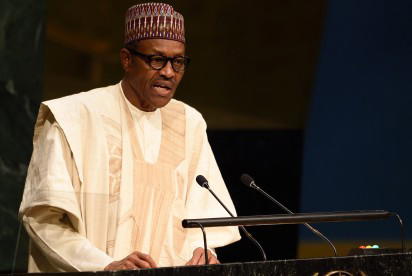
President of Nigeria Muhammadu Buhari addresses the 70th session of the United Nations General Assembly September 28, 2015 at the United Nations in New York. AFP
By Dr. Akintola Omigbodun
The Central Bank of Nigeria, CBN, during June 2015 issued a list of imported goods and services that would be excluded from the official Nigerian foreign exchange markets.
The list includes but is not limited to rice, cement, margarine, vegetable oils, meat and processed meat products, vegetables, poultry, security and razor wire, wood particle/fibre boards, plywood boards, wooden doors, furnitures, toothpicks, glass and glassware, kitchen utensils, tableware, vitrified and ceramic tiles, textiles, woven fabrics, clothes, plastic products, soap and cosmetics, tomatoes/tomato pastes, eurobond/foreign currency bond/share purchases. The CBN indicated that the order was made in order to encourage local production of items on the list, to conserve foreign reserves as well as facilitate the resuscitation of domestic industries and improve employment generation.

President of Nigeria Muhammadu Buhari addresses the 70th session of the United Nations General Assembly September 28, 2015 at the United Nations in New York. AFP
Employment generation
There are very good reasons for stating that one item that is not on the list and that should be on the list is wheat. The Kebbi State Government invited the media, the CBN and rice millers to the state a few months ago. During the visit, there were reports that the Kebbi State Government had purchased more than 200,000 metric tons of paddy rice from the farmers.
The rice millers found the rice to be of very good quality and we should therefore expect the rice millers would purchase paddy rice from Kebbi State now and in the future. Significantly, the Kebbi State Governor indicated his intentions of expanding rice and wheat production with about 250,000 young people.
One would expect that the other nine leading rice producing states, Sokoto, Zamfara, Katsina, Kano, Jigawa, Bauchi, Gombe, Niger and Kogi would follow the lead of Kebbi State.
We must move beyond the idea that the construction and utilization of strategic grain silos and storage facilities represents food security. We must utilize our people and resources to grow enough food for our needs. Japan has limited land for agricultural purposes but there are restrictions to rice imports into Japan.
Saudi Arabia and Sweden are examples of what food security should mean to us. More than 25 years ago, Saudi Arabia sank deep wells with irrigation systems and transformed desert land into wheat fields. Of course the traditional wheat growing countries expressed their displeasure at the Saudi policy of producing wheat at much higher costs than the others while excluding cheaper imports. Saudi Arabia maintained its policy and over time its wheat production was adequate for its needs and the surplus was exported.
Sweden in northern Europe has a colder climate in contrast to Greece, Italy and Spain who traditionally are the largest European producers and exporters of tomatoes. However, Sweden has a policy of growing tomatoes in green houses to ensure supplies if deliveries from other countries fail. The interesting thing is that another country, the Netherlands, has developed high-tech green houses to the extent that its tomatoes compete favourably with tomatoes from Greece, Italy and Spain.
The opposition to the CBN’s restriction on foreign exchange utilization has come in the form of a statement from JP Morgan indicating it would soon exclude Nigerian government bonds from its bonds index.
JP Morgan cited CBN’s foreign currency controls as making transactions too complicated. It is estimated that there would be a capital outflow of US $3billion from Nigeria when foreign holders of Nigerian government bonds dispose of their holdings.
These funds would largely have been applied to import goods into Nigeria on capital inflow. Nigeria has had a number of opportunities to release the energies of its people into profitable productive activities. We should seize this present opportunity. TO BE CONTINUED
Disclaimer
Comments expressed here do not reflect the opinions of Vanguard newspapers or any employee thereof.