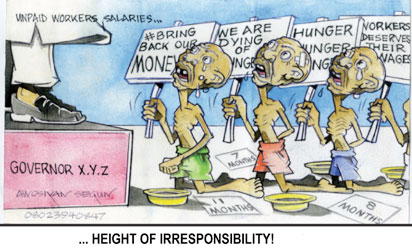
NOT quite infrequently you get to read of oxymora as news report from Nigerian dailies. Several news outlets are reporting on an ongoing but serious economic sabotage of the working class wherein the practice of Nigeria’s employment law is observed in its breach. The trending but incredulous revelation is that wages are being withheld on a widespread scale. The worrisome claim is that the very watchdog hired by the sovereigns, and empowered by the constitution, that is the executive, legislative and judicial arms of government are neck deep in an unholy practice of withholding wages of workers.
We must make some clarifications first: the practice in reference is about unlawfully withholding duly earned salary or wages, in part or in full, by an employer. In many jurisdictions, it is a violation of law and the collective bargaining agreements. We understand that the Nigerian constitution frowns at it too. It may be argued that it falls under the general premise of the Fundamental Objectives and Directive Principles of State Policy as enshrined in the 1999 constitution’s Chapter II, Section 17(3)(c ) whereby government is enjoined to protect and ensure that “the health, safety and welfare of all persons in employment are safeguarded and not endangered or abused.”
Bonafide employee
In the U.S., it is against the Fair Labour Standards Act (FLSA), which requires a qualifying employer in most cases to pay workers their earned wage, above a minimum level, and with earned overtime pay, if they are not classified as exempt. Withholding pay or wages may be allowed under certain strict guidelines vide a court order, wage garnishment, tax lien, mutually agreed proffers, or other legally permitted rules. No one will deny that arbitrarily withholding wages does far more grievous harm to the worker. In fact, wrongfully withholding wages from a bona fide employee may result in costly legal consequences for the employer, including governmental agencies. In some places, the repayment penalty may even be a multiple value of what was withheld.
The incredible idea that an employer – notably agencies of government – would retain a retinue of workers to toil on its behalf and render civil service, months on end, and then refuse to pay lawful compensation as well as extend other contractual emoluments to them is beyond fathom. It is almost certainly a fraud, whether the employee resides in outer space or on the terra firma of West Africa. Such an arbitrariness is strange and indefensible. It must stop. That several thousands of diligent workers have kept their employment contract but are repeatedly denied the reward of due compensation, their base salary and accompanied benefits, is probably a crime against humanity.
It may possibly rise to the level of a class action pursuit. Obviously the debtor State governments have scant respect for their workers that they can spurn their fundamental rights to fair compensation. It is widely assumed that the first duty of government is the protection of lives and not this conscious plan, wittingly or unwittingly, to impoverish them and force them into homelessness. The Nigerian constitution recognizes this fact under the hereinbefore referenced Chapter II, Section 14(2)(b) thus: “the security and welfare of the people shall be the primary purpose of government.” A former U.S. President, Ronald Reagan, is credited with reiterating this truism when he opined that government’s chief duty is to protect the people, and not run (or, ruin) their lives.
But the trending reports are that government entities and their agencies are widely involved in this scam and this is dangerous. Several commentators have recently written on this unfolding criminality. Yes, that is what it is when you seize wages duly earned and then withhold same for several months, some upwards of six to nine months, without interest credit! Comrade Issa Aremu of the Nigerian Labour Congress in a June 25, 2015 essay in ThisDay newspaper insists that “Nigeria is in a profound crisis of compensation.” The public, and especially the injured workers who have locus standi, without prejudice to their other rights, must take the fork in the road and contest this criminal conversion. It is a task that must be done!
What exactly is considered a job – an employment – in today’s Nigeria and who has legitimate claims to having one these days? That may be the question of the year for all the elected public officials to answer. Further, is the Nigerian employer aware of the truism that a worker is deserving of his wage? The other day, an essayist, Olusegun Adeniyi writing in the ThisDay newspaper as part of a series that debuted on June 18, 2015, wondered if the tragedy is reflective of the Nigerian situation becoming destitute such that even religious and charity organizations are making plans to donate groceries to public employees. What a sad, humiliating situation for the worker.
Humiliating situation
Unfortunately, no one is exploring legally sufficient, fair compensation for those that oil the wheels of the economy with the same gusto. The alleged plea by the state governors in asking for economic relief from the federal government as a palliative for the workers is revolting to say the least, and is clearly antithetical to the principle of accountability and good governance. If the previous federal allocation and internally (locally) generated revenue from which the wage bill is funded was allegedly mismanaged, why would any sane federal government release more funds into the rat hole without an inquisition being carried out?
The Nigerian worker must seize the initiative. Why would folks repeatedly go back to an organization – an employer – as a daily routine to oil its wheel of sustenance, if that entity has habitually and contractually failed in its basic obligation to compensate its workers? It can be argued that the alleged pension and wage theft compromises the provision of the 1999 constitution’s Chapter II, Section 16(2)(d) which requires the government to provide “suitable and adequate shelter, suitable and adequate food, reasonable national minimum living wage, old age care and pensions, and unemployment, sick benefits and welfare of the disabled are provided for all citizens.”
- Dr. Nzeribe Ihekwaba wrote in from Florida, USA
Disclaimer
Comments expressed here do not reflect the opinions of Vanguard newspapers or any employee thereof.