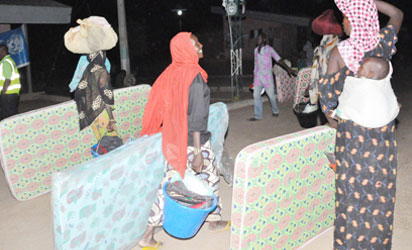
NIGERIAN RETURNEES FROM CAMEROUN WITH MATERIALS DISTRIBUTED TO THEM BY THE OFFICIALS OF THE NATIONAL EMERGENCY MANAGEMENT AGENCY, AT THE NYSC CAMP, DAWARE IN YOLA ON SUNDAY NIGHT.
By Umar Yusuf, Yola
On August 3, Cameroonian authorities began the repatriation of the over 12,000 Nigerian refugees, who fled to that country following continued assault by the Boko Haram insurgents. Some of the refugees stayed in that country for over four years as the insurgency attack continued unabated in their villages and communities back home in Nigeria. They were disorganized and detached from their homes and relations.

NIGERIAN RETURNEES FROM CAMEROUN WITH MATERIALS DISTRIBUTED TO THEM BY THE OFFICIALS OF THE NATIONAL EMERGENCY MANAGEMENT AGENCY, AT THE NYSC CAMP, DAWARE IN YOLA ON SUNDAY NIGHT. File Photo
At the time they were fleeing to Cameroun, that country had not started witnessing insurgency, it was a safe place. Cameroun continued to receive the influx of the fleeing Nigerians until the insurgents turned their terror attacks on the Nigerian neighbour. Efforts were: intensified by the two countries at diplomatic level on ways for them to contain the attacks, but the attackers remained undeferred. Cameroun was getting saturated with the Nigerian refugees and their internal displaced persons and they were left with no option than to offload the Nigerian refugees.
It was reliably gathered that even before the commencement of the repatriation, Nigerian authorities made moves to get Cameroun to rescind its decision. The plea, however, fell on deaf ears as Cameroun, early August, commenced the repatriation of the Nigerian refugees. To confirm that there was no proper diplomatic arrangements between the two countries, over the repatriation, the refugees were dumped in Mubi, a commercial border town between Adamawa State and Cameroun. And within four days of the evacuation, no fewer than 6,000 of the 12,000 refugees expected to be moved had been abandoned at the Burnt Brick Factory, Mubi.
The population of the refugees, now Internally Displaced Persons, IDPs, on the shores of the country, was too much for the premises of the abandoned brick factory.
While the returnees were being dumped in their new abode, the Nigerian military were on ground to ensure that none of them stepped out of the premises.
The reason for the restriction was not far-fetched. The military authorities were not comfortable with the returnees in terms of identity.
The identities of the returnees had to be ascertained as insurgents could have infiltrated them, hence the strict restriction.
The returnees, comprising of the young, toddlers, nursing mothers, the disabled, including those shot and maimed by Boko Haram attacks, related the dehumanizing experiences they went through before they fled to Cameroun and the ones they were going through in their makeshift camp in Mubi, where they were relocated after their repatriation. Mallam Idrissa Musa, in his late nineties, narrated how he and his co-refugees were locked up like criminals and thrown into open vehicles on the trip from Cameroun to Mubi.
“There was no prior knowledge or any communication as to where they were moving us to.
All of a sudden, the gendarmes will group you together and started ordering you to move towards waiting vehicles for movement to an unknown destination”, he said.
“After dropping a group of about 30 to 40 and they board the vehicles, the gendarmes will go for another group of people, not minding whether you or your colleagues have your little belongings and off you are thrown into the trucks.
“We were evacuated into trucks meant for goods and, worse still, about 40 to 50 of us inside a vehicle meant to carry only 15 to 20 people for a journey of over five to six hours.”
Another returnee, Malama Husseina Mato, a mother of four, whose husband was killed during a raid on Baga in April last year, declared that she lost two kids while taking refuge in Cameroun. According to her, the two children, a boy of six years and daughter, 4, died of hunger and malnutrition.
Nasir Bappa, 15, who claimed to be a fisherman in Baga, narrated how he escaped to Cameroun along with neighbours after the insurgents killed his father, mother and other members of the family when they attacked the town in 2014. According to him, he went fishing that fateful day and, on his return, found the family house in rubbles.
“That attack was the worst to have hit Baga. The early morning attack that day affected almost every household in the fishing community. My family was not lucky and the resultant effect was my sneaking into Cameroun. Now I am an orphan and don’t know how to start a new life”, Nasir spoke in tears.
At the Mubi temporary camp of the returnees, the timely visit of Borno State deputy governor, Alhaji Zanna Umar Mustapha, accompanied by the Director General of the National Emergency Relief Agency, NEMA, Alhaji Sanni Sidi, gave them some rays of hope. When the convoy of the deputy governor entered the premises of the burnt brick company, Mubi, the returnees, despite the downpour, trooped out to welcome him.
The soldiers overseeing the camp had a hectic time controlling the surging returnees as they spoke with one voice calling on Mustapha to evacuate them back home.
Addressing the returnees, the deputy governor promised that they will be moved to permanent IDPs camps in Yola, the Adamawa State capital and Fufore the following day. He, however, warned the returnees to subject themselves to the military for thorough scrutiny to detect possible bad eggs among them. He told them to bear with the military on the screening as, according to him, the exercise will be thorough to ascertain ‘who is who’ among the returnees.
The deputy governor said that any of the returness cleared should be on his way into the awaiting vehicles that will convey them to their permanent camps in Yola and Fufore.
The returnees, mainly from Gamboru Ngala, Bama, Baga, Danboa, among other areas along the borders with Cameroun and Chad, have been evacuated to IDPs camps in Damare, Malkohi and Fufore, all at the outskirts of the Adamawa State capital.
Disclaimer
Comments expressed here do not reflect the opinions of Vanguard newspapers or any employee thereof.