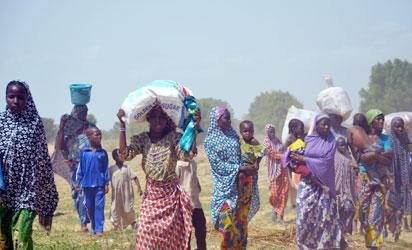
Women and children flee from home burnt by Boko Haram Islamists at Zabarmari, a fishing and farming village near Maiduguri, northeast Nigeria, on July 3, 2015. Several female suicide bombers in northeast Nigeria blew themselves up amid panicked villagers fleeing a Boko Haram attack, killing scores, the army and witnesses said on July 4. The latest carnage in series of attacks that have claimed more than 200 lives in just three days happened on Friday night in Zabarmari village, 10 kilometres (six miles) from the city of Maiduguri, the birthplace of the jihadist group. AFP PHOTO/STRINGER AFP
By Favour Nnabugwu
Every day, scores of Nigerians fleeing conflict in the North-East continue to arrive the Federal Capital Territory ( FCT). At the last count, the number of displaced persons in Abuja alone is over 21,000 people.

AFP
And because much of attention is focused on providing assistance to communities in the North-East, the displaced families are largely dependent on the National Emergency Management Agency (NEMA), the FCT Emergency Agency (FEMA) and random acts of kindness from the local community, religious bodies, philanthropists and public spirited individuals.
The Director of FEMA, Alhaji Idris Abass, in an interview, said the challenges of the IDPs were complex, revealing that thousands of them were spread across 21 camps in the FCT.
Abass said, “We have 21 locations in the FCT now and over 21,000 IDPs spread across the FCT, those are the ones we have captured. There are so many other ones and, on daily basis, they keep coming to the FCT.”
He noted that the agency will not be surprised if there are some other IDPs locations in the FCT that have not been captured, adding that FEMA only captures the ones it knows about.
On the challenges, the Director said the agency was battling with limited funds to cater for the IDPs.
“The major challenge is that we don’t have funds. Secondly, people are not humanitarian enough to make the IDPs feel a sense of belonging. Otherwise, those people need assistance, yet we have people who are able to give out little from their own but find it difficult because Nigerians do not entirely render humanitarian service,” Abass said.
He, however, acknowledged that some non-governmental organisations (NGOs) have been of tremendous assistance with relief materials and giving information to the agency on IDPs who have not been captured.
“As far as we are concerned, we are mandated to take care of the IDP’s and IDP’s are those people who are displaced from their homes.”
“We collaborate with stakeholders and other agencies on IDPs in order for each and every agency to carry out its duties to the displaced persons”.
Just recently, the agency uncovered 700 new IDPs in Gidadaya, Oronzo, Abuja.
The FEMA Director told Sunday Vanguard that the agency had profiled the new IDPs and also sent relief materials to them.
According to him, the agency learnt that the IDPs occupied an area in Oronzo for weeks before they were uncovered.
Among the IDPs were pregnant women and children from the war-ravaged North East.
He commended the United Nations Commission for Refugees (UNHRC), religious bodies, agencies and individuals for their contributions to the welfare of IDPs.
Sunday Vanguard investigations revealed that many of the IDPs in and around the FCT live in shelters made of wood crates and plastic sheets. The host communities are often too poor to support them.
Explaining why the IDPs relocated to Abuja, one Philemon Emmanuel said: “Most of us are farmers, so we are looking for the place to plant food items and make money. You know that in Borno State, especially in Gwoza, we are good in farming.
“We have our brothers living here and they told us that there are places in Nasarawa State like Kugaru and Kagruma and there is a mission field in Kwali where we can be allowed to farm”.
Disclaimer
Comments expressed here do not reflect the opinions of Vanguard newspapers or any employee thereof.