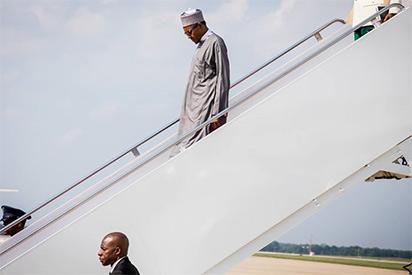
President Buhari at the Joint Base Andrews Airport in Washington, DC.
By Douglas Anele
President Muhammadu Buhari’s vuvuzelised state visit to the United States has been generating a lot of commentary in the media. Expectedly, the key issue people are arguing about is the possible benefit of the event to Nigerians as the new government struggles to overcome multi-faceted economic, security and infrastructural challenges facing the country at this time.

President Buhari at the Joint Base Andrews Airport in Washington, DC.
The debate is in order, given that bilateral engagements between two countries at the highest level of political decision-making sometimes have serious consequences particularly for countries at the lower levels of the pecking order in the international arena. According to appointees of the President and leading members of All Progressives Congress (APC), the visit was a resounding success.
On the other hand, non-partisan Nigerians dissatisfied with the higgledy-piggledy style of governance since President Buhari assumed office in May 29 would interpret it as a placebo or public relations display to make gullible Nigerians think that President Barak Obama is indeed favourably disposed to the current dispensation and would fully cooperate with it to repatriate stolen funds back to Nigeria, liquidate Boko Haram, and attract American investment into the Nigerian economy. One of the so-called benefits of President Buhari’s visit to America is the announcement of a plan by the World Bank to provide $2.1 billion dollar rehabilitation package for the North-Eastern states of Adamawa, Borno and Yobe that have been ravaged by Boko Haram.
Presently, details concerning the loan are sketchy. However, from what is known about World Bank’s relationship with underdeveloped countries, Nigerians should think carefully before celebrating the announcement. Essentially, the World Bank, like other financial institutions owned by Western neo-colonialist powers, was created with the main objective of maintaining the economic superiority of developed Western countries led by the United States over non-Western countries especially in Africa.
Therefore, although it is desirable to rehabilitate expeditiously those areas devastated by Boko Haram, the federal government should rigorously analyse the conditionalities” attached to the loan facility to avoid mistakes of the past on foreign borrowing. Certainly, the loan will increase our foreign debt overhang, which would worsen Nigeria’s vulnerability to the dictates of Western imperialist agenda.
It is difficult to ascertain exactly how much investments the President’s visit attracted to Nigeria. According to some media reports, the cumulative financial inflow into Nigeria because of the visit is about $13 billion. In fact, the President’s media aides at every opportunity proclaim that American investors would soon be in the country to explore business opportunities. Unfortunately, they failed to reckon with the fact that the image of a hideously corrupt country Buhari projected in America has degraded Nigeria considerably.
Relentless denigration of Jonathan’s government as corrupt and incompetent may boomerang by discouraging investors from establishing businesses in Nigeria. Specifically, serious genuine entrepreneurs from the United States and elsewhere would be afraid to invest in a country whose President claims that about $150 billion is stolen annually. In my view, by constantly dredging up the failures of his predecessor publicly, President Buhari and his supporters are cutting their faces to spite their own noses as well.
Moreover, APC leaders are mistaken in thinking that it is proper to denigrate Jonathan’s government thoroughly such that any achievement by the current administration no matter how insignificant would seem more impressive to Nigerians than it actually is. They should learn one or two lessons from the way successive American Presidents treat their predecessors.
For example, former President G.W. Bush committed grievous errors of judgment while in office. His eagerness to dislodge Saddam Hussein of Iraq led the US into a needless war that, overall, has cost America about $1 trillion. Besides, the 2008 economic meltdown in the US was largely the result of inappropriate economic policies by the Bush administration. Yet, even in the charged atmosphere of electioneering campaigns and after he was sworn in as President, Barak Obama hardly mentioned his predecessor’s shortcomings.
Instead, he rolled up his sleeves and got to work by implementing policies and programmes that actually improved America’s economy, which remains the largest in the world despite fierce competition from China. Meanwhile, Buhari and APC’s media machine are still responding to the serious challenges of governance as if they are campaigning for votes, constantly quibbling about how corrupt former President Goodluck Jonathan’s administration was, and about who would be probed and who would not be probed. Buhari’s penchant for castigating his immediate predecessor is aptly captured by the Igbo aphorism, ike oru gwu nwata, ike oga akara ya mma (if a child is tired of working, he spoils for a fight).
President Buhari’s trip to America is open to criticisms from several angles. To begin with, let us consider the composition of his delegation. In my view, going on a state visit with his son, Yusuf Buhari, is nepotic because there is no good reason why the young man should accompany his father on such a visit.
Yusuf is neither an official of government nor a technocrat whose expertise would be required during discussions between the Nigerian delegation and the Americans. Some commentators claim that it is part of presidential privilege for Buhari to choose anyone to accompany him on a foreign trip. Still, in leadership, public perception of a leader is usually as important as, if not more important than, reality itself.
Generally, our top public officials do not always differentiate between their personal idiosyncrasies and public interest while exercising the prerogatives of their office, a major weakness that leads to misuse of public funds and assets. During the electioneering campaigns, Buhari excoriated Jonathan and his subordinates for nepotic abuse of public office. Nevertheless, the appointment of Amina Zakari, who is closely connected with the President, as acting chairperson of the Independent National Electoral Commission (INEC) and inclusion of his son in the group that went to the US indicate that Buhari is swimming dangerously close to the murky waters of nepotism.
It is interesting to note the complete silence in the media about the cost of the President’s trip to Washington. It is as if the cost of travelling out of the country with a huge delegation by a sitting President is no longer an issue that warrants critical discussion as was the case during the tenure of Chief Olusegun Obasanjo. Remember, Buhari went to America with a 33-member delegation.
Therefore, the relevant question is, how much did the federal government spend in organising that trip, including estacodes paid to each member of the delegation and other expenditures connected with the visit? What criteria were used in selecting state governors and other politicians that travelled with the President? Going by the way our leaders waste public funds, millions of dollars must have been spent on the trip, which raises the question whether President Buhari really intends to reduce wastage of public funds by minimising the frequency of official foreign trips by top officials of government and the number of people that go on such travels.
Buhari could have achieved better results with a 20-member delegation at most. If he had appointed top class ministers, he probably would have gone to America with a few of them from the relevant ministries such as finance and economic development, justice, defence, and commerce and industry, together with some creative Nigerian businesspersons who can engage with key players in the US economy.
To be candid, it is very difficult to justify the inclusion of Rochas Okorocha, Adams Oshiomhole, Tanko Al Makura and other politicians in the delegation that travelled to America with the President.
President Buhari’s US visit seems to me like a colonial subject who went to pay tribute to his master and present a checklist of demands so that the colony entrusted to him would be managed better to meet the expectations of the colonial overlord.
To be concluded.
Disclaimer
Comments expressed here do not reflect the opinions of Vanguard newspapers or any employee thereof.