By Udeme Clement
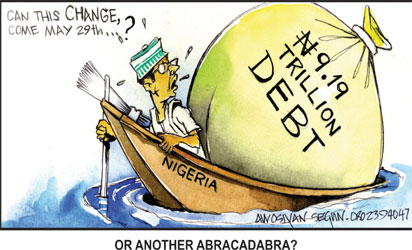
If the monetary authorities and stakeholders in the financial sector of the economy do not put measures in place urgently to curtail the increase in the volume of huge Non- Performing Loans (NPLs), the banking industry may experience yet another financial crisis capable of making some banks not to stay afloat. Data shows NPLs stand at about 3.3 per cent of the N13trillion industry credit with a set limit of five percent. This implies that NPLs in the country have only 1.7 percent to reach the limit.
 Sunday Vanguard, during a visit to some commercial banks in Lagos metropolis, gathered that some individuals and companies were rushing to pay banks their debts, while others, unable to pay immediately, were in the process of re-negotiating their terms of payment with banks to avoid being named and shamed on the pages of national newspapers. A top manager with First Bank, who spoke under anonymity, disclosed that aside corporate organisations and some states currently facing financial crisis, individuals political office holders in the country were also owing banks NPLs.
NPLs by states
However, the controversy surrounding the issue of NPLs in the financial system took a new dimension with the continuous increase in the amount involved.
Apart from the N490billion published last week, Vice President Yemi Osinbajo disclosed that the 36 states were indebted to deposit banks to the tune of over N685billion. This amount does not include the NPLs owed by business men in different sectors including oil and gas.
Debts by oil and gas companies
Aside investors in the real sector, corporate entities, individual public office holders and states, companies and individuals operating in the oil and gas sector are owing banks large sums of money. Some energy companies as well as power firms are said to be owing banks about N5 trillion. Our investigations revealed that the money includes funds obtained between 2013 and 2014.
Some oil marketers, who spoke with Sunday Vanguard, explained that oil marketers were making serious efforts to pay banks their debts, saying that some marketers defaulted in the payment because of non-payment of subsidy claims by government. “When most people are talking about fuel subsidy, what they do not take into consideration is that the oil marketers often borrow such money from banks to fund importation of refined petroleum products into the country. When products are imported into the country and the monetary claims are not paid by government as at when due, the interest on the money accumulates over time. You can see the problem oil marketers are facing also, because you cannot go and tell banks that you will not pay the money along with the interest as government did not pay you on time”, said an independent oil marketers, who spoke under anonymity.
The multiplier effect on other sectors: Some banks managers, who spoke with our correspondent, lamented that huge indebtedness was shrinking the resources of many commercial banks, making it very difficult for them to lend to manufacturers, investors as well as operators of Small and Medium Enterprises (SMEs) who need loans regularly to expand their operations. They stressed that with huge NPLs, banks may not be able to lend to the critical sectors of the economy where money is needed for developmental projects.
Expert’s perspective: In a chat with Sunday Vanguard, an entrepreneur and operator of SME in Lagos, Mr. Silas Kalu, explained that owners of SMEs are those who will be most affected by the financial issue in the country. He said, “The Central Bank of Nigeria (CBN) and other regulatory agencies in the financial sector must act fast to ensure that another financial crisis like what we experienced in 2009 fiscal year does not hit the sector again. Otherwise, the impact will be so severe. With the quantum of NPLs in the system, it is quite obvious that there is stress in the system already and something must be done to control it.
“Even before the issue of NPLs, banks were reluctant to give SMEs loan, and some that were willing to lend us money gave very stringent conditions, making it almost impossible for us to get loans. So, with what is happening now, it means SMEs may not be able to get credit facility for expansion and start-ups again. Some of us are away that the banking industry is experiencing some problems ranging from NPLs to over-regulation. Today, the industry is not competitive enough because only few banks control the entire sector. If you take time to study the activities of banks, you will realise that while many banks are declaring high profits, they are also retrenching their workers at the same time, meaning that something is wrong with the sector.”
Disclaimer
Comments expressed here do not reflect the opinions of Vanguard newspapers or any employee thereof.