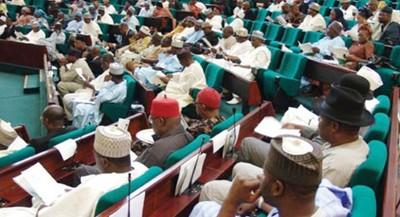
National Assembly
By Michael Eboh
THE Auditor-General of the Federation, Mr. Samuel Ukura, has blamed the rot and corruption in the oil and gas sector, as well as other critical sectors of the economy on the lack of political will by the country’s leadership, especially the National Assembly.

National Assembly
Ukura, who disclosed this at the African Network for Environment and Economic Justice, ANEEJ Roundtable on Oil and Gas Reforms, in Abuja, also lamented that the legal framework within which it operates is now obsolete.
The Auditor-General, who was represented by a Director in the Extra-Ministerial Audit Department, Mr. Rotimi Dada, disclosed that since 1999, none of the reports prepared by his office had been brought to the plenary sessions of the National Assembly.
He further noted that sanctions listed in the recommendations of its audits were rarely carried out, adding that all these had served to promote corruption in critical sectors of the economy, and therefore, became a hindrance in the discharge of its duties.
He said, “The legal framework within which we operate is a major challenge to our major activity, which is the auditing of the country’s accounts. The office of the Auditor-General of the Federation operates under the 1956 Ordinance, which has become obsolete.
“Since 1999, none of the reports of the Auditor-General has been taken to plenary. These do not augur well for our activities.” He also cited the lack of political will to implement the office recommendations as one of the major problems in the fight against corruption.
According to him, leadership problem was the cause of the huge losses suffered in the Nigerian oil and gas sector as well as in other critical sectors of the economy. Ukura called on Civil Society Organisations, CSOs, and other stakeholders to continue putting pressure on the relevant authorities on the need to implement the recommendations of its audit reports.
He further expressed optimism that with the current leadership and the quest to bring about change, there would be a significant deviation from what was obtained in the past. Also speaking, Mr. David Ugolor, Executive Director, ANEEJ, applauded the ongoing reforms in the Nigerian National Petroleum Corporation, NNPC, and the oil and gas sector in general.
“…we welcome these much-talked about reforms particularly in the area of production sharing arrangements, Joint Venture contracts, and the oil for product swapping currently going on; operations in the oil and gas sector that are conduits for siphoning billions of dollars,” he said.
He further lamented that one of the many outcomes of the mismanagement in the NNPC and in the sector was the large scale incidences of corruption and massive embezzlement among key players in the industry.
However, he said, “The role of Civil Society in engaging ongoing reforms in the oil and gas sector is crucial to ensuring the effective reversal of the resource curse phenomenon we have unfortunately found ourselves, even as the thirteenth largest producer of oil in the world and Africa’s leading oil producer.”
Disclaimer
Comments expressed here do not reflect the opinions of Vanguard newspapers or any employee thereof.