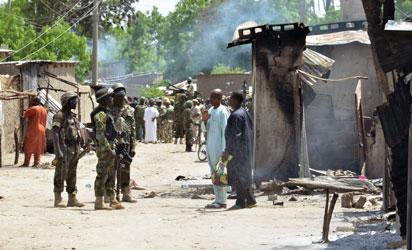
Soldiers speak to people standing away from houses burnt by Boko Haram Islamists at Zabarmari, a fishing and farming village near Maiduguri, northeast Nigeria, on July 3, 2015. Several female suicide bombers in northeast Nigeria blew themselves up amid panicked villagers fleeing a Boko Haram attack, killing scores, the army and witnesses said on July 4. The latest carnage in series of attacks that have claimed more than 200 lives in just three days happened on Friday night in Zabarmari village, 10 kilometres (six miles) from the city of Maiduguri, the birthplace of the jihadist group. AFP
By Jide Ajani
The promises were decidedly highfalutin – to sustain the momentum for change. Hopelessly unrealistic, though, were the expectations.But the reality today is disturbing, very disturbing.

Many have tried to ridicule President Muhammadu Buhari because he is seen as being too slow for the engagement of change that Nigeria requires. Some have said he hit the ground and refused to run; others have said he hit the ground and just sat there.
To be fair, the reality is that many Nigerians still underrate the quantum of challenges that awaited him while the campaigns lasted – Buhari is himself guilty of this because he did not have a panoramic view of the challenges he was plunging into when he kept making promises during the desperate campaigns to become President and Commander-in-Chief.
To be fair, a country that had been run for 16 years and has just been handed over to a new political party would need some time to adjust and come to terms with the challenges of governance. This is made worse when the country was almost run aground because of the sheer insensitivity, incompetence, lack of capacity and in some more bizarre instances the employment of vindictiveness as a directive principle of administrative policy.
In just 40days since taking over, President Buhari seems to be disappointing his ardent supporters who put their trust in him.
That said, some questions must be asked: What information did Buhari have in his possession when he made promises about ending terrorism in Nigeria in a matter of months?
What strategies were being worked on? How did he plan to execute his strategy of action against terrorism? These are pertinent questions in the light of the escalation of acts of terror in the last 40 days.
Just last month, Sunday Vanguard published a two-part expose on the dirty war on terrorism in Nigeria.
If the rate at which the insurgents have showed their hands in the last 10days is anything to go by, then Nigeria is in for a long season of terrorist activities.
But what are the facts about Jama’atu Ahliss-Sunnah Lidda’awati Wal Jihad, (Western education is evil), otherwise known as Boko Haram? How did this group of miscreants expand its frontier of terror? What does this band of criminals masquerading as fundamentalists feed on? How does it get its funding? What are the first steps to engage with a view to stopping them from spreading terror far afield? Is anyone still in doubt as to whether Nigeria is at war? And, sincerely, what can President Buhari do?
If truth be told, the political class including but not limited to people like Goodluck Ebele Jonathan and incumbent President Buhari should be held in vicarious terms for what has become of Boko Haram – and then you can add the politicians across the political divide.
In the case of Jonathan, he was President when, at infancy, members of the group demanded government’s action against those who took part in the extra-judicial killing of their leader, Muhammed Yusuf. As if Jama’atu Ahliss-Sunnah Lidda’awati Wal Jihad did not exist, the group was totally ignored. Jonathan and some leaders of the Peoples Democratic Party, PDP, were busy working out how to thwart their party’s zoning arrangement. It was not until December 2010 when the group began its heavy bombing campaigns that government took partial note. Today, the rest, as they say, is history.
For President Buhari, he did not, going by his political stature and voice of conviction, openly and vigourously condemn in the strongest terms, the activities of members of the sect in the very early days. The members of the sect also went after him and almost eliminated him. But some prominent Northern politicians who kept mute and sometimes celebrated the exploits of the group behaved as though it was a problem only for the Jonathan administration. Meanwhile, terrorism knows no tribe, religion or political party.
Worse still, there are reports of how some Nigerians sponsored a report to the State Department in America, campaigning against an FTO (Foreign Terror Organisation) status for Boko Haram. Some 25 scholars wrote to Hillary Clinton, then Secretary of State, just as one Johnnie Carson, an Under Secretary of State for African Affairs, argued before a congressional committee along the same lines. While some Nigerians saw the danger ahead, and pressed for an FTO status, even the Jonathan administration and some undiscerning Nigerians argued against such a status for Boko Haram. All these allowed the group to gain ground. That is not all.
These same hidden sympathizers of Boko Haram were the people who travelled abroad, working hands in gloves with fifth columnists within the military, got some edited video clips of real life combat between Nigeria’s gallant military men and these Boko Haram criminals but deceived Western nations that the military was on a genocide campaign. It was this convoluted reversal of context that Amnesty International (Al) partly based its report about Nigeria’s military on.
Yes, there may have been acts of rascality and overzealousness verging on the murderous by some officers, but to use the instrumentality of AI’s report to further damage Nigeria’s military institution is to open innocent military men to public scorn, an act which would dampen morale.
Those who ignorantly thought the problem was for the Jonathan administration alone are the same ones now making lame excuses on why the group has gone gaga.
But this is just the beginning except some urgent steps are taken.
Unintelligently, the PDP is attempting to pay back APC in its coin by creating the impression that the new wave of bombings should be employed for political mileage.
This is irresponsible.
Buhari may have made promises. An error on the part of Mr. President was the populist but unqualified decision to move the operational base of the military to the theatre of war in Borno. Whatever gains the relocation may have brought – if any really – the 444 number of deaths in 39days of the new administration makes a mockery of the whole exercise because fighting terror is not the same as chasing armed robbers on a particular street.
But that does not mean Nigerians should continue to harangue Buhari.
Indeed, the number of casualties on the Christian and Muslim side may not balance out because there are no exact statistics of how many Muslims of Christians have been killed by the gangsters.
Check links for more exclusive details of Boko Haram winning strategy
Boko Haram’s Winning Strategy (1)
Inside Nigeria’s dirty war on terror..
Disclaimer
Comments expressed here do not reflect the opinions of Vanguard newspapers or any employee thereof.