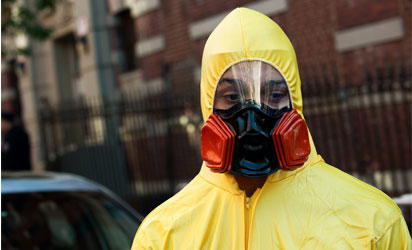
NEW YORK, NY – OCTOBER 25: A young man, dressed in a biohazard costume, stands on the corner of 546 West 147th Street on October 25, 2014 in New York City. After returning to New York City from Guinea, where he was working with Doctors Without Borders treating Ebola patients, Dr. Craig Spencer was quarantined after showing symptoms consistent with the virus. Spencer was taken to Bellevue hospital to undergo testing where he was officially diagnosed with the Ebola virus on October 23. Bryan /AFP
By Sola Ogundipe
British and Sierra Leonean researchers have called to question the norms set down by the World Health Organisation,WHO, on Ebola case definition after they established that it has a specificity of 31.5 percent, and that at least 9 percent of people that develop the Ebola Virus Disease, EVD, could be false negatives because they neither exhibited fever symptoms nor report any Ebola risk exposure.

A file photo taken on June 28, 2014 shows a member of Doctors Without Borders (MSF) putting on protective gear at the isolation ward of the Donka Hospital in Conakry, where people infected with the Ebola virus are being treated. Guinea announced on August 9, 2014 it was closing its land borders with Liberia, Sierra Leone over Ebola fears. AFP PHOTO
In a large study published last week in The Lancet Infectious Diseases, the researchers analysed data on 850 suspected and 724 lab-confirmed Ebola patients who presented to the holding unit of Connaught Hospital in Freetown from May 29 to Dec 8, 2014.
From their findings, they established that 83 percent of the patients reported fever or history of fever, 68 percent reported intense fatigue or weakness, 50 percent reported vomiting or nausea and 41 percent reported diarrhoea as the most common presenting symptoms in suspected cases.
False negatives
Based on data from these patients, the investigators found the sensitivity of the WHO case definition to be 79.7 percent, which means about 20 percent of true Ebola cases would be missed (false-negatives).
They found the specificity of the case definition to be 31.5 percent,, which means 68.5 percent, of patients who would be selected for admission would not actually have EVD (false-positives).
In a subgroup analysis, 15 (9 percent,) of 161 lab-confirmed Ebola patients reported neither a history of fever nor a risk factor for Ebola exposure.
The team also found that including these conditions increased the accuracy of the case definition: intense fatigue, confusion, conjunctivitis, hiccups, diarrhoea, or vomiting. A combination of three or more of any these symptoms tripled the odds of a confirmed Ebola diagnosis by yielding a sensitivity of 58 percent, and specificity of 71 percent,.
In a commentary, the researchers said: “The finding that 9 percent, of EVD cases had no fever or history of fever and no risk factor for exposure to the virus shows that existing case definitions that typically include criteria, such as the existing WHO case definition, have insufficient sensitivity to identify all cases of EVD.”
Further, the researchers say existing clinical criteria cannot discriminate Ebola from diseases like malaria and typhoid fever.
“A highly specific Ebola Virus Disease screening algorithm could reduce the risk of patient-to-patient transmission within holding units, which is a major clinical concern.”
Disclaimer
Comments expressed here do not reflect the opinions of Vanguard newspapers or any employee thereof.