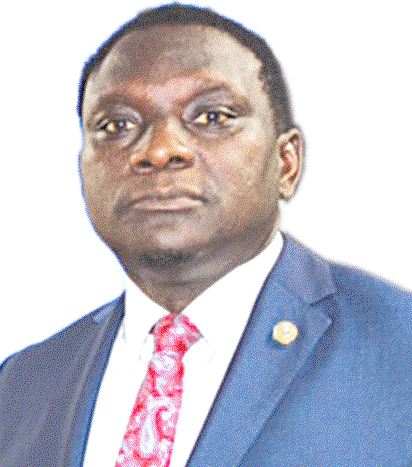
Oluwaseyi E.Abe
By Petetr Egwuatu
Mr. Oluwaseyi E. Abe, is the acting President of Chartered Institute of Stockbrokers, CIS. In this interview, he spoke on the activities of the institute as well as happenings in the capital market, among other things.
Excerpts:
The CIS has been playing a pivotal role in the engagement with the capital market regulators on the issue of recapitalisation of market operators. SEC has stated that September 2015 deadline remains sacrosanct? What is your view?

Oluwaseyi E.Abe
We are really working in collaboration with regulators and other stakeholders to ensure that the exercise is smooth. We succeeded in securing an extension of the recapitalization deadline. We are still at the fore front of engagements with the regulators to ensure that the interest of operators is protected. It will be pre-emptive to go beyond this information for now. But we are getting on well with the regulators.
There is the problem of negative reaction to the capital market as a fall out 2008 meltdown. What strategy is being put in place by the market operators to woo back investors into the market?
It is a multi-faceted approach: first, the investors must be educated and informed that our market has recovered, and that current price swings are normal. Second, the Nigerian Stock Exchange, NSE must fashion out a policy that encourages the licensing of more stockbroking firms to operate in the remote states and towns.
Third, corporate governance at all levels must be significantly enhanced. Fourth, the government also has a role to play in providing liquidity to stabilise the market. Finally, efforts should be stepped up to revitalise the primary market and promote new listings of local and foreign firms.
What is the institute’s major request from the new administration of President Mohammed Buhari?
Some of the issues we would want the new administration to give priority attention to include: Financing of major government projects, such as instance infrastructure, through the capital market, thereby moving from a largely bank-based to a capital market – based financing model; Supporting capacity building initiatives by funding appropriate professional groups such as CIS to carry out the task; Provision of a buffer stabilization funding arrangement for the capital market.
This can be done through AMCON, for instance; Putting in place policies aimed at channeling more savings to investment in the capital market. For instance the federal government should encourage Pension Funds, through PENCOM, to invest more in the stock market; Provision of appropriate incentives and legislation for companies to list; especially those in the major sectors of the economy; Consideration of the potential impact on the capital market whenever economic policies are formulated.
Any other comment for the investing public?
The public should be assured that the Nigerian capital market has fully recovered and it’s on the path of surpassing the previous high points. Domestic investors should therefore take advantage of emerging opportunities. However, investors need quality advice from qualified professionals. They must patronize only licensed stockbrokers that are eligible to trade. Investors must avoid patronizing quacks and when they are in doubt of the status of a stockbroking firm or a stockbroker, they can contact the institute for assistance.
For the teeming young Nigerians who wish to become finance and investment professionals, the time to take action is now. CIS certifications will open doors of opportunity to you, as they are some of the most attractive in the country, especially now that activities in the capital market are booming once more.
You presided over the Annual General Meeting (AGM) of the Chartered Institute of Stockbrokers (CIS) on April 30, 2015. What were the remote and immediate circumstances that led to the development?
The remote circumstances, if you want it that way was that our President, Mr. Albert Okumagba stepped aside due to issues relating to the oversight function of SEC as the apex regulator in the Capital Market on BGL, where he was Group MD/CEO. In view of this development, the Council met and unanimously agreed that I stepped into his shoe immediately to prevent a vacuum.
This is in line with our structure and the provisions of our Act. Recall that this was announced at the said AGM and in line with our openness, effective and professional communication procedure. The Institute also issued a Press Statement to the media, I am sure you are aware to forestall speculative reporting of the matter.
Could you relate the development to the relevant rules guiding the operations of the CIS?
Thank you. This question is similar to my earlier explanations. Our Institute has a clear structure for succession. Our rules provide that if the President cannot act for any reason, the First Vice President steps in. It is straight forward, and absolutely consistent with our procedures. That is exactly what happened.
At the AGM, it was announced that CIS has moved from losses spanning six years to profit. What are the critical success factors and how will these be sustained?
When our team led by Albert E. Okumagba took over the mantle of leadership in 2014, we put in place clear strategies designed to reposition the Institute. This achieved results in the following areas – debt recovery, higher income from self-financing activities, efficient cost management and control and support from other organisations that share our vision. Our Institute has what it takes to be at the commanding height at the global level of professional organisations and we shall continue to explore more opportunities through without losing focus.
As the man mandated by the Council to pilot the affairs of the CIS under the present situation, what is your immediate preoccupation?
I will continue to work with my team to consolidate on the gains we have recorded in the last one year, while further enhancing the profile of the Institute through new initiatives. Our members are quite supportive as they believe that CIS belongs to all of us. Our on-going efforts to expand membership base through a series of strategies would be pursued with renewed vigour.
We have signed Memorandum of Understandings (MOUs) with many organisations for aggressive marketing of our Professional Diploma in Securities and Investments as a way of attracting more youths into the programme. A lot of discussions are going on between the institute and some government parastatals for mutual benefits. As a good corporate citizen we are mindful of playing a pivotal role to support the government in tackling unemployment problems among our youths.
Disclaimer
Comments expressed here do not reflect the opinions of Vanguard newspapers or any employee thereof.