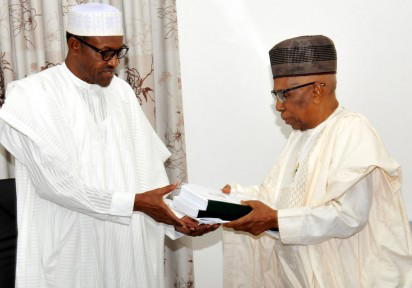
PRESIDENT MUHAMMADU BUHARI RECEIVING THE REPORT OF THE APC TRANSITION COMMITTEE FROM THE CHAIRMAN, MALAM AHMED JODA AT THE DEFENCE GUEST HOUSE IN ABUJA ON FRIDAY (12/6/15).
By Ochereome Nnanna
WHEN General Muhammadu Buhari emerged as the presidential candidate of the All Progressives Alliance (APC) I had my reservations. It had nothing to do with baseless ethnic, religious or North-South sentiments. My main point of concern was that if this politician emerged as president of Nigeria, we might be forced to go back to certain aspects of our history which we thought we had outgrown since the momentous annulled June 12 1993 presidential election.
Our history before that time was that of a country under the colonial-style grip by a section of it, the North. Buhari had been a central figure of it as a military head of state. During his time, the North was so dominant in our politics that for the first time in our history, the Head of State was a Northerner and Muslim, while his Deputy (Chief of Staff, Supreme Headquarters) was also a Northerner and Muslim. No pretence was made whatsoever about the need to balance the scales. Part of the reforms put in place after the June 12 election was to enshrine the principle of Federal Character in the constitution and split Nigeria into six unofficial geopolitical zones to ensure that every section was given a sense of belonging in power sharing.

PRESIDENT MUHAMMADU BUHARI RECEIVING THE REPORT OF THE APC TRANSITION COMMITTEE FROM THE CHAIRMAN, MALAM AHMED JODA AT THE DEFENCE GUEST HOUSE IN ABUJA ON FRIDAY (12/6/15).
During Buhari’s first time, the Nigerian economy was operated mainly by the state. The 1979 constitution gave the federal government the power to manage the economy of Nigeria on behalf of the states, which it then spoon-fed and still does till date. The Federal Government owned so many state monopolies, such as Nigerian National Petroleum Corporation (NNPC), National Electric Power Authority (NEPA), Nigerian National Shipping Line (NNSL), Nigeria Airways, Nigerian Telecommunications Ltd (NITEL), and so on.
Every year, the federal government budgeted huge sums of money to subsidize these ponderous, corrupt, inefficient and unproductive state monopolies. It took General Ibrahim Babangida, who listened to the ideas proffered by Dr Kalu Idika Kalu, Chief Olu Falae and Dr Chu SP Okongwu as Finance Ministers, for the economy to be deregulated and eventually largely privatised. Today, the only one of those monopolies still standing is the NNPC and its comatose refineries.
When Buhari won the election and appointed Dr Ahmed Joda as the Chairman of his Transition Committee, my worries of our drift back to the past were stoked. Joda, one of General Yakubu Gowon’s Super Permanent Secretaries more than forty years ago, was to the federal bureaucracy what Buhari and others were to the Nigerian Army. They represented the interest of the North in the federal government and played leading roles in concentrating political and economic powers at the centre for effective Northern control and benefit.
I was not too surprised, therefore, when online blog, Premium Times, claimed it had the “full version” of the Joda Transition Committee Report which was presented to President Buhari in June 2015. Part of the recommendations, according to the paper, was that our local private airlines should be merged into a “national carrier” and operated under the public/private partnership (PPP) model. It was their own way out of the huge indebtedness of the airlines to the Assets Management Corporation of Nigeria (AMCON) and the banks.
If Buhari accepts and implements this recommendation, the consequences are obvious. We would return to state ownership, if not monopoly, of the airline industry after paying a massive price to exit from it starting from thirty years ago. In a PPP arrangement, whoever controls the 51 per cent controls the business. If the Federal Government is given 51 per cent share, we could see a re-enactment of the Nigeria Airways misadventures.
But this time, government freeloaders will take down other people’s investments and sweat that have sustained the industry since the collapse of Nigeria Airways. If it goes to the private sector with a crowded field of investors from Arik Air, Aero Contractors, Peace Air, Azman Air and what have you, how do you control the conflict of interests to optimise the benefits of the merger? What is the guarantee that this will help repay the debts owed AMCON?
Besides, mergers between private companies are never compelled in any sensible economy. Companies opt to go into mergers to leverage on the strengths of the merging partners and minimise the negative effects of their weaknesses. For instance, it was the voluntary merger of Standard Trust Bank (STB) and the United Bank for Africa (UBA) that produced today’s UBA, a global bank. UBA gave its name and huge national network to the merger, and STB gave it its colours and Executive Chairman, Tony Elumelu. Businesses are not like government ministries and departments you just whimsically merge and damn the consequences; the consequences can be outright damning.
The argument that our airlines are debt-ridden may have its merits, but that is no excuse to take primitive decisions to forcefully merge them. All over the world airlines constantly need financial support. Since the global economic meltdown of 2007/2008, the US, UK, Kenya, Ethiopia and Nigeria, among a host of others countries, have intervened to save airlines in their economies with financial support. In any case, debt is part of business. If Arik Airline, for instance, is to continue to operate their unique, brand new planes, they need constant credit because inputs are dollar-denominated and sourced internationally. So do the others.
And if the idea, as the Joda Panel observed, is to make the product of such a merger the largest airline fleet in the West African sub-region, Arik and Aero already cover the region satisfactorily. In addition, Arik flies Nigeria’ flag to London, New York and South Africa. What our indigenous investors need is encouragement and support, not politically-motivated sliding tackles and an uncertain operating atmosphere.
We should copy the best practices that make even less fancied economies thrive, especially in an aviation sector that operates on a single, worldwide regulatory model. We should stop using the instrument of governance to enforce our narrow, ulterior and unpatriotic political desires to the detriment of the general good of the country.
Buhari should take us to a rosier, happier future, not back to the ugly, unsavoury past.
Disclaimer
Comments expressed here do not reflect the opinions of Vanguard newspapers or any employee thereof.