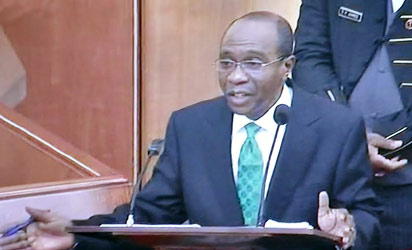
Mr Godwin Emefiele answering questions during his screening by the Senate for Central Bank Governorship in Abuja on Wednesday
By Emeka Anaeto, Economy Editor
LAGOS— THE Central Bank of Nigeria (CBN) may be saving the economy about $16.4 billion or N3.24 trillion from the new foreign exchange policy it introduced last week.
The amount represents the value of the 41 items which new forex policy had eliminated from all the major forex windows.
According to the economic research report of FSDH Merchant Bank Plc, the sections of the product lines eliminated by this policy represent about 37.29 per cent of the manufacturing sector Gross Domestic Product (GDP). It also represents about 50.62 per cent of the total foreign exchange sold at the CBN window in 2014.
Some of the items declared not eligible for the forex window includes rice, cement, margarine, palm kernel/palm oil products, vegetable oil, meat and processed meats products, poultry (chicken, eggs, turkey).
Others are private airplane/jet, fish and tinned fish, cold rolled steel sheets, galvanized steel sheets, roofing sheets, metal boxes and containers, enalwares, steel pipes, wire rods, iron rods and reinforced bars and steel nails.
Also in the list are plywood boards, wooden doors, furniture, toothpicks, glass and glass wares, kitchen utensils, textiles, plastic products, soap and cosmetics, tomatoes/ tomatoe pastes among others.
CBN stated that the exclusion of the items was necessary to sustain the stability of the foreign exchange market and ensure the efficient utilization of foreign exchange and the derivation of optimum benefit from goods and services imported into Nigeria. It added that the implementation of the policy will help conserve foreign reserves as well as facilitate the resuscitation of domestic industries and improve employment generation
The apex bank also stated that the importation of these items are not banned, thus importers wishing to import these items shall do so using their own funds without any recourse to the Nigerian foreign exchange markets.
The analysts at FSDH are of the opinion that if the policy is effectively implemented, the total manufacturing industry will receive a boost, the foreign reserve would rise and may have a positive impact on employment generation in the long run.
Disclaimer
Comments expressed here do not reflect the opinions of Vanguard newspapers or any employee thereof.