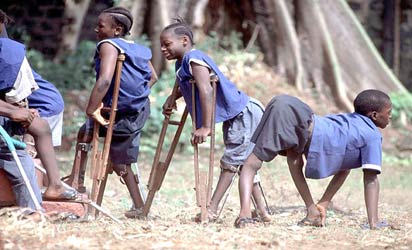
Polio kids victims
By Oyewale Tomori
This month – July – was a very auspicious month for Nigeria in 2014. Two health related occurrences took place in that month. On Sunday July 20 2014, Patrick Sawyer flew into Lagos airport, a sick man with Ebola Virus Disease. He died five days later, but not before infecting other people – his primary contacts -health workers who took care of him and who subsequently infected other people.
 By the time Nigeria was finally declared free of the disease, 20 people had been infected with eight of them dying from the disease, and spent three months tracing nearly 900 contacts.
The second health issue occurred far away from Lagos. On July 24, 2014, a day before Patrick Sawyer died, a one year old child in Sumaila LGA of Kano State had an onset of a disease later confirmed to be polio.
Last case of polio
This has been the last polio case confirmed in Nigeria for the past one year. Never has Nigeria gone on for so many months (12 months) without reporting at least one case of polio. The last time we went free of polio was for only 3 months between May and July 2014.
If we get our acts together and maintain zero polio case until the end of July 2015, the Nigeria will be removed from the list of polio endemic countries, that is, countries that have never interrupted polio transmission.
Do not expect WHO to remove out country from the ignoble list of polio endemic countries, until another late August or early September 2015, by which time all of the samples collected on or before 24 July this year, would have been tested and found negative for polio.
Delisting from polio endemic countries is only a step towards Nigeria being declared a polio free nation. This will only happen if we report no polio case for another two years, that is, after July 2017. So let us not bring out the drums and the palm wine tumblers in premature celebrations.
Questions: This leads us to three questions. First, why did it take us so long to get to this stage, making us one of the last three polio endemic countries in the world? Second, what did we suddenly do to achieve the current status, and third and more important, what must we continue to do to ensure that we finally reach polio free status in 2017 and forever?
During the five-year period between 2005 and 2009, the total number of reported polio cases in Africa was 4,039 and Nigeria alone accounted for 3,729 (92 percent) of the African cases. This number is far above our contribution to Africa’s population- I think we boast that there is a Nigerian for every five Africans; this time Nigeria was contributing more than nine out of every 10 polio cases in Africa.
In addition to the sub-optimal performance of the national immunisation programme and the poor routine immunisation coverage, the main stimulus for our poor performance was the call in 2003, for the boycott of anti-polio vaccination in northern states because of suspected contamination of the polio vaccine with anti-fertility steroids.
The call was made by a front line medical practitioner and a prominent member of the Supreme Council for Sharia in Nigeria (SCSN).
The resulting boycott brought a wobbling national polio eradication programme to a total collapse as the average annual number of reported polio cases increased from 400 (between 1998 and 2002) to 750 cases after the call.
Frantic national and international efforts were made to end the boycott. This included the adoption of a resolution in 2008 at the 61st WHA, calling on Nigeria to reduce the risk of international spread of poliovirus by ensuring that all children in the north of the country are vaccinated against polio.
Polio eradication
This special mention of Nigeria – a naming and shaming- at a global level, appears to have moved Nigeria in the right direction for achieving polio eradication. A series of activities, including a change in the leadership of the agency charged with polio eradication in Nigeria, engagement of traditional and community leaders, civil society organisations, women groups, and encouraging the community to “own” the eradication initiative began to yield positive results.
These activities were further strengthened by ensuring adequate and efficient implementation of detailed immunisation micro plans, improved monitoring of staff and their activities through the use of modern communication gadgets and systems.
Input: Another input that enhanced the performance on the field included the institution of an accountability frame work for all stakeholders and partners (Federal and state governments, LGAs, international development partners, NGOs, and members of the community).
Individuals, not the system or the organisation were held responsible and accountable for their performance – commending good performance and sanctioning poor performance at each and every level. Of note was the intervention of the Bill and Melinda Gates Foundation (BMGF) which sponsored a leadership challenge for State Governors to encourage, assure and improve their leadership and “ownership” of, as well as commitment to eradicating polio and improving routine immunization services at State and LGA levels. The initiative was supported by the NPHCDA, Federal Ministry of Health, and the WHO, and managed by the Secretariat of the Nigerian Governors’ Forum (NGF). The establishment of Emergency Operations Centres (EOCs) at Abuja and in six Northern states contributed significantly to the success recorded in the last 2-3 years.
The EOCs were designed to serve as central command and control facilities for government and non-governmental agencies to be able to respond in real-time to a polio outbreak in key endemic states and coordinate prevention activities, provide modern technology to health workers, and offer a common place for agencies and organizations to pool resources and participate on projects together.
Deployment of EOC system
One positive outcome of the establishment of the EOC was the deployment and use of the EOC system to control the 2014 Ebola outbreak. Funding for the EOCs were provided by the BMGF and supported by the Dangote Foundation
Apart from the 2003 setback arising from the boycott call, Nigeria was never really serious about polio eradication. Until we had special “negative” mention at the WHA, polio eradication was conducted in typical laissez affaire fashion. The attitude of the government was at best nonchalant, often taking external stimulus and “push” from external agencies -, WHA, BMGF, UN Rotary for our government to act. It is inconceivable to think that State governors needed a BMGF sponsored initiative to challenge them to politically commit to, and provide necessary funds for eradicating polio and improving immunisation services in their states.
The BMGF Governors leadership challenge ran for two years from 2013 and 2014. While it lasted polio eradication and routine immunization featured prominently in the discussion of the Governors’ Forum. The fracture in the Forum led to a drop in political and financial commitment to polio and a premature declaration of Nigeria’s polio free status at election campaign rallies.
Sustained commitment
Unless we get sustained and real commitment for polio eradication and routine immunization at all levels of government, there is no guaranteed that we can keep polio out of Nigeria in the next 2 years to attain the polio free status. Stopping polio is a massive operation that requires meticulous coordination from top to bottom to succeed. Our progress against polio over the last few years has been a combination of this grand coordination and small-scale detail. Achieving polio free status in 2017 and maintaining the status require more massive efforts. We still have some distance to go to polio frees status. How far depends on what we do from now on. We must continue to stress that the end of polio is only in sight, and at the end of a two year tunnel. Twice in 2007 and 2011 when we shifted our focus from polio eradication to eradication our political opponents during electioneering campaigns, polio resurged. Insecurity in the northeast part of the country has left many settlements in the area inaccessible to health workers. A recent case of circulating vaccine-derived poliovirus (cVDPV) – a very rare form of the virus mutated from the vaccine that emerges in under-immunized populations – shows that polio vaccination rates in Nigeria are still not high enough. Therefore we cannot afford to be complacent. We must build on the achievement of the past government, so that Nigerian can be declared polio free during the watch of the current government. Therefore the Buhari government must sustain political commitment to eradicating not only polio, but also controlling other infectious diseases that still plague our country- Lassa fever, Yellow Fever, Avian flu and many other yet unknown diseases. Adequate funding must be provided to sustain and expand the operations of Emergency Operations Centres currently functioning in seven locations in Nigeria. Every state must have such an EOC adequately funded and managed by qualified staff. We must provide adequate support for state epidemiology divisions for efficient disease surveillance and response.
Laboratory confirmation
One major contribution to the rapid control of Ebola in Nigeria in 2014 was the ability of the two labs in LUTH and the Redeemer’s University to provide laboratory confirmation of the cases. However these laboratories, including the Irrua Lassa Fever Institute continue to function only because they receive external support and funding. None of the other nationally supported laboratories is able to provide confirmed diagnosis for any of the currently existing viral hemorrhagic pathogens. Nigeria cannot successfully control disease outbreaks, until it commits to funding and supporting her laboratories.
We have learnt of the positive contribution of traditional, religious and community leaders to the success recorded by Nigeria in polio eradication. We must continue to involve and actively engage them until we are finally declared polio free, and ensure their support for other healthy intervention initiatives. Health workers must take responsibility of their action and strive to build the trust of the community, especially the parents, through education and provision of appropriate information which will enable them accept government health interventions and understand why it is so important for them and their children to enjoy good health.
Our new government has the chance to end polio forever, but only if it remains focused on eradication and dedicates the necessary resources to improve campaign quality, intensify surveillance measures.
We must do all we can to make sure that the last polio case with onset on July 24 2014 in Sumaila LGA of Kano State is the last polio case in Nigeria forever.
Prof. Oyewale Tomori is President, Nigerian Academy of Science and Chairman Expert Review Committee on Polio Eradication and Routine Immunisation.
Disclaimer
Comments expressed here do not reflect the opinions of Vanguard newspapers or any employee thereof.