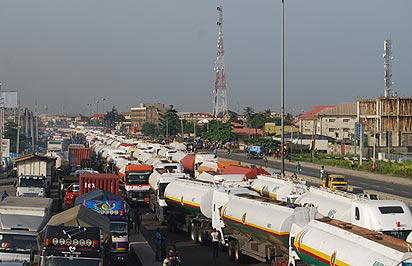
File photo of fuel tankers at Mile 2 end of Oshodi-Apapa Expressway, Lagos. PHOTO: Joe Akintola, Photo Editor.
Mr Ayodeji Peter Oyedokun was the General Manager of Lagos State Traffic Management Authority (LASTMA) and a pioneer member of the Federal Road Safety Commission (FRSC). The incumbent Chief Executive Officer, Lagos State Drivers Institute, in this piece, addresses ‘At Work Road Crashes’.
Occupational Road Traffic Crashes or At Work Road Crashes are crashes that occur while driving / traveling in an organization’s vehicle on duty.
Road traffic crashes in Nigeria are not limited to official duty vehicles and travels. More occur with private individual drivers and public commuters, where more lives are usually involved. Nigeria is reputed to rank second, 191 out of 192 countries in the world with un-safe roads with 162 death rate per 100,000 population from road traffic accident. An average of 11 people were killed daily in road accidents across Nigeria in 2012 (FRSC).
Few organizations including governments know what road crashes cost them. The true costs to organizations and governments are always higher than the resulting insurance claims where they exist, lost time in wages and salaries; output; administrative costs, legal fees; and costs due to other kinds of interruptions may not be recoverable. Road crashes can also have a negative impact on staff morale and can damage the organization’s brand. These costs will not be recovered from insurance claims, and therefore, will directly reduce the organization’s profit or financial surplus.
Organizations can rarely, if ever, solve their safety problems by simply introducing ‘one off’ measures following crashes such as sacking of driver or other punishments and or penalties. This reactive approach fails to investigate why crashes were not prevented in the first place and does not address underlying weaknesses such as vehicle condition, drivers’ competence, drivers’ schedules, drivers’ physical and mental conditions which, if not remedied, will sooner or later give rise to further crashes.
Monitoring Compliance
Adopting a proactive approach to controlling road traffic crashes will only be possible if all organizations have robust road safety management systems in place based on acknowledged good practice.
These include but not limited to having a clear policy statement, which would be communicated to all drivers, setting safety direction and general objectives. Organizations also need to have a planned approach to road safety, with performance standards for eliminating or controlling risks, based on risk assessment and with clearly prioritized and time based targets for implementation
In solving or reducing losses due to road crashes there is the need to, within the organization’s level provide adequate means to measure road safety performance, both actively by monitoring compliance with standards and reactively by investigating the causes of crashes, incidents and near incidents. This will go side by side with the development of appropriate procedures for reviewing performance against targets, auditing road safety management processes and feeding back information and experience to further develop policies and improve performance.
Many organizations that had hitherto operated transport services for the distribution of their products or services had abandoned this and have outsourced such responsibilities to contractors or service providers due to losses from road crashes and man-hours. In as much as this could be the right way to go, the organizations have not followed up with monitoring and evaluation processes, to ensure compliance with standards and this has resulted in increased fatalities and severe injuries in our Highway Transportation System. Majority of these providers whom this responsibilities have been outsourced to, cut corners or set their own safety (unsafe) standards to reduce costs of transportation business, to make more profit at the expense of the driver and other road users in Nigeria.
Towards crash site
The haulage sector in the Nigerian highway transportation environment happens to be guiltier in the area of failure to monitor and ensure compliance with road worthiness requirements and other safety standards of their vehicles. Even when enforcement is lacking it will be beneficial to all stakeholders to ensure safety through voluntary compliance to the expected minimum safety standards of vehicle road worthiness conditions. On the part of government it is very sad that in a country that transports most (above 90%) of her cargo by road, road worthiness of vehicles is tied to the ability to show revenue receipts to law enforcement officers as a proof of being certified fit, even though a novice in engineering will notice worn-out tires and defective structures in the vehicle. These vehicles pass through all law enforcement agencies on our highways towards their crash destinations. At worst, when such vehicles are apprehended, they are booked and left to continue their journey towards their crash site. A vehicle that is not roadworthy should be impounded till repairs are effected to prevent loss of lives and properties. If there is any law or operational procedure limiting law enforcement officers from removing or stopping these ‘crash-waiting-to-happen-vehicles’, such should be amended in the interest of Nigerian road users, who bear the brunt on a daily basis.
The attitude of employers of drivers towards capacity building of this category of workforce is nothing to write home about. To most employers, drivers are not responsible, drivers are difficult to handle, drivers are recalcitrant and so on. They fail to recognize the potency of capacity building in achieving a disciplined, competent, well-motivated and responsible set of drivers. It has been proven that organizing ordinary driver training exercises regularly will reduce road traffic crashes attributable to human errors to between 30 to 70%. Investing in driver training and retraining is a very good step towards protection of lives and properties. Employers of drivers need to pay more attention to the drivers’ physical and mental condition. From the records available at the Lagos State Drivers’ Institute 12% of drivers have issues with their vision and as such need to use visual aids while driving. Driving is all about seeing and being seen, no matter how competent, a driver with bad eyesight is a crash waiting to happen.
In conclusion, drivers in organizations need to be well treated like other employees, improved welfare conditions, boost morale and productivity. These with other factors such as responsible number of driving hours, good condition of service, regular training and retraining, rewards and recognitions will improve safety performance and better productivity of drivers within an organization.
Disclaimer
Comments expressed here do not reflect the opinions of Vanguard newspapers or any employee thereof.