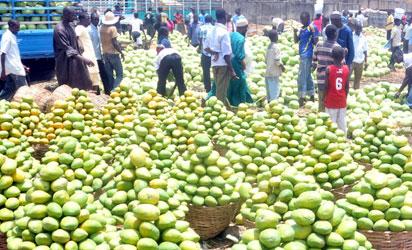
Mangoes flood Zuba Fruit Market in Abuja on Friday (13/4/12). There Is Need to Preserve Our Seasonal Fruits. NAN Photo
By Michael Eboh
The new administration of President MuhammaduBuhari will have a lot to contend with over the next couple of months, as PriceWaterhouseCoopers, PwC, has raised fresh alarm that if crude oil price averaged $45 per barrel in 2015, Nigerian would be plunged into serious economic and financial crises.
 According to its Economy Report titled:”What next for Nigeria’s economy? Navigating the rocky road ahead,” PwC said that in the scenario of crude oil price falling to $35 per barrel and averaging $45 per barrel in 2015, government revenue will decline drastically, while the country risked another financial crisis.
However, the report noted that the Nigerian economy will continue to grow, adding that a more resilient long term economic model is needed. It added that despite the uncertainties generated by the volatility in oil prices and the significant drop in government revenue, the Nigerian economy will continue to grow, even if oil prices fall to $35 per barrel and average just $45 per barrel in 2015, provided there is no deterioration of the political and security landscape.
The current average crude oil price between January and April 2015, according to the Organisation of the Petroleum Exporting Countries, OPEC, is $52 per barrel.
PwC said, “As price and production projections disappoint, government oil revenues fall to levels not seen since 2003. Taxes become difficult to collect as some parts of the country become unreachable. Combined with difficulties administering tax collection from unstable parts of the country, we would expect the federal government to fall over three months behind on paying employee wages and government bond yields on dollar debt could approach 20 per cent.
“All revenue that is collected is diverted to bolstering the military’s resources. The sharp slowdown in revenues sees both state and federal government grind to a halt as the majority of workers go on strike after going unpaid for over three months. “Pressure on the banking sector mounts as loans to state government and the oil and gas sector default. This sees non-performing loans rise to the 25 per cent-30 per cent levels seen during the 2008-2009 banking crisis.”
PwC also projected that if the low crude oil price persisted, Nigeria’s crude oil production would fall by 15 per cent through bunkering and other supply disruptions, adding that gross oil revenues would fall to a third of their 2013 level. Continuing, it said that corporate borrowing would become prohibitively expensive as banks will only extend loans against safest assets.
The report said: “The Central Bank of Nigeria, CBN, becomes the last fully-functioning public institution. It is forced into a severe devaluation of 70-80 per cent as the majority of planned Foreign Direct Investment, FDI, projects are cancelled and capital outflows accelerate as some foreign multinationals start to wind down local operations.
“Capital controls are imposed in 2016 to stop the exchange rate falling further. As a result of these interventions, the Central Bank loses control of interest rates. “Production in the non-oil sector will be severely disrupted, as the market exchange system fails as social unrest takes hold. As significant price increases hit the real economy, consumers and businesses wind down spending to subsistence levels.”
Commenting on why further fall in the oil price even to as low as $35 per barrel will not slow the economy, Partner and Chief Economist at PwC Nigeria,Dr. Andrew Nevin, said, “Despite oil’s importance to Nigerian exchequer, the real economy is largely insulated against falling oil prices. This is driven by the fundamental structure of Nigeria’s economy and how the oil and public sectors interact with the non-oil sector.
“Four points come to mind here. First, the oil sector’s importance in the economy has been falling over time. In 2013, the oil sector contributed 11 per cent of the Nigerian GDP, in comparison to a peak of 48 per cent in 2000.
“Clearly, the growth of large services and agricultural sectors has fuelled economic development, with active fiscal and monetary policies encouraging this trend. Secondly, Oil sector workers account for less than one per cent of total employment, with a high proportion of expatriates. And much of the oil supply chain is based abroad.
Disclaimer
Comments expressed here do not reflect the opinions of Vanguard newspapers or any employee thereof.