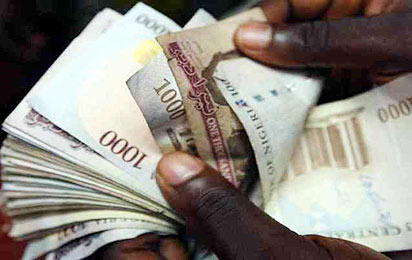
Naira
By Babajide Komolafe
In spite of economic realities, the Central Bank of Nigeria (CBN), for obvious reasons, is trying hard to avoid another devaluation of the naira. Consequently, it imposed further restrictions on the foreign exchange market by excluding 41 products and services from purchase of dollars from the nation’s foreign exchange market.
 “For the avoidance of doubt, please note that the importation of these items are not banned, thus importers desirous of importing these items shall do so using their own funds without recourse to the Nigerian foreign exchange markets”, the apex bank said in a circular issued on Tuesday.
Though the CBN said that the purpose of the restriction is to conserve the nation’s foreign reserves, which has fallen by $10.59 billion from $39.62 billion in September to $29.03 billion last week, and promote local production of the products, analysts at the Financial Derivative Company argue that the main reason might be because another devaluation will impose further hardship on Nigerians
“The previous devaluation coupled with fuel scarcity has eroded disposable income. Further devaluation of the currency will increase the burden on the Nigerian public, “they stated in the Bi-monthly Economic Bulletin issued last week.
Devaluation after restrictions
The CBN has devalued the naira twice between November and February. On Tuesday November 25th last year, the CBN announced an 8.4 percent devaluation of the Naira, moving the official exchange rate band from N155 to N168.
This was followed by an indirect devaluation on February 17th, when the apex bank announced the abolition of the official foreign exchange market, directing all foreign exchange demand to the interbank foreign exchange market. But each of these devaluations has been preceded by a set of restrictions imposed on the foreign exchange market, in a bid to avoid devaluation.
For example, prior to the November 2014 devaluation, the CBN imposed a two day restriction on utilisation of its intervention dollars. It also limited the margin on sale of such dollars to 10 kobo, and banned banks from selling them to bureau de change operators.
This was followed by the exclusion of importation of generators and some items, including invisible transactions from purchase of dollars from the official foreign exchange market. The implication is that importation of these items would not be funded with foreign exchange purchased from the bi-weekly Retail Dutch Auction System (RDAS) sessions conducted by the CBN but from foreign exchange purchased from banks.
Furthermore, prior to the February devaluation, the CBN on December 17 reduced banks’ foreign exchange trading position to zero from one percent of shareholders’ funds. This was followed by a 48 hour limit imposed on utilisation of foreign exchange purchased in the interbank market by banks’ customers.
These restrictions were however ineffective in saving the naira from the February devaluation, rather they increased uncertainty and undermined confidence in the future value of the naira as well as encouraged sharp practices in the foreign exchange market.
Impact of new restrictions
The restriction announced Tuesday last week is expected to have similar effect. According to a retired top management staff of CBN, the exclusion of the importation of the 42 items from the nation’s foreign exchange market will only heighten uncertainty and flight of foreign investors from Nigeria. “Mark my word, the naira will crash.
The policy will increase sharp practices. People will claim to purchase foreign exchange for items not excluded, but will use it to import the excluded items. Remember our ports are very porous, with prevalence of sharp practices. The CBN cannot monitor what people import or use the dollars to purchase. As a result, sharp practices will abound,” the retired staff told Vanguard on condition of anonymity.
A senior bank foreign exchange dealer also said that while the restriction might reduce demand for dollars in the interbank market, it would certainly increase demand for dollars in the black market, hence the black market exchange rate is expected to rise, and the gap between it and the interbank rate widen further.
The policy, according to Alhaji Aminu Gwadabe, Chief Executive Officer, Sabil BDC, has further created room for speculation and hoarding. He noted that already parallel market exchange rate has risen to N226 per dollar on Friday from N220 on Monday, thus increasing the gap between the parallel market and the interbank market to N28.59 from N21.35 within five days.
On their part, analysts at Afrinvest Plc said that the restrictions lack the ability to stimulate domestic production of the products excluded, and will lead to further devaluation of the naira. “We note that the capability of these restrictions to stimulate domestic production of the excluded items, as suggested by the CBN depends to a large extent on too many variables outside the CBN’s purview”, they stated in the Afrinvest Weekly Update issued on Friday.
“Structural weaknesses and infrastructural constraints which strains competitive local production and the rigorous discipline and tight border control needed to implement import substitute strategies are vulnerabilities yet to be addressed. In our view, these factors will continue to dissuade the long-term benefits of this restriction until conscious structural reforms by fiscal authorities and supportive monetary policies are directed towards addressing the weaknesses.
“Pressure at the interbank foreign exchange market is expected to ease while the transferred effect will become visible at the BDC and Street segments as importers re-direct demand. Hence, we perceive this as yet another dodgy devaluation of the Naira as we expect the spread between FX rate at the interbank and BDC/Street market to widen markedly.
This may further pressure inflation rate and Banks’ trading income due to further reduction of interbank liquidity. In addition, revenue from custom duties may be limited even as higher spread between interbank and BDC/Street market may further incentivize sharp practices.”
These predictions imply that the latest restrictions aimed at saving the naira may end up doing more harm to the economy than good. While the restrictions may help to conserve the nation’s foreign reserves, as posited by the CBN, it would definitely promote sharp practice in the foreign exchange market.
Further, in the short term, rather than stimulate local economy, it would lead to increase in the prices of the excluded items, and hence aggravate the deteriorating inflationary situation. Consequently, the restrictions, for now, represent the most convenient policy choice from a regulatory perspective, but like previous restrictions, it might turn out to be another attempt to avoid the inevitable.
Disclaimer
Comments expressed here do not reflect the opinions of Vanguard newspapers or any employee thereof.