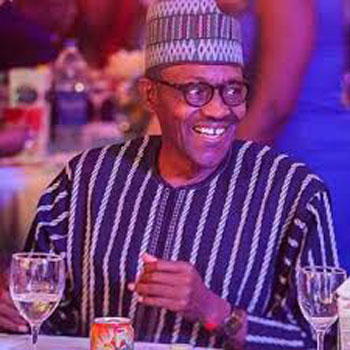
Buhari
By Zik Zulu Okafor
It was on April 27, 2015. The Nigerian Ports Authority (NPA) sent a simple, concise but corrosive letter to sea ports operators.
This letter carried a directive from the immediate past President of the Federal Republic of Nigeria, Dr. Goodluck Ebele Jonathan.
This directive carried two confounding instructions. The first is that the management of LADOL Integrated Free Logistics Zone Enterprise should relocate its present US $500 million fabrication and integrated yards currently going on in Apapa, Lagos State, to Agge, in Bayelsa state. Perhaps well aware that Bayelsa state does not have the facilities to accommodate the massive Egina FPSO Project, the directive added that, “it can be conveniently located at any dedicated Oil and Gas terminal”. And the only designated oil and gas terminal is Onne Ports, controlled by INTELS.

Buhari
The second point in the curious directive, signed by one Engineer David Omonibeke, Executive Director, Marine and Operations, decreed that all oil and gas related cargo must be handled only at the designated terminals at Onne, Warri and Calabar ports. It is very important to note that these three designated ports are controlled exclusively by INTELS.
This was one directive that convulsed the maritime world, staggered the sea ports operators and indeed shocked all stakeholders. And the reason is simple. The government has a subsisting contract it signed with the terminal operators through NPA and the Bureau of Public Enterprises (BPE) which serves as the confirming party.
This contract states in crystal terms in Article 18.2 that “No change, amendment, or modification of this agreement shall be valid or binding upon parties hereto unless such change, amendment or modification shall be in writing and duly executed by the parties here to.”
No consultation
But the former President and his men at the Federal Ministry of Transport and NPA did not hold any form of consultation with the sea port operators before making this policy statement that represents a crass violation of the agreement and subjects Nigeria to outrageous infamy before the global business community as a nation of uncivilized people without respect for simple agreements.
But Jonathan’s directive is only an incongruous climax to a thriving illegality that has endured for years.
Take, for example the case of Ports and Terminal Operators Nigeria Limited (PTOL), an indigenous registered company and the concessionaire of the multi-purpose Terminal A, Port Harcourt Port.
Discriminatory implementation of Lease Agreement
In a letter to the Attorney General of the Federation, the Managing Director, Mrs Lizzie Ovbude had decried “the wrongful, illegal and discriminatory implementation of the Lease Agreement by the Federal Ministry of Transport and NPA by the diversion of vessels meant for Terminal A in Port Harcourt in the last three years to Onne Ports under the illegal classification of vessels as oil and gas related cargoes, to Integrated Logistics Nigeria Limited (INTELS), a concessionaire at Onne Port …..”
Some of PTOL diverted vessels, leading to loss of clientele and debilitating financial losses to the tune of millions of dollars and naira include MV Kota Berlain MV Kota Bakti and Cosco Jing Gang Shan .
Groaning in pains at the crucible her organization was faced with, Ovbude employed every possible administrative and legislative means to bring the authorities to see her plight. But her appeals could not penetrate the carapace of their conscience. With no alternative, left, she headed to the court to seek redress for the crude violation of their Lease Contract.
Interlocutory injunction
Indeed, a Federal High Court in Lagos did not waste time in granting PTOL an interlocutory injunction restraining the government, NPA and their agencies from “diverting MV Industrial Faith and MV Kota Budaya BYA Q03 and or any other vessel as may be scheduled to berth at their terminal”.
Jonathan’s directive of April 27, 2015, was therefore something of an ugly stamp of approval to a ritual of illegality. By that singular action, the former President practically endorsed the enthronement of monopoly in the nation’s maritime industry. This was a retrogressive economic agenda that his two predecessors in office, Olusegun Obasanjo and Umaru Musa Yar’Adua, had condemned and rejected for running against one of the critical reasons for the port reforms which is to increase efficiency through promoting fair competition.
But the terminal operators could no longer continue to be silent in the face of unmitigated injustice. And so, LADOL headed to a Federal High Court in Lagos and soon obtained an injunction restraining the government and its relevant agencies from implementing the controversial and economically destructive directive. A flurry of litigations challenging the former President’s defective directive soon followed, with Niger Dock and Simco Free Zone Company, the management firm of Snake Island Integrated Free Zone, among others also obtaining injunctions that appear to drum a death knell for the dream foreign monopoly.
In reality, one is compelled to embark on a journey of rare introspection, to reminisce on how we descended to this all time low. How did we get to this abysmal ebb where our government could make pronouncements that are incongruous with all known international trade, maritime law and international law.
Ambiguities into port reform
How did we introduce so much ambiguities into a port reform exercise that received global acclaim for its transparency and success only nine years ago.
Why is INTELS, a supposedly cardinal name in the maritime sector?
This is why President Mohammadu Buhari needs to be firm in purpose and decisive in action in dealing with this critical matter. For it is a well known fact that Nigerian seaports, before 2006, were a huge scandal. Firmly under the grip of the monopolistic Nigerian Ports Authority, inefficiency, abject lack of facilities, revenue leakages and stark corruption reigned at the ports.
The Olusegun Obasanjo government thought this was unacceptable. It came to terms with the hard fact that the monopoly of the NPA was a primal reason for the woes at the ports. It then decided to privatise and concession the ports to private investors.
The whole purpose of this decision was to promote fair competition among terminal operators/concessionaires with the attendant efficiency that would certainly bring down the cost of port services and imported goods while revenue to the government will be enhanced.
This is why Jonathan’s directive is simply an anathema, because it practically annihilates the vital gains that the concession of the ports was conceived to bring by handing over oil and gas cargoes exclusively to INTELS Ports.
This is the same INTELS that has operated in the Niger Delta region in the last 20 years during which period Nigerian government has expended about USD 3.5 billion on its development.
This attempt at monopoly of oil and gas cargoes by INTELS lured its head way back in 2006. The then President Olusegun Obasanjo, reversed it and set up a committee to investigate it.
Committee recomendations
The committee, headed by Dr A.S.P Sekibo in its report dated May 16, 2006, among other recommendations, urged the government to curtail the proximity of INTELS’ management to the political class, but unknown to them that the core LADOL family are bonafide Niger Delta indigenes, from Itsekiri.
The report, importantly, also recommended that “NPA should ensure that cargo owners are free to patronise any truck of their choice for the freight of cargo discharged in the Oil and Gas Free Zone” In addition, “importers of oil and gas cargo should be free to choose their ports of preference”.
However, in 2008 the then Minister of State 2 for Transportation, Prince John Okechukwu Emeka, during Umaru Musa Yar’dua’s tenure unilaterally, reversed Obasanjo’s directive.
The late President cautioned Prince Emeka and ordered him to publish his directive in a national newspaper. And in compliance, the Honourable Minister of State 2 for Water, Prince Emeka published in the Guardian of Monday, August 18th 2008, thus, “Notice is hereby given that importers of oil and gas related cargoes are free to choose their port of discharge for their cargoes”. And finally, that, “This notice supersedes an earlier directive stipulating particular ports of discharge for such cargoes”.
Despite his family interest, Yar’Adua took a tough, decisive and patriotic stand against a monopoly that was crippling the maritime industry and driving away potential investors.
President Muhammadu Buhari’s government, therefore, has a solemn, patriotic responsibility not only to stop this ignominious attempt to introduce a foreign monopoly into Nigeria’s sea ports and terminals.
Zik Zulu Okafor, a Nigeria Media Merit Award Winning journalist wrote from Lagos.
Disclaimer
Comments expressed here do not reflect the opinions of Vanguard newspapers or any employee thereof.