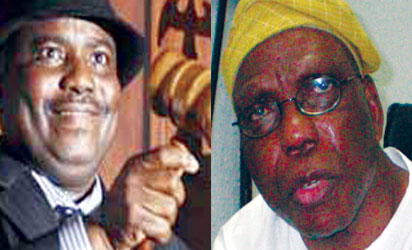
NUC’s Okojie and Speaker Tambuwal
By Dele Sobowale
Consequently, the regulatory bodies have long proscribed the study of law through Part time, Distance Learning, or Correspondence Studies and it was in consequence of this, that the Part Time LL.B Programmes run by the Faculties of Law of accredited universities were abrogated. The position of the bodies has been that every aspirant for the Legal Profession must undertake an undergraduate study on full time basis.” Advertisement by the Council of Legal Education, CLE, in PUNCH, April 14, 2015, p 42.

NUC’s Okojie and Speaker Tambuwal
The time has come when somebody or a group of law aspirants and their parents must file a class action suit against the CLE, NUC, NLS and JAMB for luring them into dead-end law programmes by various universities in Nigeria. Let me declare up-front that none of my kids is involved. But, thousands of Nigerian kids have been caught in the educational meat-grinder called Legal Education in Nigeria.
The advertisement placed by the Council of Legal Education, CLE, in the PUNCH and the calls I had received from concerned parents whose kids’ prospects in life had been messed up by the Law Faculties of various universities in Nigeria had convinced me about one thing. If war is too important to be left only to generals, then law education is also too vital to be left to lawyers. The least that can be said about legal education in Nigeria is that it is in a mess – created mostly by lawyers.
To start with, one hopes that the CLE placed that advertisement in more than one newspaper because not all newspaper readers patronize PUNCH. Seventy per cent of all subscribers buy only one newspaper everyday and the market share for PUNCH is less than twenty eight per cent. So, at least seventy-two per cent of newspaper readers would not have read the advertisement intended to warn them about enrollment in the LL.B degree Programme of the National Open University of Nigeria, NOUN.
That, however, is minor indictment of the CLE as well as other bodies responsible for the enrollment of students in law programmes in Nigerian universities. Apart from the CLE, other bodies which should come in for sanction for serious dereliction of duty, resulting in massive waste of time, lives and financial resources by aspirants for the legal profession include the National University Commission, the Joint Admission and Matriculation Board and the universities themselves.
Why each of these bodies should be included on the charge sheet will be discussed shortly. But, each and every single one of them had contributed to the disaster which just occurred to NOUN legal profession aspirants. Impunity had been condoned for very long and suddenly the CLE lowers the boom on NOUN alone. It is unfair.
Before the CLE advert came out on April 2014, NOUN had been admitting aspirants for legal education through open advertisements, placed in the same PUNCH, and sometimes other papers. All the regulatory bodies responsible for legal education had turned a blind eye to the fact. Several years down the line, and after several thousand aspirants had undertaken the Distance Learning programme (which is very expensive as I know because two of my kids have studied law), the CLE now denies the aspirants the opportunity to attend the Nigerian Law School, NLS.
“Is it fair to all concerned?” – borrowing from the Rotarian Four Way Test. Why was NOUN not stopped from the start? Why weren’t aspirants warned that they were undertaking what had now amounted to a “419” Law Programme since they could not be admitted to the NLS and become professional lawyers?
Furthermore, the CLE advertisement referred to “accredited Universities”, as if there are several of them. A visit to the NUV website will reveal that only the University of Ilorin has full accreditation for its Law Programme. Even prestigious public and private universities, like University of Lagos, University of Ibadan, University of Nigeria, Nsukka; Ahmadu Bello University; University of Abuja; Babcock; Redeemers University; Igbiniedon University; and Afe Babalola University, to mention a few, had been operating with “Provisional Accreditation” for more than ten to twenty years.
Disclaimer
Comments expressed here do not reflect the opinions of Vanguard newspapers or any employee thereof.