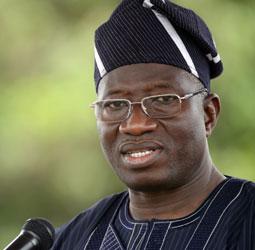
President Jonathan
By Prof. Kayode Oyediran & Prince Adetowo Aderemi
In the Sunday April 12, 2015 edition of the Sunday Vanguard, Obi Nwakanma expressed the view that President Goodluck Jonathan’s ready concession of victory to General Muhammadu Buhari in the March 28, 2015 Presidential elections”- has been frankly over analyzed in the local and international media -”. He proceeded to state.

Jonathan and Buhari
“But those of us who are a bit more historically minded should know that concessions have been made in power by those who consider Nigeria far above their personal interest. It is on record that Dr Nnamdi Azikiwe won the 1957 elections, for which the British colonial Governor-General, Sir James Robertson, first setting the standard of electoral manipulations and gerrymandering in Nigeria, invited Sir Abubakar Tafawa Balewa to come first to head the government at the centre even before the votes had all fully come in 1957 for the first home rule government. Azikiwe conceded and bid his time even though his party was compensated by having the highest number of ministers in 1957 – 60 in the independence elections of 1959, again Azikiwe’s party had the highest plurality of votes nationwide and would very easily have formed the National government with the Action Group. But against a threat of Northern secession, much like today’s Boko Haram, compelled Azikiwe to agree to join the Northern Peoples Party in a ‘government of national unity”, one from which Awo’s Action Group opted out, but which along the road torpedoed the AG in due course.”
All the foregoing statements and claims by Nwakanma are most incorrect. It is curious and worrisome that such grotesque falsification of Nigeria’s political history was made by someone who claimed to be “- more historically minded”. It is also unnecessary and avoidable because the facts are available and easily accessible in various documents at the National Archives. They were also published in the 5th Edition of Nigeria a complete Factfinder in 2004. It is very important to correct the falsehood presented by Nwakanma because, for far too long, the public especially our youth have been fed with lies about Nigeria’s history, and this has promoted disaffection among our communities. The correct relevant facts may be summarized as follows:
- In 1951 the Macpherson constitution was proclaimed, and led to elections in the newly created Houses of Assembly which ushered in participation by Nigerians in governance all over the groups of provinces.
- On January 29, 1952 the Federal House of Representatives met for the first time with members selected by and from the Houses of Assembly, and the House of Chiefs in Ibadan and Kaduna. Regional governments were set-up in the groups of provinces and were controlled by the NCNC (East), NPC(North) and AG (West). Four Central Ministers were appointed from each of the three regions.
- On March 30, 1953 Anthony Enahoro (AG) moved a private member’s motion for Nigeria to become independent in 1956. Alhaji Ahmadu Bello (Sardauna of Sokoto and leader of the NPC) moved an amendment to replace “1956” with “as soon as possible.”This led to uproar in the House, and the Governor, Sir John Macpherson, threatened to sack any minister who participated in the debate in reaction to this, the four AG ministers (Oba Adesoji Aderemi, Chief S.L. Akintola, Chief Bode Thomas and Chief Arthur Prest) walked out of the chamber and resigned their appointments. Their NCNC colleagues from the East also walked out of the chamber but did not resign from the cabinet. A constitutional crisis ensued.
- When it was not possible to replace the AG ministers Mr. Oliver Lyttleton, then British Secretary for the Colonies, came to Lagos to try to resolve the impasse. After a series of meetings in Lagos and London, adjustments were made to the 1951 Macpherson constitution which resulted in the creation of semi-autonomous regions (each with its own constitution, coat of arms etc), and a new Federal Constitution which took effect from October 1, 1954.
- The Federal House of Representatives with members selected from the regions was dissolved, and direct elections into a new House were held on October 11, 1954 throughout the country. In the Western Region the NCNC won 23 seats as against 18 seats for the AG. That was the first time in Nigeria that a political party lost elections in a region where it was in power. It is important to emphasize that the regional Assemblies were not dissolved, so the AG’s control of the Western Regional government was not affected. The defeat of the AG in the federal elections in the region was a result of opposition to the introduction of the Capitation Tax in 1953 in order to generate funds for the Free Education programme which was scheduled to begin in January 1955. However, the AG won the subsequent regional elections held in May 1956, some 18 months after the start of the free education scheme, with 49 seats to NCNC’s 31.
- Because it won the October 1954 elections in the Eastern and Western regions, it was the NCNC that nominated ministers to represent both regions in the federal government – Raymond Njoku, Kingsley Mbadiwe and Matthew Mbu from the East, and Adegoke Adelabu, Kola Balogun and Festus Okotie-Eboh from the West. The NPC nominated Tafawa Balewa, Inuwa Wada and Mohammadu Ribadu from the North. Balewa became primus inter pares because his party had the highest number of 79 seats in the House, while the NCNC had 56 seats, the AG 23, and others had a total of 17 seats.
- On August 5, 1957 self government was granted to the Eastern and Western Regions, the Northern Region declined because it was not ready for it. In a dramatic announcement on August 30, 1957 the Governor-General, Sir James Robertson (who had succeeded Macpherson in 1954), named Balewa as Prime Minister to head a broad-based National Government which would midwife Nigeria’s independence.
- No elections were held in 1957. Contrary to Nwakanma’s claim, there was nothing like Azikiwe conceding the Prime Ministership to Balewa. Balewa’s cabinet was a carry over from the 1954 elections with Malam Bukar Dipcharima replacing Inuwa Wada, Aja Wachukwu replacing Mbu, and I.M. Johnson replacing Adegoke Adelabu. In addition S.L. Akintola and Ayo Rosiji were appointed into the broad-based national government.
- The next elections into the Federal House of Representatives were held on December 12, 1959. Whereas Chief Awolowo and Dr. Azikiwe resigned as Premier of their respective region to vie for seats in the Federal House, the Sardauna did not, Chief Akintola and Dr. Michael Okpara took over as Premier of the Western and Eastern Regions respectively. In the elections the NPC won 134 seats, NCNC/NEPU/89 seats, AG 73 seats and others 16 seats. Thus NO POLITICAL PARTY HAD THE SIMPLE MAJORITY TO FORM A NEW GOVERNMENT.
10.The leadership of the AG sought an alliance with the NCNC but the latter preferred to team-up with the NPC. In the ensuing horse-trading Balewa retained his position as

PRESIDENT-ELECT RETIRED MAJ.-GEN. MUHAMMADU BUHARI (L) IN A HANDSHAKE WITH PRESIDENT GOODLUCK JONATHAN DURING HIS OFFICIAL VISIT TO THE PRESIDENTIAL VILLA IN ABUJA
ON FRIDAY (24/4/15).WITH THEM IS THE FORMER CHIEF OF ARMY STAFF,RETIRED LT.-GEN. ABDUHRAMAN DAMBAZAU.
Prime Minister and Azikiwe emerged as Governor-General at independence in 1960, a post which proved to be ceremonial. Azikiwe did not and could not have conceded anything to Balewa whose party won 45 more seats than the NCNC/NEPU. Moreover Nwakanma’s claim that”- threat of a Northern secession – compelled Azikiwe to agree to join the Northern Peoples Party (Congress) in a ‘government of national unity’ from which Awo’s Action Group opted out” is pure fiction. There was no threat of secession; Azikiwe led the NCNC into alliance with the NPC for what they perceived as their best interests; and the AG did not opt out of any fictional government of national unity. Rather,Chief Awolowo did what he had said he would do if he lost the elections: he became the Leader of Opposition in the Federal House of Representatives at independence.
In conclusion, President Jonathan’s concession of victory to General Buhari before the official announcement by INEC is the first of such occurrence in Nigeria whether at the federal, regional or state level. He must be given due credit for this irrespective of whatever analysis by any individual or group at local or international level.
Dr. Azikiwe never conceded electoral victory to anyone at any time. On the contrary, despite incontrovertible documentary evidence, persistent lies have continued to be peddled about the 1951 elections in Western Nigeria which the NCNC lost to the AG. Some of the admirers of Dr. Azikiwe should note that inadvertent or deliberate distortion of Nigeria’s political history tarnish rather than burnish his legacy.
*Oyediran is a former VC, University of Ibadan while Aderemi is Publisher of Nigeria: A Complete Factfinder.
Disclaimer
Comments expressed here do not reflect the opinions of Vanguard newspapers or any employee thereof.