By Omoh Gabriel
Nigeria’s economic potential is well known. The country’s considerable resource endowment and coastal location ordinarily should allow the emergence of a strong growth pole for Sub-Saharan Africa. Over the years, Nigeria has realised very little of this potential. Instead, its history has been marked by economic stagnation and associated with declining welfare and social instability.

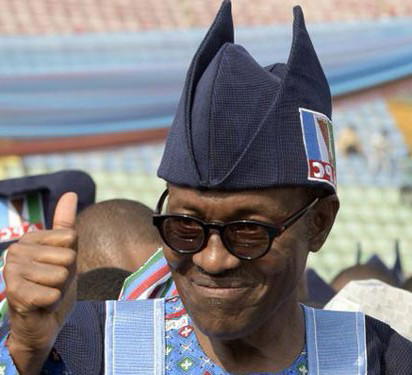
President-elect Muhammadu Buhari
Over the last few years however, policymakers have said that Nigeria has been experiencing a growth turnaround and conditions seem right for launching onto a path of sustained and rapid growth.
President Goodluck Jonathan had attempted to seize this opportunity to build a diversified economy able to provide jobs and improved welfare for Nigerians. Although the economy is said to be the largest in Africa, it has not been translated into putting food on the tables of many Nigerians.
It was a growth without development. Yes, it is time for Mr. President- elect to think economy, speak economy, dream economy and act on the economy.
Renowned Professor of Economics, Professor Jeffrey Sachs has long identified rural and urban integration; infrastructure and family planning as the critical factors to the transformation of the nation’s economy and its emergence as one of the top twenty economies in the world.
The problem that needed to be tackled is the duality of the nation’s economy. The duality between the formal and informal sectors is an important factor in the lack of competitiveness of the non-oil sector. Addressing the duality of the economy is therefore vital for strengthening and sustaining job creation.
President-elect, Mohammadu Buhari will do himself and the nation a lot of good by embarking on a nationwide consultation. He should consult with the organised private sector leaders, leaders of the informal sector, the old, young, community leaders, leaders of the various ethnic groups in the country, market women, traders, professionals and student leaders.
The consultation should seek answers to questions such as: ‘If you were the President of Nigeria, what would you do take make Nigeria a nation of equal opportunity for all?’ He should solicit for ideas and ways to move Nigerian economy forward. By so doing, he will under stand the dreams and aspirations of the ordinary Nigerian. It would give him an idea of what the average Nigerian craves for.
Buhari must avoid the mistake of past leaders who felt they knew it all and thus bungled the opportunity to mobilise the ordinary Nigerians for productive purposes that would have made the nation great. The President-elect must avoid power hangers-on that abound in the party and presidency structure that could hold him captive and deprive him of the knowledge of happenings within the country.
Consulting widely will afford him the rare opportunity to heal the wounds of the vicious campaigns undertaken by both parties and politicians during the 2015 electioneering. It will reunite the various warring sections of the Nigerian fractionalised regions to come together as one to face a common purpose of building a virile economy.
This effort also has the advantage of reconciling those who are hurting and feeling marginalised within the Nigerian polity and could forge the much needed unity in the country and encourage people to buy into his programmes. What has been lacking in previous administrations in Nigeria is that the populace has not been sufficiently mobilised and the Federal Government has not gotten the support of the ordinary Nigerian to buy into government programmes and projects.
This has been the bane of the economy as those who felt alienated look for ways to sabotage the system. This government needs the support of every Nigerian for it to embark on economic revival. Across the globe, knowledge economy has put nations in higher pedestal than natural resources endowment. Buhari must set measurable economic goals and targets. He must come out with a clear economic blueprint and formulate achievable policies and strategies to bring about a truly diversified economy.
He should state in clear terms when he expects the nation to achieve at least 40 per cent dependence on oil. He should come out with a target date when receipts from oil will no longer be shared but must be kept aside for the rainy day as is done in Norway. This is the only way by which Nigeria can be cured of the Dutch disease.
Behari should as a matter of urgency state when he expects Nigeria to stop the madness of importation of refined products. He should not allow the endemic importation of petroleum products longer than necessary.
He should call managers at NNPC and in unequivocal terms, tell them that the refineries must work within a specified time frame. He should go further to ensure that all the abandoned NNPC facilities for the distribution of petroleum products across the country are rehabilitated and put into immediate use. He should equally call those who milk Nigerians through the importation of generators to a round table talk and get an undertaking from them that they will no longer stand in the way of power generation and distribution in the country.
Finally, Buhari should appoint ministers based on integrity and capacity to perform. He should ditch the ethnic arithmetic of appointing ministers on basis of state representation. If he must appoint ministers from states, they must be men and women who can perform, who can mobilise Nigerians. It must not be based on patronage. Then he would have started the change mantra that swept him to power.
Disclaimer
Comments expressed here do not reflect the opinions of Vanguard newspapers or any employee thereof.