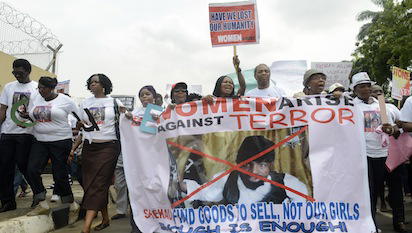
Women Arise civil society led by Joe Odumakin (C) accompanied by afro-beat musician Femi Anikulapo Kuti demonstrate to press for the release of missing Chibok school girls in Lagos on May 12, 2014. Boko Haram released a new video on Monday claiming to show the missing Nigerian schoolgirls, alleging they had converted to Islam and would not be released until all militant prisoners were freed. AFP
2014
April 14. Boko Haram militants kidnap more than 200 schoolgirls
April 16
- The government of the Borno state region announces a reward of nearly $300,000 for information leading to the rescue of the abducted school girls.
- President Goodluck Jonathan summons his National Security Council to a meeting in Abuja. The President is said to have plans to review security measures and operations in efforts to determine the “best way forward.”
- Nigeria’s military says it has freed all of the abducted schoolgirls with the exception of eight girls. The military also said that they captured one of the “terrorists.”
April 17
- Parents and the principal of the all-girls school dispute the military’s statement that all but eight of the girls are still missing. Parents and the principal say the number of girls that are still missing is 234 rather than the 129 previously mentioned by government officials.
- Nigeria’s military retracts statement that only eight of the abducted girls are still missing. They report that only twenty of the missing girls had escaped from their kidnappers and returned to their homes.
April 24
The abducted Nigerian girls trends on Twitter in Nigeria with people using the hashtags #BringBackOurGirls and #WeAreOurDaughters to call on authorities and the government to rescue the girls.
April 30
The “million-woman march,” called by the Women for Peace and Justice organization is held in Abuja and gathers about 500 people who are mostly women dressed in red. They march to the National Assembly and deliver a letter of complaint that states that the government is not doing enough to ensure the release of the girls. Other protests and rallies are carried out in Nigeria and other countries around the world simultaneously and in the days after the Abuja protest.
May 2
- President Goodluck Jonathan announces a “fact-finding committee” to help in the search of the schoolgirls.
- The president has a televised “Presidential Media Chat” in which he pledges that the girls would be found, yet admits to not knowing where they are. He added that the parents of the abducted girls were not cooperating with officials in the investigation, saying “what we request is maximum cooperation from the guardians and the parents of these girls. Because up to this time, they have not been able to come clearly to give the police clear identity of the girls that have yet to return.”
- First Lady of Nigeria,Patience Jonathan cries over the abducted school girls.
- Nigerian authorities arrest protest leader, Naomi Mutah Nyadar, who called on the government to do more to rescue the school girls in Abuja. Nyadar was picked up after a meeting she and other campaigners held with the First Lady about the missing girls. Nyadar was detained for allegedly lying about being the mother of one of the missing girls.
May 5
- Protest leader Naomi Mutah Nyadar is released by police who claim that she was merely invited for an interview. Nigeria’s first lady, Patience Jonathan, denies ordering the arrest of Nyadar. She also urges protesters in Abuja to go home, saying “You are playing games. Don’t use school children and women for demonstrations again. Keep it to Borno, let it end there.”
- In a video purported to be from Boko Haram, the group’s leader claims responsibility for abducting the over 200 girls and threatens to sell them. He says “I abducted your girls. I will sell them in the market, by Allah.”
- The spokesman for Nigeria’s ruling People’s Democratic Party (PDP), Abdullahi Jalo, condemns threats made by Boko Haram to sell the girls. Jalo says President Goodluck Jonathan’s government is doing everything possible to find the abducted girls.
- The White House confirms that the United States is helping Nigeria in the quest to find and free the abducted schoolgirls.
May 6
- Cameroon denies allegations that some of the schoolgirls have been taken into the country to be sold.
- British Foreign Minister William Hague offers “practical help” to Nigeria for efforts to release of the girls.
- US confirms that a team of US experts including military and law enforcement officials is heading to Nigeria to help find the schoolgirls
- Eight additional girls are reported to have been kidnapped by Boko Haram in the month of May
May 7
- Nigeria Police announce a cash reward of about $300,000 for “anyone who volunteers credible information that will lead to the location and rescue of the female students.” In their statement, they list phone numbers that citizens can call with information.
- France announces that it will boost intelligence ties with Nigeria and send security service agents to the country to help tackle Boko Haram.
- Boko Haram attacks the Nigerian village of Gamboru Ngala on the border with Cameroon. Over 300 people are killed in the attack.
- The Chairperson of the African Union Commission condemns the abduction of over 200 Nigerian girls by extremist group Boko Haram
May 8
- Nigerian President Goodluck Jonathan pledges to find the schoolgirls in an address at the World Economic Forum (WEF) in Nigeria’s capital, Abuja. He thanks foreign nations including the United States, Britain, France and China for their support in the rescue the girls.
- US First Lady Michelle Obama joins the call to rescue the abducted girls by posting a picture of herself holding a sign with the hashtag #BringBackOurGirls. She joins the call with other world leaders and activists around the the world.
May 9
- Amnesty International says Nigerian security forces had advance warning four hours ahead of the raid on the girls boarding school but failed to act.
May 10
- US First Lady Michelle Obama marks Mother’s Day by speaking on the abducted girls and the importance of girl’s education around the world.
May 11
- The Economic Community of West African States (ECOWAS) announces that it has increased collaboration with Nigeria’s government on security in efforts to combat Boko Haram’s cross border terrorist activities.
- French President Francois Hollande calls on African leaders to meet in Paris later in the week for a summit on how to deal with Boko Haram.
May 12
- Boko Haram allegedly releases a video claiming to show the missing Nigerian schoolgirls. The girls say they have converted to Islam and the terrorist group asks for their imprisoned fighters in exchange for the girls.
May 15
- Nigerian government rules out an exchange of detained Boko Haram militants for the abducted schoolgirls.
May 16
- Citing security reasons, Nigeria’s President cancels his visit to Chibok, where the schoolgirls were kidnapped.
May 17
- France’s President Francois Hollande hosts a summit in Paris with President Goodluck Jonathan and the Presidents of Benin, Chad, Niger, and Cameroon over the response to the Boko Haram kidnapping. The meeting results with participants agreeing to a unified regional effort to fight Boko Haram.
May 22
- United Nations Security Council imposes a sanction on Boko Haram
- After several failed kidnapping attacks, Nigeria’s police increases security in two secondary schools in Benue State.
June 2
- Nigeria’s police ban protests calling for the rescue of the schoolgirls for security reason, fearing that protests could be hijacked by “dangerous elements.”
June 3
- Nigeria’s police retract statement suggesting a ban of protests and says their previous statement was meant to warn protesters about ill-meaning groups that could bring criminal elements to the protest.
June 20
- The Nigerian government’s fact-finding committee on the schoolgirls submits the final report. According to the report, the number of girls still missing is 219.
July 7
- 60 women who were previously kidnapped by Boko Haram escape.
- Nigeria’s military says it is closer to finding the over 200 kidnapped girls
July 13
- Education and girls rights activist, Malala Yousafzai visits the parents of the missing schoolgirls and assures them that she is committed to ‘bring back our girls.’
July 14
- Goodluck Jonathan promises Malala Yousafzai that his government will rescue the girls.
- Boko Haram leader, Abubakar Shekau, releases new video in which he mocks the #BringBackOurGirls campaign.
July 15
- Human Rights Watch releases a report that says Boko Haram has killed 2,000 in 2014.
- Families of the kidnapped schoolgirls cancel a meeting with President Goodluck Jonathan. Government officials criticize
activists for influencing the families for political interests, while activist cite security reasons for the cancellation.
July 17
- President Goodluck Jonathan seeks $1 billion in foreign aid to help fight Boko Haram.
- The hashtag #SomeoneTellLevick begins trending in Nigeria after parents of the abducted girls refuse to meet with Goodluck Jonathan during Malala Yousafzai’s visit. The hashtag is a response to a press statement reportedly drafted with Levick that blamed #BringBackOurGirls supporters for the cancellation.
July 23
* Vigils and protests to mark 100 days of the abduction hold in Nigeria, Pakistan, India, Bangladesh, Togo, the United Kingdom, the United States, Canada, and Portugal and following global attention brought by the abduction, the UK, US, France, China, Canada, Israel and the European Union all offer support to Nigeria.
Nov 14
* The Islamic extremists seize Chibok
2015
January
* Fleeing residents say Boko Haram extremists kidnapped about 40 boys and young men in North-East and an intelligence officer says the insurgents killed scores of soldiers in an attack on a multinational military base.
March
About 80 children rescued from a Boko Haram camp in Cameroon cannot remember their names or origins, according to an aid official who visited them.
Disclaimer
Comments expressed here do not reflect the opinions of Vanguard newspapers or any employee thereof.