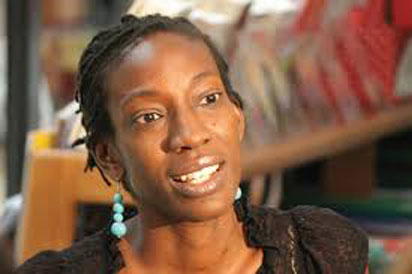
Yewande Omotoso
By PRISCA SAM-DURU
Yewande Omotoso is the daughter of renowned scholar, and writer, Profesor Kole Omotoso. She was born in Barbados but grew up in Nigeria before moving to South Africa in 1992. The writer and poet who is currently based in Cape Town where she works as freelance writer and novelist, is an architect turned writer.
Her debut novel, Bomboy, won the South African Literary Award for First Time Author and was shortlisted for the 2012 Sunday Times Fiction Prize. Bom Boy which was shortlisted for the 2012 Sunday Times Fiction Prize, also made it to the final three at the inaugural edition of the Etisalat Prize For Literature 2013.
The writer who prides in writing novels that “entertain but also get people to think, reflect on themselves and reflect on prejudice”, in this interview, tells more about her career. Excerpts.
Do you still regret not winning the inaugural edition of the Etisalat Prize?

Yewande Omotoso
I can’t really say I regretted not winning the prize. Regret is too strong a word. I was disappointed for a few minutes after the announcement and then you move along.
There are things I regret in life but when it comes to prizes, I don’t think it’s worthwhile spending much time regretting such things. In these matters, at a time when scarcity can seem the rule, I prefer subscribing to the notion that there is an abundance.
How has that affected your writings and personality?
Being shortlisted has presented me with many opportunities and has made a difference to my writing endeavours.
What inspired Bomboy?
What inspires is always a hard question for me. The simplest answer is a curiosity to write about someone on the edge of society, separate and yet with a concern for being a part of something – a culture, a people, a family and so on. It’s a kind of one-off story. Whatever comes next will be distinct.
What challenges did you encounter while writing?
Nothing unusual. Time was the biggest challenge, I was working a fairly intense job at the time but it was easy enough to write in the wee-hours. My boss was encouraging and my supervisor was incredibly generous.
You’re an architect, one can’t help wondering its relationship with writing.
I think relationships can be drawn between almost anything if you think about it long enough. In reality though I studied architecture because that seemed sensible and I went back, after working for about five years as an architect, to do a masters in Creative Writing, because that too, at the time, seemed, if not sensible, then what my heart longed for, which is a kind of sense of its own.
Is writing a passion or just following the footsteps of your father?
Both my parents were very influential in my love of writing and reading. I was into my career as an Architect, however, when I chose to study Creative Writing part time and work on a novel as my thesis. It was quite an independent and stubborn thing to do. Which means when I made that decision I also made sure I was doing it for my own reasons and not anyone else’s.
Etisalat presented you with an opportunity at East Anglia University, how has that imparted you?
My time at the University of East Anglia is an experience I will cherish. More than anything it connected me with a constellation of writers, a few of whom have become dear friends, and this I am grateful for. I believe that timely associations with fellow writers can have a large and positive impact on the quality of a writer’s work.
Apart from that, the staff of the UEA Creative Writing School were incredibly generous and warm. Norwich is a vibrant literary city and the time and space afforded me to write was invaluable.
People are beginning to worry that for the second time, no Nigerian writer has won the Etisalat prize for Literature, does it say something negative about the quality of works coming from within?
I wasn’t aware of this concern but really, “people” ought to relax. Prizes are an interesting beast. We love and need them, they honour hard work done and provide solid monetary relief to a profession seldom seen as one and definitely known to have “bad pay”! But Prizes are also hard to gamble with.
I don’t think Nigerians should spend time worrying about whether enough Nigerians are winning the Etisalat Prize! Let’s celebrate that there is such a prize at all, that it is hosted by us, that we invite the continent and the world every year to behold the long and short lists and join us in celebrating the winner.
Disclaimer
Comments expressed here do not reflect the opinions of Vanguard newspapers or any employee thereof.