By Amaka Abayomi
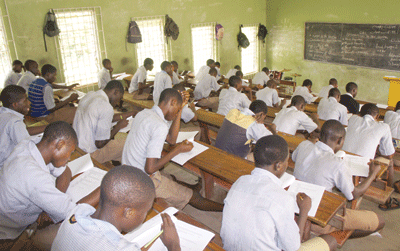
Sequel to the recent UNESCO 2015 Education for All Global Monitoring Report that Nigeria houses the highest number of out-of-school children and also has one of the worst education systems in the world, National Coordinator, Education Rights Campaign, ERC, Mr. Hassan Soweto, has blamed past leaders for the sector’s misfortune. Themed “Education for All 2000-2015: Achievements and Challenges”, the report stated that Nigeria lacks progress in almost every EFA goal as corruption, conflict and lack of investment have resulted in Nigeria having one of the worst educational systems in the world.
 The report also stated that Nigeria is among countries which are way off target on the six key educational goals that 164 countries agreed to try to achieve between 2000 and 2015, while identifying the political leadership as corrupt and losing $21million of education funding over two years.
Referring to the report as a damning indictment of the failure of capitalism to meet the basic needs of Nigerians for education, the ERC boss said the dilapidated state of public education is a consequence of the neo-liberal and pro-market education policies of the past decade which de-emphasized government role in providing investment for education and instead placed the responsibility on the private sector.
He said “we are glad this report has confirmed what we have been saying about the statistics of progress always being reeled out by our ministers, politicians and government apologists which barely correspond to the reality that students and parents see on ground. “Despite huge revenues from crude oil sale and monies received from foreign donors for the purpose of investment in education, no fundamental improvement has come the way of public education, rather, things have worsened.
“We now have the highest number of out-of-school children in the world. We have more girls out of school or dropping out due to poverty, child marriage, early pregnancy, while in the South East for instance, we have very low enrollment of boys into primary and secondary schools.
“Our most immediate demand would be that all those in government at federal and state levels in the last 15 years must be held accountable for this. If all the resources available to the country could do nothing to salvage our education sector in 15 years, then those who were (and are) in charge of governance during this period must tell the country what happened to the money.
“We place this demand at the doorstep of the incoming government of Buhari because nothing short of bringing past governments to give account can be acceptable to our children whose future have been mortgaged and the teeming graduates who are now adjudged unemployable as a result of the poor quality of education they received while in school.
“When this level of retrogression occurs and a country’s education sector is left to rot for over 15 years and against a background of abundance of resources, simply shrugging our shoulders and moving on would not do. “If this demand is not met, then it would only mean that we are seeing a repetition of how new governments cover up the crimes of the past in order to have the ‘moral’ right to commit similar crimes.”
Pointing out that since the report highlights the failure of capitalist neo-liberal policies in making public education available for all, Soweto said the new government can avoid such mistakes of the past by halting all subsisting pro-market education policies and rather recognising that education, being the cornerstone of development, is the social responsibility of government.
He said: “this realisation should reflect immediately in improved budgetary allocation, and we demand nothing less than 26 percent budgetary allocation as a starting point to be increased annually. “One of the factors the report identifed to have contributed to low enrollment and dropping out of school is tuition and some form of costs still transferred to parents and guradians even in states where education is allegedly free.
“For years, the ERC has argued that Nigeria’s resources, if democratically and judiciously utilised, can support the provision of free education at all levels. If the new government is ready to reposition Nigeria’s dilapidated public education, it should find the political will to make education free at all levels by harnessing Nigeria’s enormous resources.
“Together with this, the education sector has to be thoroughly democratised to permit elected representatives of education workers, students, parents and communities to have a say in how schools are administered and funded and how the funds are dispensed. That way, funds meant for schools can be prevented from disappearing into the bank accounts of politicians and bureaucrats in the Ministries and the schools.”
These are the outlined wayforward the ERC has repeatedly canvassed for. But can any of these political parties and candidates implement this? I strongly doubt this. The fact that all of the parties support capitalism in one form or the other makes them incapable of implementing any of these outlined measures, and this is why the ERC is supporting a newly formed political party, the Socialist Party of Nigeria (SPN), as the only party at the moment that has the manifesto that best captures these outlined measures to revive our public universities.
Disclaimer
Comments expressed here do not reflect the opinions of Vanguard newspapers or any employee thereof.