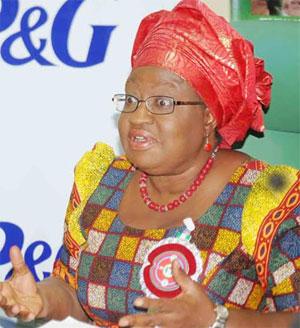
Dr. Ngozi Okonjo-Iweala
By Dele Sobowale
“Unsold Nigerian crude grows as buyer interest fails”.
PUNCH, Thursday, April 9, 2015.
The Problem Confronting Nigeria.
“If people are going to buy your solution, first of all they have to buy the problem you present.” (VANGUARD BOOK OF QUOTATIONS p 229).
Giving advice is a risky and often thankless undertaking, even when people or governments ask for it. The call to place “all hands on deck”, in Nigeria, had proved to be more deceptive than meant. Invariably, a cabal pursuing its personal interests soon takes over the directions of economic policy and the greatest good for the greatest number soon become a distant mirage.
The Peoples Democratic Party, PDP, in the last sixteen years had operated an economy based on the exclusion of the vast majority of Nigerians. That explains why as the economy grew at more than 7% annually, the benefits have eluded the vast majority. The last election, in many respects, reflected the frustrations and angers of the silent majority who only read of the economic gains on the pages of newspapers or watched on television as one documentary after another proclaimed achievements which they never experienced.
President-elect Buhari will however inherit an economy now heading for a recession. The reasons are not hard to discover. The crude oil, which had oiled the wheels of our economic progress, is now failing us badly – without an alternative readily available. The report mentioned above disclosed that “only 25 per cent of the May programme had so far been placed”. This is novel experience for a country which in the past sold its allocation fully three or four months in advance.

Jonathan and Buhari
Demand drop represents only a small part of the calamity. This time last year, crude sold, on the average, for over $100 per barrel. In May, as we have seen for most of the first four months, the price will most likely hover around $55 per barrel. Gas sales and prices have moved in tandem with crude oil – both have headed downwards; and will most probably remain down for 2015 if not for years to come.
Meanwhile, the forces driving down the revenue from oil and gas threaten to remain for several years. First, the United States of America, USA, which had, for decades, been the world’s largest importer of petroleum products, had suddenly emerged as the largest global producer in 2014; it is also challenging traditional exporters for market share. That situation promises to remain for the long term forcing Nigeria and other countries depending on the US market to come up with new ideas about the use of their crude.
Second, China, the world’s second largest economy and India, as well as Brazil in South America, are experiencing economic slow down. The Chinese Central Bank recently lowered interest rates in a bid to stimulate the sluggish economy. Whether it will work or not remains to be seen. This is not the first cut. Previous attempts at stimulating the export-oriented economy had failed to yield desired results.
Third, decades of paying lip service to diversification of the economy had produced little by way of exportable products and services. One obvious reason is lack of competitive advantage resulting from high production costs to poor quality products. The other is the absence of any demonstrable surplus of any products designed for export. The feeble attempt to turn cassava export into “agro-dollars” proved to be short-lived. There is still a great global demand for cassava, but, our annual output, coupled with increasing domestic consumption, ensure that the export revenue remains flat. Obviously, there will be little income from non-oil exports to make up for the drastic shortfall.
Clearly, we have a revenue problem. But, unfortunately, it is not the only problem we are confronted with. Simultaneously, we have a growing debt problem and the threat of debt default cannot be lightly dismissed. The second time Finance Minister left Nigeria relatively debt-free when she departed in 2006. Okonjo-Iweala returned to find the nation’s external debt close to $5 billion. Today, it is almost $10 billion. The disturbing aspect of the new debt trap rests in the fact that we had blundered into this problem precisely in the same way we did in the late 1970s to 2004. Let us quickly recap and close this segment.
Back in 1978, encouraged by the rising price of crude oil and Nigeria’s low debt, “technocrats” advised the military government headed by Obasanjo that Nigeria was “under-borrowed” and the economy would grow faster if we took some debt to finance some projects. The advice, charitably, would be assumed to be based on good intentions. None of Obasanjo’s advisers then remembered that the road to hell is always paved with good intentions. For good measure, Nigerians were assured that we could easily repay the $2.8 billion facility we took from the International Monetary Fund, IMF. By the time Obasanjo returned to the helm in 1999, the debt stock had risen to $36 billion; we were in the debt trap. The debt load Buhari will inherit started when the price of crude again started going up. It will have to be repaid when the price of crude had tumbled as it did in the 1980s. The question is: why?
NEXT WEEK: Corruption and Fiscal Irresponsibility Will Always Ruin Us.
Disclaimer
Comments expressed here do not reflect the opinions of Vanguard newspapers or any employee thereof.