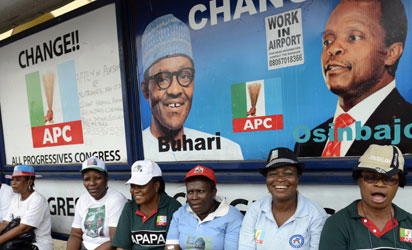
Women sit in a branded bus station as they support leading opposition All Progressives Congress presidential candidate Mohammadu Buhari during a rally christened ‘Walk for Change” in Lagos, on March 7, 2015 in Lagos, Nigeria’s commercial capital. Presidential elections scheduled for February 14 were delayed for six weeks as the military said the ongoing counter-offensive against Islamists Boko Haram meant that troops could not provide security on polling day. Elections will take place on March 28, with gubernatorial and state house assembly polls two weeks later. AFP PHOTO
By Prof. Ladipo Adamolekun
ALTHOUGH it is only the APC candidate who has committed to running a “lean government” if he is elected president on March 28 (The Nation, February 16, 2015), this unsolicited advice is for whoever becomes president after the election. In my considered opinion, running a lean government will be a necessity not a choice for Nigeria’s next president. And he would need to announce a roadmap for achieving it as a priority action after assuming office.
Beyond cutting out “wastages” that APC presidential candidate is reported to have stressed, achieving a lean and efficient government that would free funds for “capital and development projects that will assure prosperity for all Nigerians” would require significant reductions in the cost of running both the executive and legislative arms of government.
The decline in revenue earnings from petroleum resources that is likely to remain permanent for the foreseeable future makes serious cost cutting inevitable. I would argue that an important dimension to the cost cutting that must be embraced is a sizeable reduction in the salaries and allowances of all political office holders.
After discussing the kinds of cost cutting that can be achieved in respect of the executive and legislative arms of government, I make some suggestions on reducing the salaries and allowances of political office holders. In closing, I consider the linkage of cost cutting to the problem of corruption.
Reducing a bloated federal executive: A lean and smart federal executive can be achieved by reducing the size of the Federal Cabinet by about half of its current size. Section 14 (3) of the 1999 Constitution on “Federal Character” does not require that a minister or minister of state must be appointed from each state. It only requires that the composition of the Government of the Federation shall ensure “that there shall be no predominance of persons from a few States or from a few ethnic or other sectional groups in that Government…” Therefore, I would recommend a cabinet of 12 members (two per each of the six geopolitical zones) and each would have a deputy (minister of state) who will not have cabinet rank. This contrasts with the current total of 27 ministers and 17 ministers of state.
Next, the current large number of special advisers/senior special assistants (SAs/SSAs) can be reduced by about 50 percent, at least. I would recommend twenty SAs/SSAs for the president, five for the vice-president, two for each cabinet minister and one each for ministers of state.
Techno-professional competence
This would be close to a return to the modest numbers of SAs/SSAs when they were first introduced in Nigeria in 1979-83. The opacity that surrounds the numbers, functions and accountabilities of SAs/SSAs must be replaced by transparent rules for their appointment and relations with the permanent civil service and ministers. In particular, only men and women with decent levels of techno-professional competence (such as policy, political and media expertise) should be appointed into these positions.
The recommended reductions in the number of political office holders in the executive will result in significant cost savings. With a 12-member cabinet, the ministries, departments and agencies (MDAs) will shrink and this, too, should result in cost savings. Furthermore, a president that works through 12 ministers is very likely to be more effective than one that works through 27 or 28 ministers. (For comparison, current USA cabinet has fifteen members, called Secretaries). For example, performance contracting for ministers that has not been meaningfully implemented to date is likely to become more effectively operational in respect of 12 ministers and the functioning of the entire federal bureaucracy is likely to improve.
Reducing the cost of running the legislative arm of government: The burden of Nigeria’s National Assembly (NASS) on the budget is among the most onerous in the world. The modest achievements recorded by successive legislatures to date in respect of law making and oversight functions constitute a strong argument for significant reduction in the cost of running the NASS. Two obvious areas for cost cutting are: reducing the number of committees in both Chambers by 50 percent (currently there are between 60 and 80 committees in each Chamber) and abolition of constituency projects.
Because constituency projects are ignored by state and local governments who are not consulted by the legislators who finance them, they are, with a few exceptions, white elephants that add no value to the lives of the citizens. It is also the case that a good number of projects are uncompleted while a significant number of legislators simply convert funds for constituency projects into additional allowances. This huge wastage must be eliminated. The bad idea of legislators’ constituency projects that was first introduced in Africa in Kenya in 2003 must not be allowed to take root in Nigeria. The good news is that Kenya parliamentarians’ Constituency Development Fund Act (2013) was declared unconstitutional by a high court last month.
Reducing the salaries and allowances of political office holders: Comparison of the salaries and allowances of Nigerian legislators with those of legislators across the continents has revealed that those of the Nigerians far exceed the average of the others. The minimum cost cutting that would make the earnings of Nigerian legislators close to those of the comparators would be a 50 per cent reduction. In 2009, the Federal Government inexplicably extended the definition of “political office holders” to include permanent secretaries in the civil service, vice-chancellors in universities, and several other chief executives of federal government agencies.
Salaries and allowance
Then, the Revenue Mobilisation Allocation and Fiscal Commission (RMAFC) approved huge increases in the salaries and allowances of all the political office holders with significant distortionary consequences within the civil service and the other agencies of the Federal Government. For example, arising from the increases that were not based on any job evaluation, there is a huge gap between the total emoluments of permanent secretaries and those of the immediate next rank of directors. And this has unsurprisingly resulted in low morale among the directors with negative consequences for performance in the service.
Regarding the public officials who were reclassified as political appointees in 2009, adjusting the increases awarded to them in a fair and just manner would require a job evaluation involving the civil service, the universities, and the other concerned agencies.
The proposed job evaluation would be a much-delayed sequel to that undertaken by the Udoji Commission (1972-1974). Although RMAFC acted within its constitutional mandate (Third Schedule of 1999 Constitution) – “determine the remuneration appropriate for political office holders”. Significantly, President Jonathan announced on March 16th a salary reduction of 30 percent for himself, ministers and some political office holders in response to the prevailing austerity. This is the right thing to do. However, details of reductions for the different categories of political office holders concerned should be made public: salaries and allowances before the reductions and the new amounts to be earned by the officials concerned. And this is what whoever wins the presidential elections on March 28 should do.
Linkage of cost cutting to the problem of corruption: There is evidence to support the thesis that decent pay levels for political office holders and chief executives of government agencies and parastatals tend to discourage corrupt practices on the part of the concerned officials. For example, Lee Kuan Yew, Singapore’s first Prime Minister, who led the transformation of the country from Third to First World has claimed that he combined a Head of Government remuneration that was one of the highest among his peers world-wide but with zero corruption.
Corruption perception
He cascaded this down the country’s entire public sector and Singapore has been one of the world’s top five “clean” countries annually since Transparency International began to track corruption perception levels in the late 1990s.
The Nigerian case since 2009 has been a counter factual: the huge increases in the emoluments of our legislators and other public office holders has been accompanied with ever rising levels of corrupt practices. Whilst the existing institutions, systems and processes for fighting corruption might not be robust enough as recently observed by the Coordinating Minister of the Economy, it is also true that political will to fight corruption in the country has been lacking. Because the fish rots from the head, the corrupt practices in all our public sector institutions would be significantly reduced if the heads of the different institutions were to demonstrate zero tolerance for corruption.
I would end by commending the recently reported commitment of APC presidential candidate to publicly declare his assets and those of his wife if he is elected president on March 28th as a commitment that all presidential aspirants and governorship candidates should make. If Nigeria’s next president and the governors of all thirty-six states publicly declare their assets and those of their spouses and oblige all political office holders under them as well as the top executives in the civil services, government agencies and parastatals to follow suit, the level of corrupt practices in the country is almost certain to begin to fall drastically.
Prof. Prof. Ladipo Adamolekun writes from Iju, Akure North, Ondo State
Disclaimer
Comments expressed here do not reflect the opinions of Vanguard newspapers or any employee thereof.