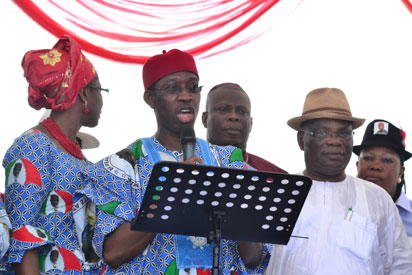
•Senator Ifeanyi Okowa flanked by his wife and Professor Sam Oyobvbaire during his governorship declaration in Asaba, Delta State.
By Charles Kumolu
The Peoples Democratic Party, PDP, governorship candidate in Delta State, Senator Ifeanyi Okowa, in this interview, offers insight into his political trajectory and vision for the state. Okowa, who displays his mastery of the peculiar concerns of those he seeks to govern, is confident of emerging the fourth civilian governor of the state.

• Ifeanyi Okowa
You have had town hall meetings across the 20 local government areas out of the 25 in the state. Can we know how successful they were?
Having gone to 20 local government areas out of the 25 local government areas, I can say that we have gotten a huge success far beyond what I did expect from the beginning. And the whole concept came about from the realisation that we need to do more on our previous campaign. During the local government rallies, people gathered to listen to us without having the opportunity of responding to what we had to say. The town hall meetings offered us the opportunity of knowing the challenges they are going through in the electioneering process.
In all the meetings there were at least 200 to 300 people who were selected by the people themselves. The selection cut across the various strata of the society; it was not just limited to the political class. The various levels of community leadership including women and youth groups were represented. It has been quite enriching because it gave us the opportunity of knowing what their challenges are. Through that discourse we have been able to understand their feelings and we gave the assurance that we will address all their concerns. I think we left every one of those local governments we visited better informed and better understood. We now have a more reconciled people and a united family. I am not talking about the political family alone, but the entire populace in those places. I think that is something that should be held regularly beyond our electoral victory.
In specific terms, can you tell us some of the peculiar challenges you discovered during the course of these meetings?
We found out that some people were aggrieved as a result of the processes leading to the primaries. They were of the opinion that things could have been done better, and this was not necessarily about the governorship race. So we needed to have a better interface with those who lost the primaries. One thing we have learnt during the town hall meetings is that the youth don’t wish to be seen as insignificant in the scheme of things. Issues also came from the women who complained that they work very hard during the elections but they were usually forgotten at the end of the elections. They said they needed women to be more participatory in the post-election period. I agree with them and I think that more women need to be engaged in the process of governance. That was also a very clear issue.
There were a lot of issues bordering on the neglect of some communities. That is an issue that needs to be tackled because if we want to be fair and just, we should be able to address their complaints. Some people have talked about infrastructural development in the cities and the need to extend it to the rural communities. I know that a lot has been done in Delta especially in the rural areas but we used the opportunity to reassure the people about our commitment to a holistic development programme. We will try to be fair to all. There were lots of issues, but the key issue for me is that the youth want to engage in politics and they also want assurance of a better future for them. They demanded that they be empowered through employment and any means the government considers meaningful. We are looking forward to putting processes in place to achieve that. It also gave us the opportunity of telling the youth on the importance of being responsible and staying peaceful.
Prior to the town hall meetings, your campaign across the state was adjudged to be impressive in every way. What does it feel like considering the intrigues that characterised the build up to the primaries that produced you as the PDP candidate?
I have been a politician for a very long period. So the intrigues that characterised the process were very normal. There was nothing unusual about it because everybody going into the race plans to win. Eventually the grace of God made my emergence possible. And having won the primaries election there was need for true reconciliation. The first step was to get the backing of the governor to enable us have that reconciliation and he immediately provided the platform for us to do that within two days after the primaries were held. On December 10, 2014, we were able to have a meeting with the aspirants who contested with me.
Of the 23 of us, about 14 were at the meeting. It was a very useful meeting where we spoke to ourselves on a number of issues. From that moment we were able to cement the relationship. Everything we agreed on, worked out successfully. We agreed to have a Campaign Council with a membership that comprises the governor, his deputy, state party chairman and all the aspirants that contested with me. That actually brought a lot of confidence into the entire campaign machinery. And since then we have had robust outings and I think we have done very well.
Our structures are present in every ward in the state and the results we are getting are encouraging and enriching. If you look at the political composition of the state, you will find out that it is only the PDP that has structures, physical and human, in every ward in the state. Others are waiting for manna to fall from heaven because they are just grandstanding and waiting for an endorsement. They are actually not into serious campaigning and that it not the way politics works. We will remain steadfast in our campaign till the last day and we believe that we will win massively.
How were you able to get some of these aspirants into working for you and how significant has their contribution been?
I think the greatest point is the fact that the primaries was actually adjudged to be free and fair. That was what enabled us to come together to work for the party even though it means working for me to be governor. But it is all about the PDP. I am just the face of the party going into the general election. The night after the primaries, I walked up to the governor and thanked him for allowing a free and fair contest. If we did not have a free and fair process, it would have been difficult to convince those who lost to participate in the process. That was the strongest point that united us because everybody acknowledged that the process was free and fair.
The other reason is that they all genuinely love the PDP. The governor was also instrumental to the unity because he created a platform for us to sit together and talk within 48 hours. And the contestants were also statesmanlike in their conduct because within 24 hours after the election all of them actually called to congratulate me, which meant that they accepted the result. Even during the days leading up to the primaries, we were in touch with one another. We did not see it as a do or die affair. Most of us were still chatting on phone and, even those we did not chat with, any time we met at events or programmes we had good fellowship together. The process was such that we did not have to resort to abusing ourselves. We still saw ourselves as brothers and sisters. So, there was no loss of friendship at any point in time and that made it quite easy for us to come together after the primaries
.Beyond some of these things you said about the incumbent governor, can you point at other significant contributions he made towards the robust outings you have so far had?
He established the initial platforms for the meetings that we had. From these meetings we were able to move forward. That was quite significant. In our first campaign rally where flags were given to all the candidates of the party, he was there to lead the process. We left there and went to his local government. In some other functions he was with us. I recall that his wife also joined us at some of the campaigns. And these are quite significant contributions. He has also supported the campaign in the best ways that he could. But the fact is that he has assisted in creating an enabling environment for us to move forward in our campaign.
The important thing is being able to get everybody on board. Our family is now a well-blended family. The governor is the coordinator of the PDP presidential campaign, and he is campaigning for the President and myself. We have all tried to bring a synergy into the process of campaign. So, it is one happy PDP family here in Delta.
Give us an insight into your SMART Agenda for Deltans and what is the disposition of the people towards your manifesto of prosperity for all?
We have actually spoken to the people about what we stand for and we know that there is a lot of expectation from the people. We have adopted a comprehensive and multi-pronged approach to development encapsulated in our five-point agenda with the acronym S.M.A.R.T. The state has witnessed massive infrastructural development in the last 16 years. A lot of progress has been made but government as you know is a continuum.
One of the greatest challenges of our day is the issue of youth unemployment which is a global issue. Within the African context, families are not able to create the needed wealth for a sustainable family economy. That is a major challenge because if we don’t deal with that we are going to run into big trouble as a society. And if we don’t address issues relating to the restive youth population, it will remain a ticking time bomb. That is why we are going to prioritize wealth generation and job creation as a government. It is our first priority. To create wealth and maintain the current peace that we enjoy in Delta state, we are committed to agricultural reform and accelerated industrialisation.
Over 60 per cent of our people are still engaged in farming, so we must assist them to develop and grow in such a manner that they can prosper in whatever form of farming they engage in. We will find a way to support them to expand beyond where they are. What that means is that we have to rework the agricultural process by restructuring the Agricultural Development Programme, ADP. It will be structured to provide extension services with the purpose of stimulating and increasing production.
A key component of our agricultural programme is to develop industrial estates that will encourage more of agro processing industries because this will also help stimulate agricultural production in the state. Once our farmers know that there is ready market for their produce, that they will not be exposed to the vagaries of fluctuating market prices and lack of storage, they will produce more and be empowered economically in the process.
We already have the Warri Industrial Business Park that is just being constructed. It is our hope to take it to a stage of full completion. We also plan to build more industrial estates that will be geared towards the agri-sector. In industrial estate, government will provide the necessary infrastructure such as roads, light, and water. Once a company knows it doesn’t have to worry about these amenities it has all the needed incentive to come and establish in a place. With this enabling environment it is more likely that industries will have the needed incentive to be cited in Delta.
Another critical aspect of our manifesto is the refocusing and strengthening of our technical education. At some point in time in this country, technical education was greatly encouraged. Even during the military we embraced technical education but unfortunately we missed our way in this regard at some point in our political evolution. It is so bad that today Nigerians have to import people from other countries to do their plumbing, electrical, and construction work. That should not happen in a country where there are millions of unemployed youths. We need to re-engineer technical education as soon as possible though it is not something that can happen overnight. Some of our schools will be redeveloped and the curricula will be sharpened to provide more technical education.
The current administration has done so well in terms of health, making Delta state the best performing state in that respect. There are three key programmes that have helped in this regard. They include; the rural healthcare programme (a programme implemented to offer free health care services to the poorer section of the society), free maternal healthcare programme that is allowed at government hospitals and the free under-five treatment programme. These programmes are very enabling and we intend to continue them. We also want to introduce, from the beginning, a legislation that will enable Deltans benefit from community health insurance scheme under the Universal Health Insurance Policy. That is the way to go because it will make our families spend less on healthcare. The primary healthcare centres will also be developed.
We are also mindful of the fact that we have to develop our urban centres and regenerate our environment. Through our urban renewal programme at least one city or settlement in each of the ten federal constituencies. We shall also embark on beautification of our cities taking into cognizance cultural uniqueness, environmental improvement, and the general atmosphere of such towns/cities to discourage rural-urban migration. It is our hope to have enough funds for all these through improved Internally Generated Revenue. We are also hoping that the economy grows beyond what it is now. But all the same when we come on board we will review our IGR approach to generate more.
Before the commencement of your campaign, there were fears that a particular section of the state, the Urhobo may not support you. What is the situation now?
They may not have been disposed to my candidacy because at the time of the campaign everybody said different things to get the votes of the party delegates. Before the primaries I did go to the Urhobo Progress Union and explained to them what my background is and my unshakeable commitment to be the governor of all Deltans. I did reassure them that I was going to be a fair and equitable governor. I am not a stranger to all the ethnic groupings in the state. I have been with them and they know me. And I have a track that can be relied upon. They acknowledged that I am suitable for the job. They also told me that they would rather wish to have their son as governor but that if I emerged, they would support me. I remember that conversation very well. We did have that kind of explanation before we started hearing dissenting opinions.
Since the primaries were free and fair it is the responsibility of every one to support me. The aspirant they supported, Olorogun David Edevbie has been working for my success. The Urhobos are my friends and brothers. I don’t have any cause to believe that even those who speak about Urhobo son becoming governor hate me. That is just their view, and I cannot deny them their right to air their views. But I know majority of the Urhobos are favourably disposed to my candidacy and that showed itself in our rallies. It has also become very evident in the interactive sessions we are having.
So, I believe that a larger proportion of them are still backing my candidacy. I have no cause to truly complain because the result would speak at the end of the day. I have respect for all the ethnic groups in Delta and it is my wish that we grow as one happy Delta family because that is the only way we can grow and inspire hope in our children. I also believe that even those who are insisting that it must be their son are committed to the peaceful coexistence of the state. They may some other reasons for choosing the cause they have chosen. We need everybody on board to develop the Delta of our dream.
The current and emerging electoral map has projected you ahead of other candidates in this race. But your major opponents appear to be riding on the strength of endorsement. Are you concerned about that?
As a politician I will say that I am concerned to the extent that I believe that my brother who may be placing his hope on ethnic endorsement is not leading Delta in the right cause. I want to see a peaceful and united Delta. And if someone aspires to govern a state, he will need to be a governor of all ethnic nationalities within that state. So, when you begin to drum your support based from one ethnic nationality to the exclusion of the other four ethnic groups, it portends some level of danger and it is not right. And I think if all that they are only interested in is getting the Urhobo votes, the best option would have been to run for the senate and obviously not for the governorship of the state because they will probably make a very good representation at the senate.
I actually reach out to very part of the state because I want their votes because I know that I want to be governor of all. It is when you run a proper campaign that you will get the confidence of the people through their votes. You cannot be a good governor of the people when you don’t care about their votes. If I don’t care about the Ijaw why should I wish to be their governor? Same applies to other ethnic groups. I don’t think it is the right trend but I also do know that it is usually unlikely that anyone can emerge governor through that kind of strategy.
I don’t desire and I don’t seek to be the governor of the Anioma; it is just by chance that I was born in Delta north. Even in the Senate, I see myself as representing Delta State and on every issue I talk for Delta State. In my empowerment programme, I stretched my hands beyond Delta North. And that is the way it should be. I have been in politics for a long time and I grew up together with so many people in politics. What we are seeing is the result of withdrawing back to Lagos after elections. That cannot be said about me because I can feel the pulse of the people as a result of my grassroots appeal.
Those promoting ethnic tendencies do not mean well for the people. And they will be defeated on April 11, 2015.
On campaign funds/pledges
Many of those that made pledges at the fund raising dinner have redeemed their pledges and the finance committee is on top of the situation. Some are possibly still looking for money to redeem their pledges. We know that sometimes money is not easy to come by. The economic downturn has not made things as easy as they should be. We were able to put the funds we received into our campaign and we are doing well. I am hopeful that others who have not redeemed their pledges would do so before the elections.
How were you able to sponsor as may as 12 many bills in the Senate within a three-year period even when some people spend a whole term there without being able to sponsor one?
I have been able to sponsor 12 bills. One of these, the national health bill, is already signed into the law and it is known as the National Health Act. I give God the glory. It took a lot of hard work to achieve that. Some others are at various stages. It is just that the campaigns have not allowed the Senate to seat. We hope to continue after the election. I went there on a purpose and I was determined that I was going there to make a difference. I must also thank the Senate President, his deputy and Senate leader who assisted me when I got to the senate. Wherever I found myself I always want to make a difference and want to contribute my own quota. The exposure that I have in all the positions I had occupied in Delta State also prepared me for the assignment. There is no doubt that I will miss the Senate. It is a place of its own where you can decide to work hard and make a name or decide not to work hard and not make a name. The good thing about the Senate is that we see ourselves as a family. It is a great place with a very good leadership. Even as I will miss them, some of the leadership attributes I find in David Mark and Ike Ekweremadu are things I will like to bring home in Delta. These are very large hearted people with a great deal of political savvy and great administrative skills.
How do you intend to create ethnic harmony in Delta given the fact that ethnic disharmony is a recurring feature?
As governor, I need to provide the needed leadership so that I can be trusted. They need to see that there is a reasonable sense of justice, fairness, and equity in any action I take as their governor. And it begins with political appointments. Deltans will be watching to see if I am going to be sectional or lopsided in my political appointments. Deltans are also going to look forward to whether I am going to allow them contribute into the process of governance. I have consistently promised to be just and equitable. So that will consistently reflect in the appointments and in the spread of developments across the state. I will also create a platform, a round table if you like, where we can regularly have meaningful discussions to build confidence, promote unity and oneness.
The monthly allocation from the federation account is likely to decrease as a result of the falling oil prices. Since the Delta Beyond Oil initiative is still at its teething stage, how do you intend to cope with the situation in practical terms?
There is no doubt that the prices have gone down and therefore the allocations have gone down. That is not a situation that we anticipated. The oil prices could start rising the way it dropped globally. But that will not make us take our eyes away from our programme. We are aware of the challenge but that leads to not just prudent but smart management of funds. We need to manage the funds available in such a manner that we take remaining resources, after payment of salaries, into areas of needs and build up from there. The issue of accountability is also of utmost importance here. Once people can see that we are accountable and we are using our funds judiciously they will be motivated to pay their taxes. The good thing about our wealth creation programme is that it not only puts more money in the pocket of the individual, it puts more money in the coffers of the government through taxes. Our agricultural reforms and industrialisation programme are what will drive the Delta Beyond Oil Policy into a stage of full implementation.
Claims emerged recently that you are into some form of partnership with Accord Party in Delta North. Can you clear the air on that?
I have never had any agreement with Accord Party. I am a PDP man and the party’s governorship candidate. The party also has candidates for the Senate, House of Representatives and the House of Assembly. It is my responsibility to ensure that our candidates emerge victorious. I cannot imagine why people will think or spread the wicked rumour that I am in some accord with Accord Party. If I do that, I will hurt myself and the party. It is not possible because as the governorship candidate, I am a key symbol of the party.
Disclaimer
Comments expressed here do not reflect the opinions of Vanguard newspapers or any employee thereof.