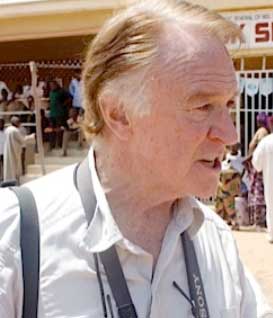
*Prof. Don North (2014)
Says he has covered 16 wars since Vietnam
By Ebele Orakpo
Don North, professor of journalism, is so many things rolled into one. He is the Director of Northstar Productions, Inc., Virginia, USA, a communications expert, teacher, writer, documentary filmmaker and above all, a veteran war correspondent having covered the wars in Vietnam, Borneo, Cambodia, Afghanistan, El- Salvador, Egypt, Israel, the Gulf, Bosnia, Kosovo and Iraq. He has worked for ABC News and NBC News.
In this interview conducted online, North, who has won awards for some of his works including Remembering Saddam (Aurora Awards); Time of the Jackals (gold medal, New York Film Festival), Siege of Beirut (Berlin Film Festival) and a recent book, Inappropriate Conduct: Mystery of a Disgraced War Correspondent, speaks on his experience as a war correspondent, Boko Haram coverage in Nigeria and says he always felt his reporting would educate people on the horror and futility of war.
Who is Prof. Don North?
I was in Nigeria last year as a visiting professor at the American University of Nigeria, Yola. I grew up in a little town called Ladner in the south west corner of British Columbia, Canada. It was a very peaceful town of farmers and fishermen and my father was the manager of a grocery store. I heard the reports of Canadian Broadcasting Corporation (CBC) journalists during the Second World War and I was impressed with their courage and determination to tell the truth about war. I took several years of university education but was anxious to start work as a journalist; so I travelled to India and began writing news stories and sending radio reports back to Canada.

*Don North, war correspondent in Vietnam for ABC News, crosses a stream in the Mekong Delta, 1968
I worked for two years at the China Mail Newspaper in Hong Kong but was soon drawn to the war in Vietnam as a freelance photojournalist. I spent about five years covering the Vietnam war for newspapers, radio and television. I hated the war but loved the job of covering it…that was 50 years ago. We were journalists of a lost war. The U.S. suffered defeat in an unwinnable war, fighting against a country about which we knew virtually nothing and in which we had no vital interests.
I believe photographs of a conflict can lure our senses into awareness. Some among us may be influenced to heed reason, to find a way to right that which is wrong through photographs. I believe in it very strongly as a journalist.
And so I became a journalist who specialised in covering wars….16 wars since Vietnam.
What was the experience like?
Very challenging, but some of the best of journalism is produced in war and I always felt my reporting would educate people on the horror and futility of war.
How will you rate media coverage of war situations in developing countries?
The US, Canada and Britain have a history of having journalists accompany their soldiers into battle. Although the media relationship with the military has never been smooth, in the West, we are expected and given close relationships with the military in time of war. It is recognised as the citizens’ right to know, especially in times of war, what our nation is facing. Unfortunately, in many third world countries, the freedom of the press is often at risk and journalists are not allowed access to soldiers in conflict situation. This is regrettable as a nation needs to fully understand the challenges and realities of the battlefield to support the military in time of war. It is important to understand the nation’s military successes and failures in order to support them.
Are war correspondents specially trained?
I had minimum military training before I covered combat in Vietnam. I survived thanks to the help and advice of journalist-colleagues. Today, modern war is much more difficult and dangerous to cover and any journalist venturing into battle conditions must have basic instruction on how to cover a war and survive. Being able to treat oneself and colleagues who are wounded is also essential. Here in the U.S and Britain, there are organisations of war veterans who will train journalists to work in war situations. Almost every nation has war veterans who could educate journalists in working in war conditions.
War coverage in Nigeria:
In the four months I spent at AUN, I read with great interest a wide variety of Nigerian news reports.
I was not impressed with their accuracy or unbiased views. Because the Nigerian military does not allow journalists to embed with them to cover the conflict, it is almost impossible to have access to the battlefield. It is high time the Nigerian government made arrangements for journalists to accompany the army in countering Boko Haram forces. It is not reasonable for journalists to travel into contested areas without the protection of the Nigerian military. However, more contact with local stringers is essential and local stringers should be well paid to cover the conflict. Perhaps, more communication facilities by phone and internet need to be arranged. Journalists must also strive to report in depth, background and context to the stories they report. Just a bit of bang bang and casualty figures is not enough to clearly explain a conflict.
Advice to young journalists in developing nations:
My advice is the same for journalists in developed countries. Journalism is a valuable resource to any country to help the citizens and electorate decide intelligently on what persons and powers to support.
I believe the western allies were poorly served by journalists who did not question the wisdom of attacking Iraq. I have always felt journalism is an honourable profession of great benefit to the population when it is followed vigorously and honestly. I support and admire journalists throughout this world who, through their honesty and intelligence, write about the major problems, crises, tragedies and joys of this world…plumb the depths of this world and learn the secret songs that orchestrate our universe. We are a global village now and we live in a transitional era of profound pain and identity quest, but the agony of our age is the labour pain of rebirth. May the force be with Nigeria in these trying times.
Disclaimer
Comments expressed here do not reflect the opinions of Vanguard newspapers or any employee thereof.