Douglas Anele
With the ongoing elections, Nigerians are facing one of the toughest challenges in their quest for consolidation and sustenance of the modest political gains achieved since civilian rule was reintroduced in 1999. In other words, form March 28, they would engage in a peaceful and orderly selection of political office holders that would manage the country’s affairs at various levels from May 29 until 2019. Expectedly, the electioneering campaigns, especially the presidential, have been particularly fierce, brutal and bruising.
 The main opposition party, All Progressives Congress (APC) mounted a very vociferous campaign aimed at projecting the image of its flag bearer, Gen. Muhammadu Buhari, as the long awaited messiah that would eliminate corruption, ensure security nationwide, and reinvigorate the economy. Integral to APC’s campaign strategy is unrelenting effort to discredit the present administration of Dr. Goodluck Jonathan as clueless, corrupt, incompetent, and disastrous in every aspect of our national life.
On the other hand, the ruling Peoples Democratic party (PDP) has worked really hard, somewhat belatedly, to showcase achievements of the federal government in agriculture, anti-corruption, infrastructural development, health, education, economic management, political re-engineering, payroll system, maintenance of civil liberties, and so on. Also, the party’s campaign machinery has consistently maintained that Gen. Buhari is unsuitable for the office of President because of his age, concerns about his health and physical fitness for the job, unimpressive academic qualifications, dictatorial proclivities, antiquated ideas of economic management, religious extremism, hypocritical attitude to corruption etc. In terms of personality traits and record of accomplishments in public office, the two leading presidential candidates are qualified for the job.
However, overall, because I consider Gen. Buhari’s negative qualities weightier than those of Dr. Jonathan, the incumbent President is a more suitable candidate than his arch rival. Moreover, although President Jonathan has made several mistakes that turned millions of Nigerians against his re-election bid, we must acknowledge his good works which should be consolidated if he is re-elected for a second term of office. Now, as the Independent National Electoral Commission (INEC) is collating results of the just concluded presidential and National Assembly elections, Nigerians must remain peaceful and avoid any act capable of truncating our fledgling democracy. Therefore, everyone should internalise President Jonathan’s proclamation that “nobody’s political ambition is worth the blood of any Nigerian.”
Philosophers, right from antiquity to date, have theorised concerning the origin of civil society and the best form of government. Whereas some of them, like Plato and Aristotle, recommended aristocracy, others, such as Thomas Hobbes, Sir Robert Filmer and G.W.F. Hegel prefer some kind of monarchical arrangement. John Locke, J.S. Mill, Prof. Karl Popper, Dr. Nnamdi Azikiwe and Chief Obafemi Awolowo insist that representative government or democracy is the most appropriate system considering the plastic and complex nature of humans and the necessity of co-operative existence within a given geopolitical space.
Essentially democracy, as Abraham Lincoln defined it, is government of the people, by the people and for the people. Although in every form of government only a tiny minority or elite actually take decisions that affect the vast majority, the fundamental difference between a democratic system and the rest is that in the former there are specified intervals when eligible voters are permitted by law to select the tiny minority that would run the government at both the executive and legislative levels.
A democratic government cannot exist in a vacuum; it must be built on, nourished and sustained by, a robust democratic culture dominated by certain values. The values necessary in a democratic system include reasonableness, respect for the rule of law and for basic human rights and freedoms as enshrined in the United Nations charter on human rights, tolerance, and uncompromising desire for peaceful coexistence. But establishment of a viable democratic culture in any country or geopolitical environment is a daunting time-consuming challenge because, among other things, it requires certain intellectual qualities and psychological dispositions which are not very easy to cultivate and sustain. It follows that democratisation is always and everywhere a work-in-progress. Citizens of fairly well established democracies such as Britain, the United States, Switzerland and Botswana are still battling to ensure that the system is not derailed by the ever-present centrifugal forces tending to weaken or destroy democracies all over the world.
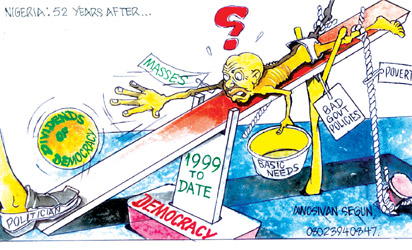
Experiment with democracy in Nigeria as a colonial amalgam began early in the twentieth century under the supervision of the colonial power, Britain. Since 1960 when the country became independent, various attempts have been made by several political leaders to deepen democratic culture, epitomised in the political writings and activities of Azikiwe, Awolowo, Adeniran Ogunsanya and Aminu Kano among others. Yet, ethnicity, religion, bulimic greed and hyperbolic political ambition among the political class remain the greatest obstacles to democratic consolidation in the country.
Of course, periodic military interventions retarded the evolution of genuine democratic culture between 1966 and 1999, to the extent that politicians sometimes conduct themselves as if they were military dictators propelled by authoritarian mentality. Nothing exemplifies this shameful approach to democratic governance better than worsening impunity and brazen emasculation of the local government system by various governors in different states of the federation. That said, it must be acknowledged that the 1999 constitution, which constitutes the fundamental legal document or grund norm of the country, is replete with anti-democratic provisions.
This is not surprising, bearing in mind that the document was prepared under the aegis of a military regime to serve certain entrenched feudalistic interests of the North. But there is no good reason why a constitution for a multiply pluralistic federation like Nigeria should contain provisions subordinating the interests of the federating units to that of the central government. Indeed, the most remarkable progress in Nigerian history was made when the country operated regionalism, which indicates that proper devolution of powers to the federating units is the most appropriate political structure for Nigeria as a whole.
Moreover, restructuring the federation now along the six widely recognised geopolitical zones will deepen our democratic experience by allowing the component parts to organise themselves in the most appropriate manner consonant with their history, culture and resources for rapid social transformation. Now, due to long-standing and entrenched interests benefiting from the current skewed arrangement, restructuring the federation will require a piecemeal approach. That is why Nigerians should accept recommendations of the National Conference organised by the federal government by seeing it as the first step in addressing the vexed issue of “true federalism.”
In my opinion, APC made a mistake when it refused to support the programme, because the action is a hasty and negativist cynical response to the task of reshaping Nigeria necessitated by the imperatives of our historical experiences. Moreover, the belief that Gen. Buhari will bring about meaningful change if elected President in spite of the disabled political structure we have now is too optimistic; it ignores the crippling effects of an overbearing central government on the developmental aspirations of the federating units.
Disclaimer
Comments expressed here do not reflect the opinions of Vanguard newspapers or any employee thereof.