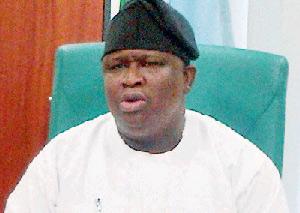
*Olamilekan Adeola
Hon. Adeola Solomon Olamilekan is the Chairman of House of Representatives Committee on Public Accounts. He represents Alimosho/Egbeda Federal Constituency in Lagos. Olamilekan is seeking to represent Lagos West in the Senate via the forthcoming polls.. In this chat, he speaks on issues bordering on the polls.
By Emman Ovuakporie
Can you tell us about your political sojourn?
Talking about my political sojourn, I ventured into it during the Hope 93 era when we had the election of Chief M.K.O Abiola. At that point, we believed that by now we would be having the Nigeria of our dreams because Nigerians were full of hope and that, with the coming on board of Abiola, we would be singing a new song. But man proposes, God approves. What stuck me to June 12, 1993 was because I lost my junior brother to the struggle. He was hit in the neck through a stray bullet during the bonfire we made to say we were not going to allow the cancellation of June 12, 1993. That got me into the game of politics.
So in 1998, the Gen Abdulsalam- led military government came into power and promised its transition would last one or two years. We didn’t believe because we had this sort of thing before when Gen Babangida cancelled the June 12, 1993 election adjuged to be free and fair. From there, Gen Abacha set up all sorts of political structures, conducted elections to the level of the Senate and, at the point of conducting a presidential election, he wanted to transform to a civilian president and that led to his death. Some some months later, Abiola died.
In 1999, we had a transition from a military government to a civilian government and we had Gen Olusegun Obasanjo for the second time returning to power. But there was a lot of uncertainty until 2003 when we had another election and Obasanjo was voted into power again. At that point, it dawned on us that, at long last, there might be light at the end of the tunnel, that why couldn’t we join the fray I had a lot of people coming to tell me to come and represent them which I was in doubt because I didn’t want a situation I would get involved and I still had that memory of losing my brother in the 1993 struggle.

*Olamilekan Adeola
But as God would have it, I was given the opportunity to represent Alimosho constituency then in the Assembly of Lagos State. And I was there for eight years between 2003 – 2011. From there, I moved to the House of Representatives where I currently represent Alimosho Federal Constituency and also chairing the only constitutional recognised committee which is the House Committee on Public Accounts.
Now I want to represent Lagos West Senatorial District comprising ten local governments, that is, Ojo, Badagry, Amuwo -Odofin, Ajeromi, Ifelodun, Alimosho, Ifako-Ijaye, Mushin, Oshodi -Isolo, Agege and Ikeja. The first five biggest local governments in Lagos are in this senatorial district. These indices, population make it the biggest. And don’t forget, Lagos created thirty seven LCDAs. And if you put the additional LCDAs , we have additional twenty eight LCDAs. That is why I say it is the biggest senatorial district in Nigeria and as far as Lagos is concerned.
After serving in the last four years in the House, what are your achievements considering that you chair the Committee on Public Accounts?
Looking at where I am coming from, I am happy that I am in the legislature and I am not in the legislative business just for fun. I came in as a professional. I have the rare opportunity to put into practice my professional experience which I acquired over the years. I can vividly remember that while Lagos was approaching the World Bank for a loan to execute some long term projects, there were challenges because the World Bank was refusing to give the loan without us meeting certain criteria. I was chairing the Committee on Finance and Appropriation at that time and the criteria given by the World Bank included that we must have in place a Fiscal Responsibility Act acceptable to the World Bank; we must have in place an audit law acceptable to the World Bank. At that time, Lagos did not have any of these laws in place.
Also in trying to remove the Ministry of Finance from the Board of Internal Revenue, there were challenges because the main aspect of the ministry is the Board of Internal Revenue. But in Lagos, under Asiwaju Ahmed Tinubu as governor, there was this challenge in terms of revenue. The then military governor was generating about N600 million but Asiwaju was able to use his knowledge of finance to drive the revenue from N600 to about N7.5 billion; that was the foundation which Governor Babatunde Raji Fashola built upon to jerk up the internally generated revenue (IGR) of the state to what we currently have. Part of what gave Lagos the opportunity to arrive at that destination was the passage into law an Act that gives the State Internal Revenue Service autonomy. Lagos was able to widen its tax net, brought a lot of people into it, opened a lot of sectorial sources of income. As we speak, Lagos can stand on its own irrespective of the allocations from the Federal Government. That is one achievement.
Difference
Coming back to the House of Representatives, what is happening there is quite different from where you are coming from. In Lagos House, we have forty members who were of the same party, maybe with one or two members of the opposition at that time. But here, you are operating from the opposition point of view. As such, the kind of power and influence you can wield is reduced to the barest minimum because you are not in the dominant party. But even as it is, with the backing of God and the leadership of the House and my party, I was given the headship of the Committee of Public Accounts (PAC) .
From my observation, we need the Office of the Auditor General of the Federation (AGF) that is truly independent. If that particular office is empowered, the issue of corruption would be a thing of the past and it would be unnecessary for us to have the Economic and Financial Crimes Commission (EFCC) and the Independent Corrupt Practices Commission (ICPC). It would just be the report of the Auditor General straight to prosecution. But because that office has been reduced to the barest minimum by those in authority and who ought to have done something to assist that office, it lacks the bite to fight corruption.
The AGF challenge
Over the years, we can look into it through the budget allocated to the office. That office, year in year out, goes cap in hands begging for fund to sustain itself. And I can say this that as I prepare to leave the House to go to the Senate, what we have been able to achieve through constitutional amendment includes to ensure that we have that office on the first line charge on the consolidated revenue, empowering that office to have access to the books and records of the entire 601 agencies of the Federal Government unlike in the past where we have the AGF recommending to these agencies for them to pick one or two firms to carry out their audit exercise. We have succeeded in giving the power to the AGF Office to carry out audit exercise.
Of recent, there was this issue of missing $20 billion as alleged by the then Central Bank Governor (CBN). If we have an Office of the AGF that is properly funded and staffed, there will be no need for the Federal Government to call in PriceWaterCooper to carry out a forensic audit. The AGF would have taken up this assignment and report back to Nigerians. But because we have a government that is not sincere in fighting corruption, that is not sincere in taking the bull by the horn, they have brought the office to the lowest level that they could so that they have access to do whatever they want and, when there are issues, they call in private firms to work in their favour.
Can you imagine that the capital budget of the Office of AGF for 2015 was reduced from N1.9 billion to N100 million? Can you also imagine an Office of the AGF that has 144 foreign missions to audit and, as we speak, between 1999 and 2015, that office has not audited up to 30 of these foreign mission while three quarter of these foreign missions are revenue generating. So there is nobody to audit the revenue generated and the expenditure they incur. The Office of the AGF has been shortchanged and the budget has been reduced to nothing and, as such, the government of the day is having field day to do whatever its officials know they have an office that is not functioning.
Budget within budget
Just of recent we found out that the service wide vote account, which I tag as a budget in the budget, is a slush fund. It is an account that the Federal Government has been using to siphon money that ordinarily should be used for the basic needs of Nigerians. I will continue to say this that particular aspect of the budget must be cancelled. And I have my reasons. If you go into agencies and parastatals of government today, they will tell you that the last time money was given to them from the capital budget point of view was in the second or the third quarter while if you go to their overhead expenditure, they would tell you the last time fund was given to them was maybe in the third quarter and this is statutory money approved by the National Assembly for these agencies to function.
Now what comes to play is how do we now judge the performance of the budget? If you go into that same budget, look into the service wide vote account, you would notice that that particular budget account performed hundred percent because it is operated by three main people – the President, the Finance Minister and the Director of Budget. That particular account performs hundred percent, while the budget of the ministries and parastatals performs between forty and forty five percent. By the time you bring forty five percent and a hundred percent and you average it, you have an average performance of about seventy percent and that is what they judge as budget performance year in, year out whenever the Minister of Finance is speaking to Nigerians.
I call on my colleagues that there is the urgent need for us to look properly into our budget and see that this issue of service wide vote becomes a thing of the past. Let all these funds go into the ministries and departments of government and leave certain amount, about five percent of the entire budget, which we can tag as special expenditure vote head in the budget. This would take care of any emergency or contingency. If you go into the budget of any ministry, you will see contingency head and even miscellaneous.
Part of our duty is to correct lack of compliance by these agencies and, over the years, like in other Assemblies, this current Assembly has been able to put all agencies of government on their toes and also make them understand the importance of the Office of the AGF. As I speak to you, there is no flagrant disregard for the Fiscal Responsibility Act because we refer to that law and we stick to it. And one area which would be of interest to us and to the generality of Nigerians is that year in year out, the President lays before the House what they tag budget of N4.9 trillion.
That is the budget that all Nigerians are listening to, but in the true sense of it, budget of the statutory and extra -ministerial departments put together is about N16 trillion and so the total budget year in, year out is over N20 trillion which the executive arm operates but nobody is asking questions as to the implementation of all the budget, nobody is bringing information on the implementation; this is one area Nigerians need to start asking questions in order to move this country forward.
Disclaimer
Comments expressed here do not reflect the opinions of Vanguard newspapers or any employee thereof.