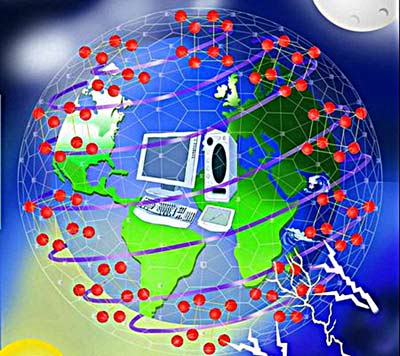
The Wired World: A graphic representation of the Internet
By Prince Osuagwu
Federal government is trying hard to prove that their desire to anchor the economy on Information and Communications Technology, ICT is not a fluke. This apparently has given rise to the introduction of numerous initiatives which tend to deepen digital awareness across all sectors of economy including governance.

The Wired World: A graphic representation of the Internet
However, in an attempt to take the project to a critical mass of the Nigerian society, the federal government through the Nigerian Communications Commission has identified secondary and tertiary institutions as effective vehicles.
The commission in a deliberate attempt to give digital freedom to more Nigerians and bridge digital divides across a broad spectrum of the society, had created a twin programme; the Advanced Digital Awareness Programme for Tertiary Institutions, ADAPTI and Digital Awareness Programme, DAP for secondary schools.
ADAPTI empowers several higher institutions with digital centres, computer laboratories fitted with laptops and internet connectivity and generating sets as part of the digital dividends.
Meanwhile, DAP ensures that teachers are empowered with digital knowledge which they would conveniently pass to the students. DAP promotes hands-on digital empowerment by creating an environment where students have direct knowledge of usage of computers and ICTs in support of their studies.
From available statistics from the commission, DAP Project alone has supported 229 secondary Schools across the six geopolitical zones of Nigeria, with the provision of twenty one desktop computers, Local Area Network, printers, scanners, VSAT dish and deployment of one year bandwidth subscription for Internet access. These facilities are complemented with standby generators and a special accommodation built for that purpose; thus aggregating everything into a fully kitted Computer Laboratory.
However, the commission has noted that the most important aspect of the programmes was to ensure they continually oil the wheels of digital inclusion which government placed much priority on, to move the economy forward.
As a result, the commission is ensuring that digital presence is felt through ADAPTI and DAP across the six geo political zones of the country. Among the tertiary institutions that have benefitted from ADAPTI, included Ekiti State University, Ado Ekiti, The Polytechnic Ibadan, Imo State Polytechnic, Umuagwo, Federal Polytechnic Nekede, Ahmadu Bello University, Zaria and University of Benin.
Also on DAP, Government Junior Secondary School, Jabi, Abuja, Katsina State College, Katsina, Government Secondary School Dan Musa, Katsina State, among others have all benefitted.
Executive Vice Chairman (EVC) Dr. Eugene Juwah explained that this is one of the ways government can reach the unreached and serve the unserved and underserved members of the society.
According to him, many more institutions and schools will be covered especially now that the broadband revolution has begun.
Juwah added that the quest to implement programmes and plans that promote the development of the communications industry has seen the commission implementing several capacity building initiatives to enhance the knowledge base of the participants in the telecoms industry in Nigeria. Some of these initiatives include the establishment of the Digital Bridge Institute in 2004 in order to contribute to the creation of knowledge-based information society in Africa, through human resource capacity building in the Information and Communications Technology, ICT sector.
The EVC stated that the Commission has National Books Donation Initiative and in 2005 also established the NCC library for use by researchers and undergraduate students from various tertiary institutions across the country.
Although he noted that higher institutions in Ekiti State, which fall within South West geo-political zone, have not benefitted from the National Books Donation Initiative of the Commission since inception, he explained that it was why recently, the commission donated Eighty Seven ICT/Telecom Engineering books to the Ekiti State University.
The Commission has also taken the ADAPTI project to The Polytechnic, Ibadan Oyo State, where 110 laptops were commissioned. Juwah stated that the key objectives of these programmes are to prepare the nation for a digital tomorrow and equip the youth with the necessary skills to tap into the potentials of the digital age.
Disclaimer
Comments expressed here do not reflect the opinions of Vanguard newspapers or any employee thereof.