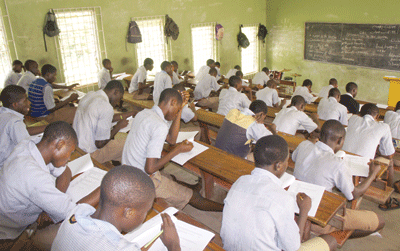
Like any other year, the year 2014 would have started on a promising note for the education sector but for the almost half the year ASUU strike in 2013 occasioned by the Federal Government’s insensitivity to the sector at tertiary level. This, set the tone for the sector in 2014.
 Former Executive Secretary, National Universities Commission, NUC, Professor Peter Okebukola in his over view of the sector in 2014 said that there were at least 12 defining events in the education sector in Nigeria. He referred to these as the good, the bad and the ugly.
On the good and positive entries in the report card, he pointed out: the improved performance of candidates in the May/June Senior School Certificate Examination conducted by WAEC; increase in access as additional 982,000 were enrolled nationwide in the basic education system and the carrying capacity of the 129 universities leapt to about 1,000,000.
Out of school children
“We also had the establishment of more Almajiri schools to reduce the number of out-of-school children which was put at about 10 million. The curriculum at all levels enjoyed some positive tweaking by NERDC, NCCE, NBTE, and NUC.’’ He said.
Okebukola who noted that NUC’s action was particularly striking in entrenching an improved entrepreneurship studies programme in Nigerian universities added that its positive impact showed during the national entrepreneurship fair in December 2014. Moreover, he disclosed that funding for physical development and research by TETFund was above the N80 billion mark during the year.
These six events, he concurred, were blue marks on the report card.
Education report
Analysing the “bad” and negative (red) entries in the education report card in 2014, the Pro-Chancellor identified four notable events. The woeful performance of candidates in the November/December Senior School Certificate Examination with more than 50 percent failing to earn five credits in English, Mathematics and three other subjects. He lamented about the poor quality of teachers across all levels of the education system stating that the condition remained generally shameful and unacceptably low.
He said: “Quality of buildings and other teaching-learning infrastructure did not significantly improve and so did the poor reading culture among students not get better.’’
On the “ugly” he spoke in consonance with Professor, Oyesoji Aremu’s view on insecurity of our schools. Okebukola maintained that school safety has put Nigeria on the dark side of the world map. According to him, the entry includes the alleged slaughter by Boko Haram of 43 secondary school students in Federal Government College, Buni Yadi in February and the abduction in April of about 200 girls from Government Secondary School in Chibok.
‘’The overall score shown in the education report card at the state and federal levels is far from the pass grade. If I were the class teacher of this student known as Nigeria, I will make the following closing comments on the 2014 performance in education: “You need to buckle up next session. You were rather too laid back with severe consequences for your future. Work harder in the area of access, teacher quality and facilities.”
Looking into year 2015, his prediction was that no significant difference in performance will be recorded in Education sector over 2014 scores. His words: ‘’In the language of simple mathematics, the graph of performance of education will plateau, that is, will remain flat.
‘’Three factors will account for this stagnancy. One is that the slide in crude oil price will induce a lowering of funding into the education system. With reduced funding, all those areas in which education has been encouraged to improve its performance- access, teacher quality and facilities, will suffer.
“Second, 2015 is an election year. The first quarter of the year will be eaten up by the electoral process with politicians struggling for their survival and caring little for education.
With many states unable to pay salaries, teacher welfare will suffer and this will take a debilitating toll on curriculum delivery. The second quarter will end with the swearing in of the political actors on May 29 and cabinets put in place by the third quarter.
Graph of education
These new Ministers and Commissioners for Education will begin to find their feet in the fourth quarter and the year is gone. This will explain my conjecture for the plateauing of the graph. By 2016, I foresee a spurt (rise) in the graph of education as the sector will blossom again.’’
Meanwhile, appraising the sector holistically in 2014 under review, Professor, Oyesoji Aremu, Department of Guidance and Counselling, University of Ibadan said: ‘’Below average pass mark and poor performance should be given to the government.
He likened the performance of the federal government to that of last two years preceding 2014. He said that the education sector witnessed a huge bombardment as a result of Boko Haram insurgency in the North East in particular and some other adjoining states to the three states of Borno, Yobe and Adamawa.
The sector, he added, witnessed the abduction of over 200 girls of Federal Government Secondary School in Chibok between the night of April 14 and 15.
This attack and abduction, he insists have brought untold psychological traumas to the girls, their immediate families and has brought the collective national psyche of the country to all-time low internationally.
Others are Yobe State killing of school children through suicide bombing during morning assembly, forced closure of schools, elongated period of school break due to insurgency, Ebola virus saga and incessant movement of school children to safer schools.
The above cumulative, according to Aremu, affect not only the school-going behaviour of the school pupils, it also has some negative effect on teaching and learning generally.
These, have reflected in the results of WAEC and NECO which were below the expected standards. The last of which revealed 71 percent failure nationwide. What is witnessed at the secondary school level, is a reflection of the decadence in the education sector.
Education sector
His words: “The sector, as we usher in the year 2015 demands not our collective sympathies, but our resolve to make schools safe not only for learners and their teachers, but also to make the parents and guardians emotionally at ease while their wards are in schools.
Beyond the safe school project, the government should as a matter of urgency, make the schools absolutely safe and equip the school to truly reflect 21st century challenges. The sector should also be given attention by the political class.
“Emerging countries with strong GDPs like China, Japan, Singapore are devoting a good share of their national budget to education. Even in Africa, countries like South Africa and Ghana are getting it right. The sector, therefore, deserves all the attention that it truly requires.”
On her part, Prof Florence Banku-Obi, Dean of Faculty of Education, University of Calabar said: “Last year, Nigeria education sector fared better than in 2013. She gave credit to the government for the special intervention after the ASUU strike.
According to her, a lot of renovations took place in tertiary institutions particularly infrastructural development.
While Banku-Obi is optimistic that stakeholders are looking forward to a successful academic year in 2015, she urged the Federal Government to look into some pending issues on money not yet resolved between ASUU and the government. ‘’We are not praying for strike, we hope that issues that may lead to strike action will be resolved.” she added.
Disclaimer
Comments expressed here do not reflect the opinions of Vanguard newspapers or any employee thereof.