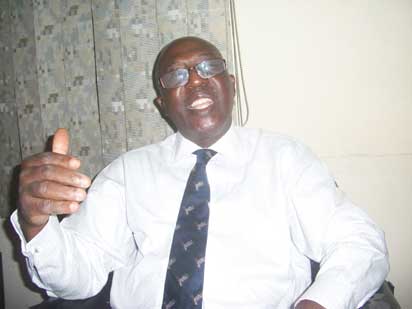
Sowemimo
SEnior advocate of Nigeria, Seyi Sowemimo, is one of the children of the late Chief Justice of Nigeria, Justice Sodehinde Sowemimo. He was called to the Bar in 1978 after he obtained his law degree at the University of Lagos. He latter proceeded to England for his Masters degree at the University of London and had since being in active legal practice. In this interview he spoke on the forthcoming general election, conflicting judgments emanating from courts, alternative dispute resolution and delay in administration of justice as well as other related issues.
Excerpts:
By Abdulwahab Abdulah
THE general election is around the corner election, as a senior advocate like you may become a Vice President. What spectacular change would this bring?
I don’t have sufficient information about what must have informed the choice of Professor Yemi Osinbajo. I had read in the papers that the party was considering picking from the class of governors and it has come to me as a surprise that Osinbajo was picked. But, one has to see how things go, it may well turn out to be a very good choice, it may also turn out to be different. However, it is possible that it is a very sensible choice depending on what the parameters are put in place by his political party. He is not a politician but maybe what they need for that post is someone who is not a politician.
Recently the Chief Justice of Nigeria, CJN, expressed worries over conflicting judgments emanating from the Court of Appeal. What is your take on this?
The people who occupy these courts are human beings and it is natural to have different opinions in the interpretations of the law. The only time you can criticize them is if a lower court derogate from the decision of the Supreme Court which is the highest court in the land. But when you have a situation where two different divisions of the Court of Appeal come up with conflicting decisions then one can accept that situation, it is legitimate. It is only when they depart from the decision of the Supreme Court or when the Supreme Court gives conflicting judgment that we now feel uneasy.
Differences of opinion
My take is that election petitions and election cases throw up such sensitive issues that it is very difficult at times to account for the differences of opinions being voiced by different courts. Whatever the case is, it is not ideal that we should have decisions of the same court which are conflicting. This is because in that situation, we cannot provide good guidance for lawyers and litigants who will like to know exactly what the position of the law is.
Also, the CJN has expressed preference for Alternative Dispute resolution (ADR) for settlement of disputes. Do you think this will solve the problem experienced in court proceeding?

Sowemimo
I don’t think ADR is the way out. There are some types of disputes that can be settled by the ADR process. There are some that are more complicated and need to go through a trial process. This delay is not confined to Nigerian courts alone, although we are justified when we complain of delay. All we have to do is to continue to appeal to our judges, particularly those at the high courts to be more industrious in performing their functions. I think that some judges could handle matters more speedily than they do at present.
We need to appeal to judges at the trial courts for some increased productivity and that those who are appointed to the Bench should be seasoned practitioners. Most especially, those who are appointed should be people from the Bar, people who have active practice. With that sort of background and experience they can perform more efficiently at the high court level.
It is a different thing when you have someone who is coming from the practicing Bar and somebody who is coming from the ministry or other places. Those coming from the ministry are not well exposed to the rigour of the trial process. You find that the output differs depending on where they are coming from.
Not enough lawyers are being appointed from the practicing Bar. Most of the people being appointed are either from the ministry or the magisterial Bench and other administrative positions. Naturally, it takes them time to come to grip with the duties they need to perform at the high court level. That is partly what is contributing to delay in our courts. They are not appointing the right caliber of professionals to man the high court Bench.
A country like England is doing so well because for people to go to high court Bench, they pick them from the rank of Queens Counsel which is the equivalent of Senior Advocates that we have in Nigeria. These are people who have reached the peak of their professional career. They have distinguished themselves at the Bar.
Experienced professionals
They are the cream of the Bar and by the time you put them on the high court Bench, they are very much at home with what they are doing. They are very experienced professionals but what we have in most cases here is that people who are yet to make a mark are appointed to the Bench and that reflect on the work they do.
In what way do you think delays in the administration of justice could be eliminated?
Those are the sort of reforms we are also calling for. In the age when we have the use of cell phones, we have SMS, we have internet and so many technological devices by which you can make contact with people, it can’t be justified that you have these sorts of things happening and you wouldn’t be able to correct it. So, it’s one of those things I believe the judges and those involved in the administration of the court should look into.
You have a situation for instance, lawyers furnish to the court their telephone numbers and email addresses, and I think the main reason for doing that is because they want to utilize the information to address the sort of issues you have raised. It is important that these kinds of complaints are dealt with, so that we can reform the system.
A lot of measures are being put in place but it appears to me that we still do not have sufficient number of judges to deal with number of cases that are being filed in our courts. We also need a situation whereby our judges will really apply themselves more seriously to the disposal of these cases. So that we don’t have as many adjournments and longer sitting hours.
Recently, the Body of Senior Advocates of Nigeria, (BOSAN) which you are the Secretary condemned the attack on judicial officers in Ekiti State, describing it as a grave assault on the temple of justice. Are you satisfied with the way the situation was handled?
I don’t think the matter has been settled yet.
Result of the investigations
At that time, there was a complaint that people who were acting for the present governor stormed the court and molested judges. I am aware that a report has been made to the National Judicial Council, and that the matter is being investigated. I am not aware that there is report or recommendations which have been made as a result of the investigation by the NJC. As it is now, I am personally quite uncomfortable with the situation under which the judges have to perform their functions in Ekiti State. This is because without some indictments, it means that judges in Ekiti cannot act with much independence until some decisions are taken by the NJC.
What do you think BOSAN can do to prevent future occurrence?
You know the NJC is actually better positioned than any other organ to investigate this matter because it concerns the conduct of judges of the high court. I think the Body of Senior Advocate has to await the outcome of the investigation being made before it can take a decision on this matter. I recall that Fayose said he had nothing to do with the people who invaded the court. So it will be wrong to begin to take a decision on the assumption that he was the one who instigated these people to invade the court. I think we should wait for the outcome of NJC’s investigation.
How do you see the recent mass failure at the Nigerian Law School Bar exam?
Well, from what I have heard about that mass failure, it only reveals that there are some problems with our educational system. I strongly think that in this case the blame should be with the universities. If the students being churned out by the universities are really up-to-standard, they should not have problems at the Nigerian Law School. I tend to believe that the university authorities where they teach law as a discipline need to be more up-and-doing to ensure that the faculties they have are stronger than what they are at present in order to withstand the rigorous of the Nigerian Law School. From what I have heard, in the past years, they have been able to avert this sort of situation by probably lowering the pass mark. What we have now is a Director General of the Law School who insist on very high standards and it is that insistence that has revealed that most of the graduates of the Nigerian universities are not up-to-standard in terms of what is required of them before they are called to the Bar.
What is you assessment of the Judiciary in the last 54 years?
I think the judiciary started well and has been doing well, out of the various arms of government, the executive, the legislature and the judiciary, you find that the judiciary has performed its best. It is because of their performance that we have enjoyed a measure of stability in this country. But, I must observe that in the past few years, like ten years ago, the performance of the judiciary has been opened to questions. There are instances where people have strongly suggested that judges have been compromised. This has been more pronounced in the politics of the third republic. I think a lot needs to be done to ensure that our judges carry on their duties responsibly and without political interference. That is why I think the NJC really has a lot of job to do in ensuring that the very robust reputation which the judiciary used to enjoy is preserved.
What is your relationship with the late CJN, Justice Sodehinde Sowemimo?
The late justice was my father and he was Chief Justice between 1983 and 1985. He inspired me to opt for a legal career.
Does it mean that he influenced your choice of legal career?
No, he inspired me. He was not the sort that dictates the choice of a career. But, I was inspired by his achievements to also toll the legal line.
Among his children, are you the only one that studied law?
No, I have a sister who is also a lawyer, although she is not in practice. I am the only one in full time practice.
If you have an opportunity to go to the Bench, will you do so?
Well, what I am interested in is breaking new frontiers. My dad ended up as Chief Justice, even if I were to go on the Bench today, the most I could also achieve would be Chief Justice of Nigeria, that would be simply treading along a beaten tract. I would rather break new grounds. I think I have more contributions to make through the practice of law than a Bench appointment. Today, the perception of the judiciary and the status that they used to command in those days are not what you have today. Really, if I had wanted to go to the Bench it would have been many years ago.
Today many people who are junior to me occupy positions on the Bench. My own mates at the Law School are on Bench of the Court of Appeal and at the Supreme Court. Even you have people who are junior to me at the Bar who are now at the Supreme Court level. So when you ask whether I will consider a Bench career, I would ask myself where do I start from. It is too late in the day even to think of a career on the Bench. But, above everything else, I am quite satisfied with the Bar, it gives me greater inspiration and greater flexibility and more opportunity to contribute to the legal profession.
What is your advice to younger lawyers?
I think any junior who wants to make quick money will find that practice at the Bar is not the place for him or her. It has always being the case that when juniors are starting out, they may not earn the sort of remunerations that they consider adequate for their purposes. But, I think most seniors will pay what they can afford. If a junior finds that a senior is not able to pay what he is really looking for, he is not oblige to work for that person. He can always look for some other law firms.
Quality of law graduates
But part of the problem I find these days is the low quality of law graduates being turned out. When they come into chambers they don’t make a difference. You spend a number of years trying to tutor them, trying to make-up for the shortcoming of the education which they have received at the university.
You end up vetting and vetting letters which ordinarily are responsibilities which you would have delegated out absolutely to a junior. You find yourself doing the very same thing which you were doing even before you employed the junior.
Most juniors don’t reduce the burden of the work, so the value which they are bringing to chambers is not much. Probably that is what is reflected in this pay they are complaining about. Because if you have a junior that add so much value in terms of what he can contribute, you will not likely want to lose that sorts of junior. But I think the problem also is that the juniors that are coming from the law school are not of such quality as to attract optimal income from chambers.
So my advice for them is that they should not be in a hurry to make money. Hard work should be the basic consideration for the new lawyers. They should be more interested in getting some satisfaction in the work they are doing, and they should me more committed.
Disclaimer
Comments expressed here do not reflect the opinions of Vanguard newspapers or any employee thereof.