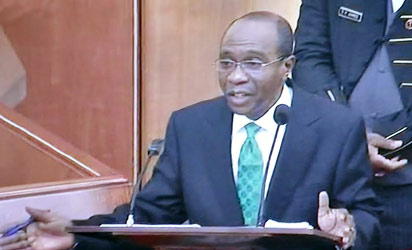
Mr Godwin Emefiele answering questions during his screening by the Senate for Central Bank Governorship in Abuja on Wednesday
By Emma Ujah & Emma Elebeke
ABUJA — The Monetary Policy Committee rose from its first meeting in the year, in Abuja, yesterday, with a decision to retain the Monetary Policy Rate, MPR, at the current 13 per cent, the Cash Reserve Ratio, CRR, on Private and Public deposits at 20 per cent and 75 per cent respectively.

Mr Godwin Emefiele answering questions during his screening by the Senate for Central Bank Governorship in Abuja on Wednesday
The Governor of the Central Bank of Nigeria, CBN, Mr. Godwin Emefiele, who briefed the press on the decisions of the committee, also announced that the liquidity ratio was also retained at 30 per cent.
While saying that his team was closely monitoring developments in the money market, Emefiele said it was paramount to defend the external reserve and the Naira at the foreign exchange market.
According to him, “anybody that needed to do business in the country will be allowed to do so but for only legitimate purposes,” but warned: “We will not tolerate speculative attacks on the devaluation. We have a mandate to ensure that transaction activities taking place in the market are only for legitimate transactions.
“We have also made it very clear that we are monitoring the market to the extent that we feel that the inter-bank market will continue to support trading activities of both Nigerians and foreign investors.
“And at any point, where we discover that the market is unable to absorb or to provide the liquidity that is needed, the CBN will come up to intervene in the market, to provide the liquidity that is needed for transaction to go on for legitimate transaction.
JP Morgan Index
On JP Morgan’s negative watch on Nigeria, Emefiele said the bank would do everything necessary to remain on the index.
He said: “We are looking at it and are ready to provide the number and increase the level of liquidity required in the market. I am very optimistic that the JP Morgan will see reasons with us.
“We are committed to remaining on the index. We will do everything possible to remain on the index because we know what the departure will cause the country.”
No further devaluation for now
Asked if the CBN was planning further devaluation of the Naira, he said: “We cannot comment on that now, whether or not there would be devaluation. It is again, an issue that will be subjected to review from time to time.
“At this time, the naira is appropriately priced and there is no need for anybody to worry about devaluation. At this time, the currency is appropriately priced.”
On the widening gap between the official exchange rate and that of the Bureau de Change segment of the foreign exchange market, the governor said the CBN was doing its best to bridge the gap.
His words: “We will continue to ensure that exchange rate does not spiral out of control. That is why we are watching it and at the appropriate time, certain actions will be taken.”
According to the governor, the nation’s gross official external reserves as at December 31, 2014 stood at $34.25 billion compared with $42.85 billion at the corresponding period of 2013.
The decrease in the reserves level, according to him, was driven largely by increased funding of the foreign exchange market interventions to stabilise the exchange rate in the face of decline in reserve accretion.
The country’s external reserves as at end-December 2014 could finance 7.44 months of imports.
FG not reviewing 2015 oil benchmark
Meanwhile, the Federal Government has insisted that it would not review the $65 per barrel in the 2015 benchmark.
Reacting to enquiries on the position of the Federal Government on the benchmark, given the persistent fall in oil prices, Mr. Paul Nwabuikwu, Special Adviser to the Coordinating Minister for the Economy and Minister of Finance, Dr. Ngozi Okonjo-Iweala, said the price was still too volatile for such a review and that the scenario-based approach to the budget was capable of handling the situation.
His words: “We are not reviewing the budget benchmark price at the moment. The price of oil is still quite volatile and we do not know how it will bottom out.
“We are taking a scenario-based approach in handling the 2015 Budget. That means that for various levels of oil price, we have additional measures both on the revenue and expenditure side, which will kick in when it bottoms out.
“The Medium Term Expenditure Framework, MTEF, is currently at the National Assembly. We have been working together with our lawmakers to ensure that we steer the country in the right direction during this period.”
Disclaimer
Comments expressed here do not reflect the opinions of Vanguard newspapers or any employee thereof.