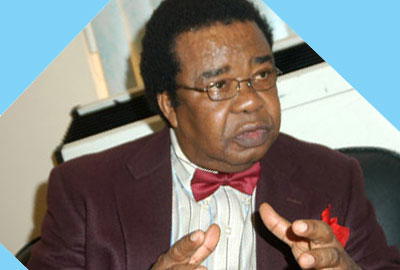
Professor Bolaji Akinyemi was Foreign Affairs Minister
By Charles Kumolu
THERE is no likelihood that anyone would be faulted for describing Prof Bolaji Akinyemi as a man of many parts.He means different things to different people.
Indeed, he comes across as a colossal scholar, fascinating diplomat, imaginary politician, misunderstood activist and quintessential statesman.
Those whose perception of him may be at variance with the aforementioned are likely to commit the class blunder of regarding him as a gadfly.
But that is at the peril of his antagonists, as the 1947-born-intellectual par excellence has never ceased from being a reference point since his first national appointment in 1975.
Like a colossus, Akinyemi, whose appointment as the Director-General of the Nigeria Institute of International Affairs, NIIA, came at a rather astonishing age of 33, has continued to bestrode Nigeria’s socio-political sphere.
In the trail of this nearly four decades of pragmatic sojourning are complex and yet workable variables expended on Nigeria’s journey to nationhood.
As the head of the NIIA, he championed dialogue as an alternative vehicle for foreign policy consultation.
He organised and presided over the following: Nigerian-United States Dialogue (1978), Nigerian-Soviet Dialogue (1978), Nigerian-Chinese Dialogue (1979), Nigerian- Scandinavian Dialogue (1980), Nigerian-Brazilian Dialogue (1980), Dialogue on North-South, Dialogue with Prime Minister Pierre Trudeau (1981) and the Nigerian-Chinese Dialogue (1982).
From the various national assignments he had undertaken at different times, Akinyemi, who was appointed Minister of Foreign Affairs by President Ibrahim Babangida in 1985, boasts of an unwavering passion to serve his fatherland.

Professor Bolaji Akinyemi
This yet to be rivaled drive that saw him being a handy resource person each time stringent solutions are needed for contentious national questions, are conspicuously present in his speeches, seminal works and even media interviews.
An encounter with him would surely make every student of history long for further engagements, as a result of his expansive knowledge of the strengths and weaknesses of governance.
As Minister of External Affairs, Akinyemi brought his provoking scholarly prowess to bearthrough policy actions at a time when the dynamics and complexities of global politics required men of his calibre to promote Nigeria’s stance on international affairs.
Till date, some of the structures and frameworks he put in place act as testimonies to the indelible footprints he left in the nation’s foreign service.
Of note is the Technical Aid Corps ,TAC, a programme which sent professionals overseas to engage in volunteer work among the continuous interdependent nations of the world.
TAC was designed to promote Nigeria’s image and status as a major player in global affairs, particularlythe African continent which had been the centre piece of the country’s foreign policy.
Black bomb
He was also credited to have initiated the Concert of Medium Powers, aimed at maximizing the potentialities of third world countries. A direct offshoot of that was his support for Nigeria to consider developing nuclear weapons.
Such proposal, which he described as the black bomb, connoted that Nigeria had a sacred responsibility to challenge the racial monopoly of nuclear weapons.
He was the leader of the Nigerian delegation to the United Nations Annual General Assembly Session, New York (1985); deputy leader of the Nigerian delegation to the Commonwealth Summit, Bahamas (1985); leader of the Nigerian delegation to the Organisation of African Unity, Council of Ministers Session (1986); deputy leader of the Nigerian delegation to the Organisation of African Unity Heads of State and Government Summit (1986); leader of the Nigerian delegation to the Non-Aligned Foreign Ministers Conference, Harare (1986); deputy leader of the Nigerian delegation to the Non-Aligned Summit, Harare (1986); leader of the Nigerian Delegation to the United.
Nations General Assembly Annual Session (1986); leader of the Nigerian delegation to the United Nations General Assembly Special Session on the Critical Economic Situation in Africa (1986); leader of the Nigerian delegation to the Budget Session of the Council of Ministers of the Organisation of African Unity, Addis Ababa (1987); leader of the Nigerian delegation to the Ordinary Session of the Council of Ministers of the Organisation of African Unity, Addis Ababa (1987); deputy leader of the Nigerian Delegation to the Annual Summit of the Organisation of African Unity (1987), among others.
The other side of him also manifested during the Abacha regime, when the tumultuous state of the nation then demanded that agents of change, like him, proceed to the trenches in the interest of the nation.
Mixed bag
With the nation on the brink, Akinyemi chose rather not to sit on the fence as he, alongside the late Pa Anthony Enahoro, Bola Tinubu, Dan Suleiman, among others, formed the National Democratic Coalition, NADECO.
With the display of uncommon bravery in the face of the brutality of the worst dictatorship in Nigeria’shistory, Akinyemi braved the odds to ensure that civil rule was enthroned.
His role in that era also came as a mixed bag to those who thought that he was unlikely to stand up against the military-an institution he had served in some capacities before then. But that was the typical Akinyemi, manifesting his conviction that there isn’t any known alternative to democratic governance.
Of significance, recently, was the stabilizing role Akinyemi played as the Deputy Chairman of the 2014 National Conference. Whenever matters were heading for catastrophe, Akinyemi brought his wealth of diplomacy to bear.
It was that same sagacity that he demonstrated, penultimate week, when he sent an open letter to the two major presidential candidates – President Goodluck Jonathan of the Peoples Democratic Party, PDP, and Muhammadu BUHARI of the All Progressive Congress, APC.
In that letter, Akinyemi went down memory lane, bringing his fears home.
“We have this very notorious prediction from United States semi-official sources that the world is expecting a cataclysmic meltdown of the Nigerian nation come 2015. Of course most Nigerians have taken umbrage at this prediction for their country. But there are Nigerians who are indifferent to the outcome of this prediction. One of my low moments during the just concluded 2014 National Conference was when in an attempt to break an impasse, I painted a grim picture of devastation which would follow a breakdown of the Nigerian state, to which a delegate between 45 and 55 years old replied “so what?” I thought to myself, here is a man who would probably run away to a neighboring country at the boom of the first gun but was callously indifferent to the fate of the youth, women and children who would be caught in the middle.”
Akinyemi did not only identify the problem. He, also, in that letter, proferred solutions.
As he celebrates his 73rd birthday today, we join Nigerians in wishing him well.
Disclaimer
Comments expressed here do not reflect the opinions of Vanguard newspapers or any employee thereof.